
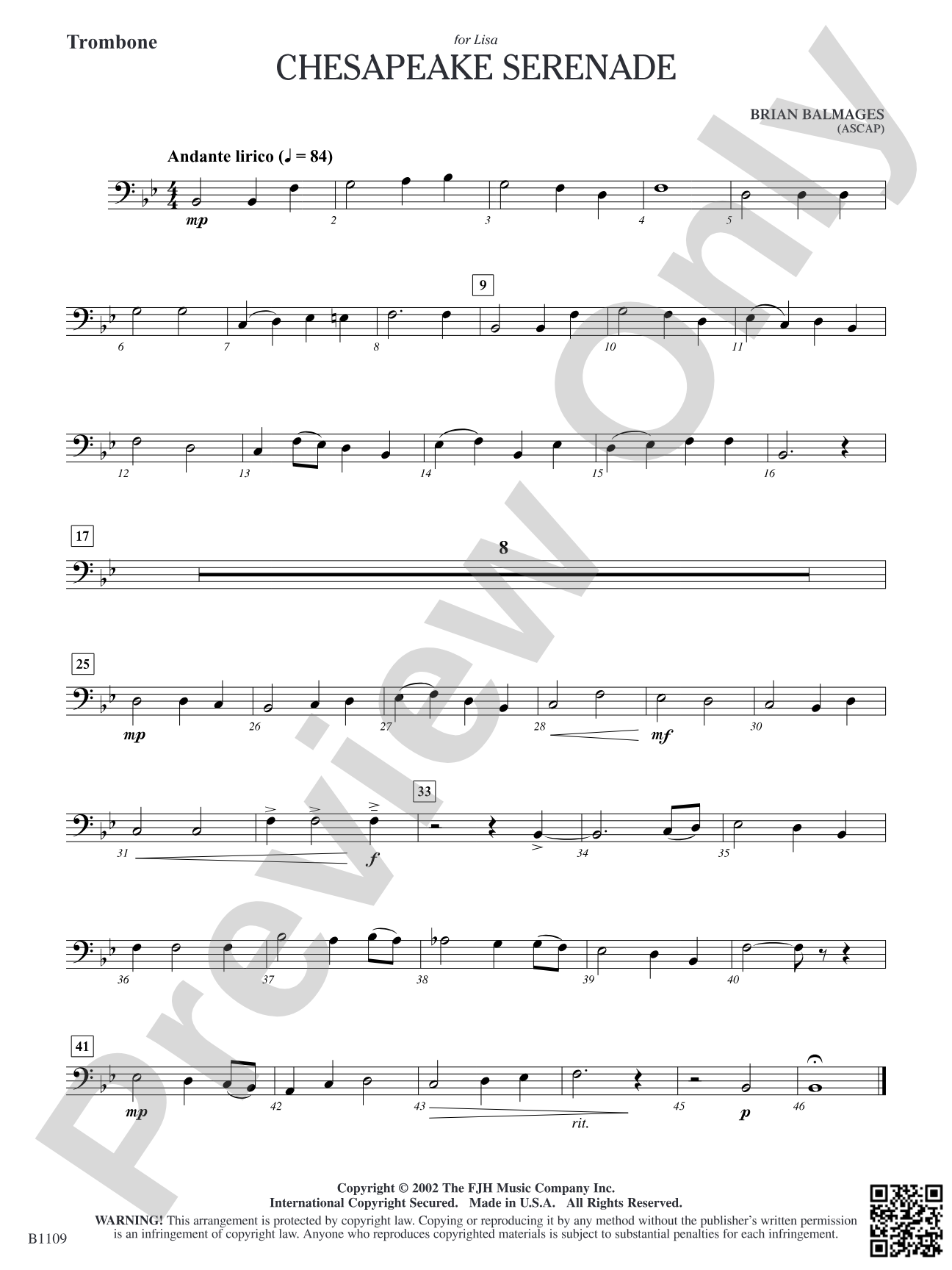

Chesapeake Serenade: Trombone
By Brian Balmages
Grade: 1
Item: 98-PC-DB1109_TN1
$7.00
Pickup currently not available
Description
Not very often are we treated to such a beautiful chorale at the grade 1 level. Brian has scored this to work well with your beginning band instrumentation while providing opportunities to work on musicianship and intonation both at the elementary and middle school levels. Excellent for concert situations and also effective in developing a rich sound. Highly recommended! (2:40)


Don't just read it, hear it, play along with it, and watch your students grow with it. In MakeMusic Cloud, Chesapeake Serenade: Trombone comes alive with professional accompaniment, adjustable tempo, and built-in practice tools that turn solo practice into real progress.
Open in the Player
Jump straight in and assign it today.
Start Your Free Trial
Open this title and explore the full library in minutes.
Sample Audio
1
Audio File
--:--
0:00
0:00
Sample Video
No sample videos found.
Additional Details
Series:
FJH Beginning Band
Publisher:
The FJH Music Company, Inc.
SKU:
98-PC-DB1109_TN1
More about this title
About the Composer: Brian Balmages

Brian Balmages has built a distinguished career composing for orchestras, bands, and chamber ensembles, with performances at Carnegie Hall, the Kennedy Center, Sydney Opera House, and the Toronto Centre for the Arts. His accolades include the A. Austin Harding Award from the American School Band Directors Association, the 2020 NBA William D. Revelli Composition Contest for Love and Light, and membership in the American Bandmasters Association.
Balmages received the inaugural James Madison University Distinguished Alumni Award and was later commissioned by the University of Miami to compose music for the inauguration of the institution's president. His work was performed during the 2013 Presidential Inaugural Prayer Service attended by President Obama and Vice President Biden. As a conductor, he regularly guest conducts all-state ensembles, university groups, and professional orchestras worldwide, with notable appearances at the Midwest Clinic, Western International Band Clinic, and numerous international conferences. He currently serves as Director of MakeMusic Publications and Digital Education for Alfred and MakeMusic.
Why we love this
Grade 1 pieces rarely offer the harmonic richness and melodic beauty of Chesapeake Serenade. Balmages has crafted something that sounds elegant and substantial while remaining genuinely accessible for beginning players, giving your ensemble the chance to create genuine musicianship from day one rather than merely playing through notes.
What to expect
Chesapeake Serenade unfolds with the quiet dignity of a morning on the water; the melody emerges gently while the harmonic foundation provides warmth and depth. The piece invites contemplation and rewards careful listening, creating an intimate atmosphere even in a gymnasium or auditorium.
Who it's for
Beginning concert bands at the elementary and middle school levels seeking quality literature that sounds mature without overwhelming young musicians. Directors programming concert situations where a single elegant work can anchor the program and demonstrate what careful ensemble balance sounds like.
How to get the most out of it
- Balance the chorale texture by asking each section to listen across the ensemble, not just within their part; this transforms individual lines into a unified harmonic sound.
- Shape the phrasing as a conductor through subtle gesture and expressive rubato rather than relying on marking every breath in the parts; this teaches players to listen and respond rather than follow notation alone.
- Work intonation through sustained tones in sectionals before rehearsing with the full band, establishing pitch confidence that will anchor the chorale's sonority.
How to use it
Use this as a centerpiece concert work that opens or closes a program with grace, or pair it with more energetic selections to demonstrate your band's musical range. The piece also works effectively as a festival showcase of musicianship and tonal development, allowing judges and audiences to hear what Grade 1 ensemble playing can actually accomplish.
Skills your students will build
- Sustaining tone quality across long phrases
- Listening for and matching pitch within harmonic textures
- Responding to expressive conducting gesture
- Balancing melodic and harmonic roles within the ensemble
- Shaping phrasing with intention rather than mechanical articulation