
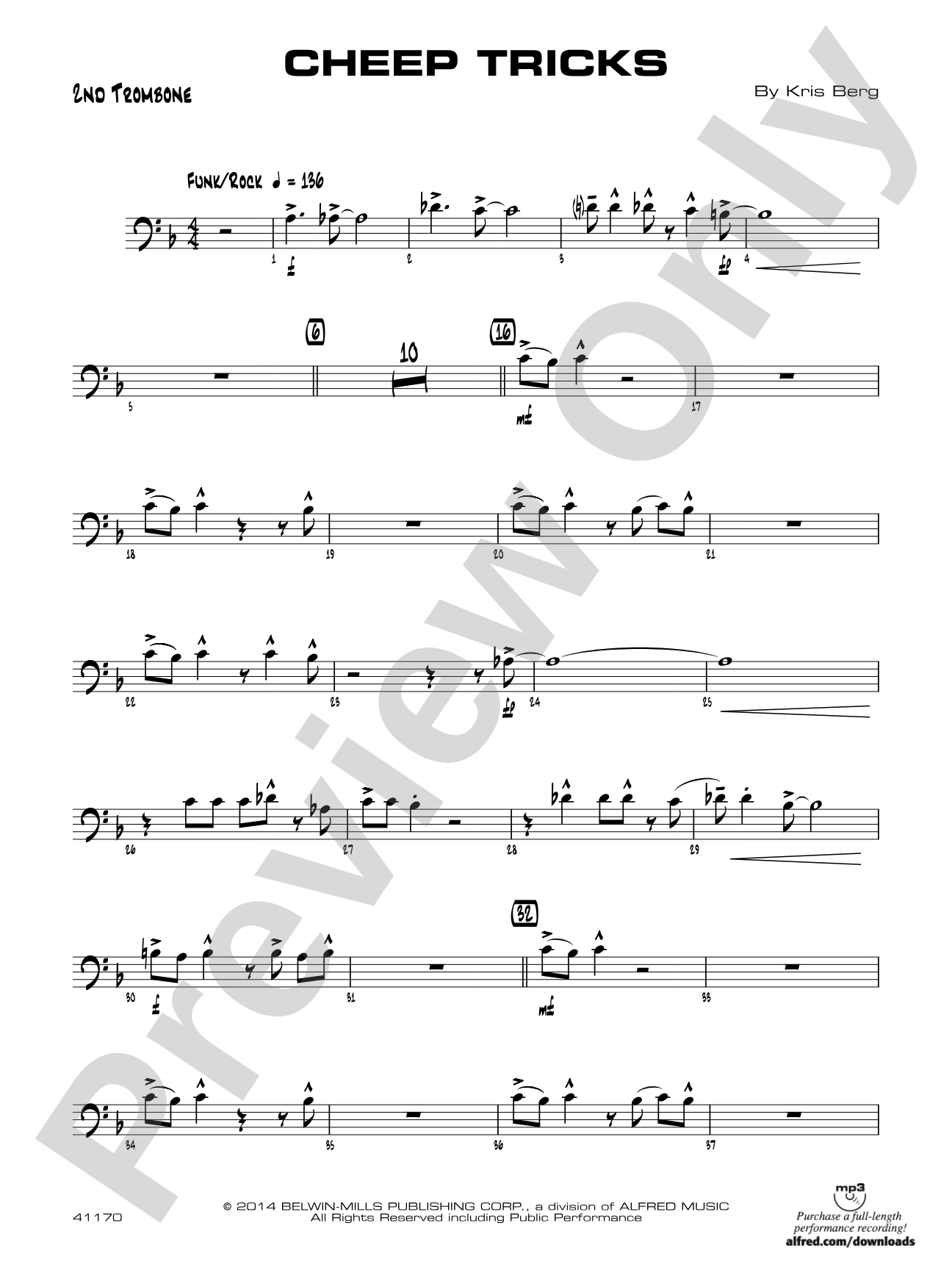

Cheep Tricks: 2nd Trombone
By Kris Berg
Grade: 3 (Medium)
Item: 00-PC-0016298_TN2
$3.00
Pickup currently not available
Description
Yep, you guessed it---Cheep Tricks by Kris Berg is a funk chart. The groove is deep at 136 BPM, solos are written out for tenor and/or guitar, and lead trumpet range is to written A. Do you like chicken? (3:45) This title is available in MakeMusic Cloud.


Don't just read it, hear it, play along with it, and watch your students grow with it. In MakeMusic Cloud, Cheep Tricks: 2nd Trombone comes alive with professional accompaniment, adjustable tempo, and built-in practice tools that turn solo practice into real progress.
Open in the Player
Jump straight in and assign it today.
Start Your Free Trial
Open this title and explore the full library in minutes.
Sample Audio
1
Audio File
--:--
0:00
0:00
Sample Video
Additional Details
Series:
Jazz Band Series
Publisher:
Alfred Music
Page Count:
98
SKU:
00-PC-0016298_TN2
More about this title
About the Composer: Kris Berg
Kris Berg leads the jazz studies program at Collin County Community College in Texas, where he earned both his bachelor's and master's degrees in jazz studies from the University of North Texas. His work as a composer and arranger has circulated internationally; his charts are performed and recorded worldwide, and he serves as a bestselling big band arranger and composer for Belwin Jazz, part of Alfred Publishing. He founded and directs both the Collin Jazz Fest and the Texas All-Star Jazz Camp, and under his leadership, the college's jazz ensembles have earned multiple invitations to perform at the Montreux Jazz Festival.
Beyond composition, Berg remains deeply active in the jazz community as a clinician and artist for Yamaha Corporation of America. He has performed and collaborated with an impressive roster of jazz musicians including Kurt Elling, Randy Brecker, Peter Erskine, Bob Mintzer, Clark Terry, and many others. Berg is also the author of Bass Lines in Minutes, a widely used resource for jazz pedagogy, and is endorsed by Walter Woods Amplifiers.
Why we love this
Berg writes grooves that sit in the pocket and demand precision from your ensemble. The funk foundation at 136 BPM gives students a clear rhythmic target to lock onto, while the written tenor and guitar solos provide exactly the kind of structured improvisation opportunities that build confidence in younger jazz players without overwhelming them.
What to expect
Cheep Tricks locks into a deep, modern funk groove that feels effortless once your ensemble finds the pocket. The written solos give it genuine conversation and personality; there's space for individual voices to shine while the ensemble maintains a tight, grooving foundation underneath.
Who it's for
Intermediate to advanced high school jazz ensembles and college jazz bands looking for a contemporary funk chart with real soloistic opportunities. This works particularly well for programs confident in their rhythm section and ready to feature tenor and guitar players in written solo sections.
How to get the most out of it
- Lock the rhythm section early and often. The groove is the foundation; have the drums, bass, and piano rehearse their parts together before bringing in the full ensemble so the pocket is airtight.
- Keep the lead trumpet articulation crisp and direct. At this tempo and with this style, clarity in the opening and closing sections will cut through the ensemble and define the chart's character.
- Balance the written solos carefully. These aren't background figures; tenor and guitar solos need space to breathe and be heard, so adjust surrounding voicings if needed during rehearsal.
- Let the funk breathe. Resist the urge to over-accent or push the tempo; the chart's strength comes from its laid-back pocket and confident groove.
How to use it
Program this as a centerpiece in a jazz concert that highlights both ensemble precision and individual soloists. Its contemporary funk voice pairs well alongside blues heads and more traditional swing charts, and at 3:45 it provides substantial substance without overextending a concert set.
Skills your students will build
- Locking into and maintaining a funk groove at 136 BPM
- Reading and performing written jazz solos for tenor saxophone and guitar
- Balancing unison articulation in the trumpet section with a lead to written A
- Listening critically to blend rhythm section parts (drums, bass, piano) in a funk setting
- Understanding the relationship between groove-based comping and ensemble soloing