
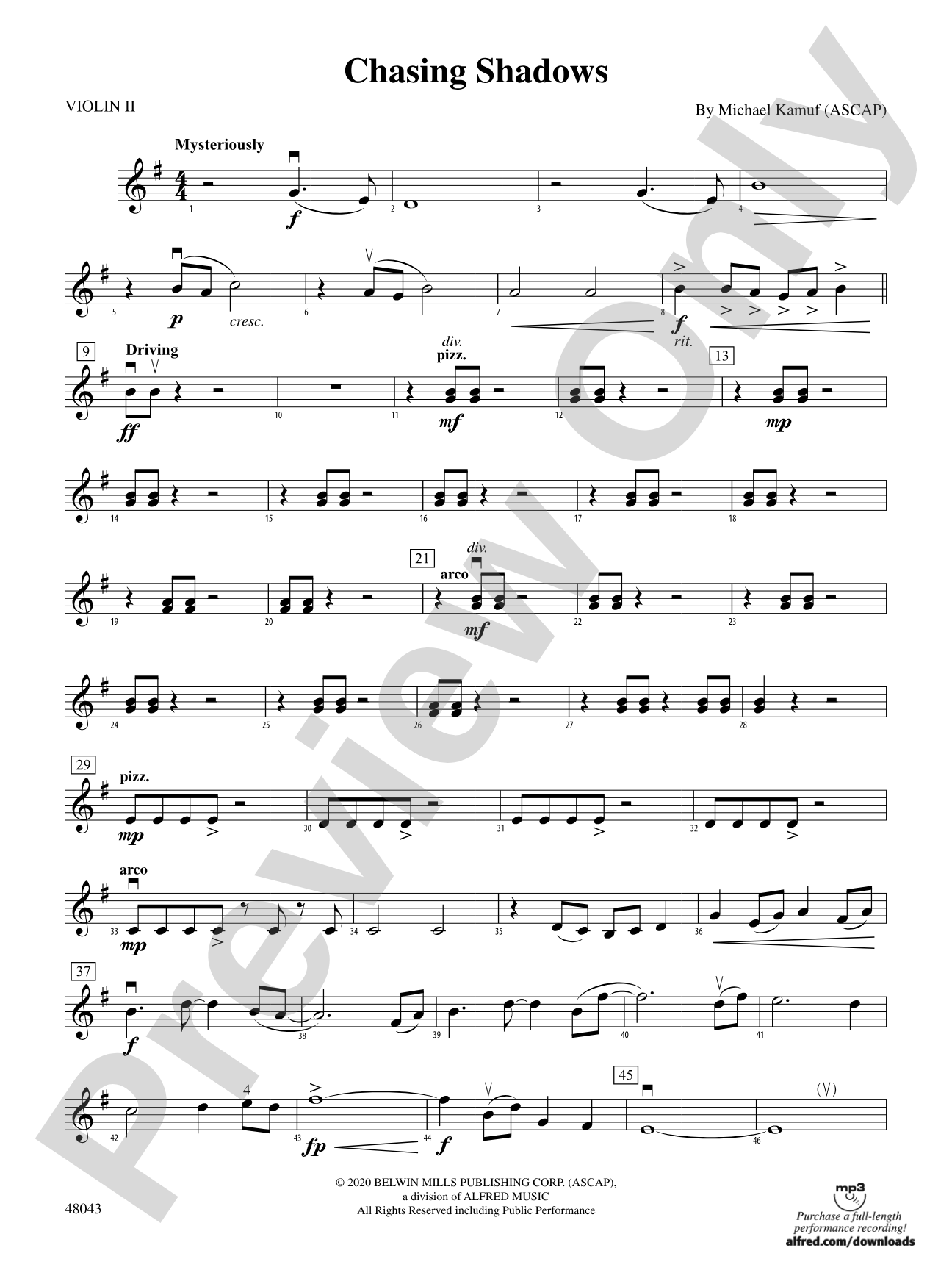

Chasing Shadows: 2nd Violin
By Michael Kamuf
Grade: 2.5
Item: 00-PC-0018426_VN2
$5.99
Pickup currently not available
Description
Chasing Shadows by Michael Kamuf features soaring melodies, driving rhythms, and bold harmonies which work together to create cinematic overtones. The use of syncopated rhythms throughout will help reinforce your orchestra's understanding of subdivision. A perfect selection for concerts and festivals that both students and audiences will enjoy! This title is available in MakeMusic Cloud. (3:00)


Don't just read it, hear it, play along with it, and watch your students grow with it. In MakeMusic Cloud, Chasing Shadows: 2nd Violin comes alive with professional accompaniment, adjustable tempo, and built-in practice tools that turn solo practice into real progress.
Open in the Player
Jump straight in and assign it today.
Start Your Free Trial
Open this title and explore the full library in minutes.
Sample Audio
1
Audio File
--:--
0:00
0:00
Sample Video
Additional Details
Series:
Belwin Intermediate String Orchestra
Publisher:
Alfred Music
Page Count:
148
SKU:
00-PC-0018426_VN2
More about this title
About the Composer: Michael Kamuf

Michael Kamuf earned degrees in Jazz Performance and Music Education from Youngstown State University's Dana School of Music, followed by a Master of Arts in Instrumental Conducting from George Mason University. His compositions and arrangements have been performed by prestigious ensembles including the Woody Herman Orchestra, Glenn Miller Orchestra, USAF Airmen of Note, and soloists like James Moody and Eddie Daniels. Over 100 of his works are currently in print across Belwin, UNC Jazz Press, Neil A. Kjos Music, and FJH Music Company.
Kamuf spent three decades in the Montgomery County (Maryland) Public Schools as an instrumental music teacher and served for twenty-seven years as Director of Bands and Orchestras at John T. Baker Middle School in Damascus, Maryland. Under his leadership, the school's ensembles earned consistent high ratings at festivals and commissioned numerous works for young concert bands. He currently leads the Mike Kamuf Little Big Band, performing with accomplished musicians from the Baltimore and Washington, DC regions.
Why we love this
Kamuf understands exactly what mid-level string orchestras need to tackle syncopation without overwhelming the ensemble. The cinematic quality gives your orchestra something genuinely engaging to perform, and audiences respond to that scope without the piece feeling out of reach. It's the kind of title that makes both musicians and listeners feel the ensemble has arrived.
What to expect
Energy propels through the piece as rhythmic momentum and harmonic boldness create a sense of forward motion. The soaring melodies sit above that rhythmic foundation with cinematic sweep, giving the ensemble room to breathe between the more driven sections. It feels modern without losing the warmth that draws an audience in.
Who it's for
String orchestras at the intermediate level who are ready to build serious rhythmic independence while performing repertoire with real musical substance. Directors seeking a piece that programs well at concerts and festivals will find an arrangement that challenges students without stalling rehearsal momentum.
How to get the most out of it
- Isolate the syncopated passages in sectional rehearsals before bringing them into full ensemble context. Have each section speak the rhythmic patterns aloud first to lock the subdivision clearly.
- Shape the soaring melodies with attention to phrase architecture rather than individual note emphasis. Let the arc of the line guide your bow choices and dynamics.
- Balance the driving rhythms in the accompaniment so they support rather than compete with the melodic material. Adjust the internal dynamic relationships between sections in the middle register.
How to use it
Position this as a centerpiece work on a concert program or festival entry where you want to demonstrate both technical growth and musical maturity. Its three-minute runtime fits comfortably alongside lighter opening works or as a transition piece that elevates the sophistication of the full program.
Skills your students will build
- Syncopated rhythm reading and execution across mixed meters
- Subdivision and internal pulse awareness in driving rhythmic passages
- Balancing melodic lines against rhythmic accompaniment textures
- Phrasing and shaping extended melodic contours
- Ensemble precision and independence at intermediate tempo and dynamic complexity