
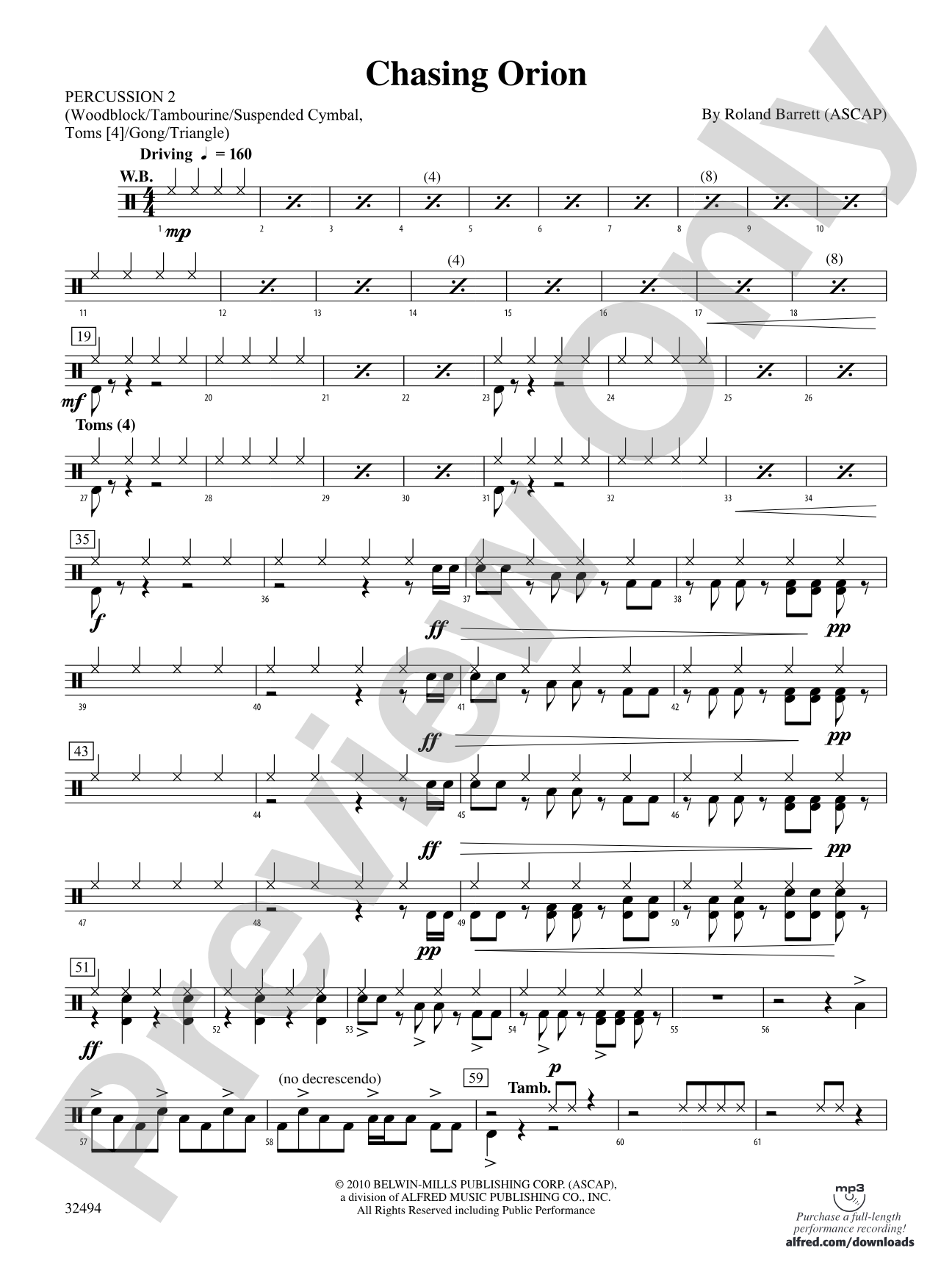

Chasing Orion: 2nd Percussion
By Roland Barrett
Grade: 2 (Easy)
Item: 00-PC-0014374_PC2
$3.00
Pickup currently not available
Description
Chasing Orion refers to the practice of celestial navigation, or "sailing by the stars." It was inspired by the rich early history of maritime sailing and the commercial shipping industry. After traveling to distant and exotic lands, the fast clipper ships raced toward home, their holds bursting with grain, wool, spices, gold, and other treasures. Catapulted forward by the "roaring forties" wind currents, the sleek and elegant sailing ships swept around the ever-dangerous Cape Horn as they navigated by the stars, "chasing Orion." A dramatic new addition to the young band literature! This title is available in MakeMusic Cloud.


Don't just read it, hear it, play along with it, and watch your students grow with it. In MakeMusic Cloud, Chasing Orion: 2nd Percussion comes alive with professional accompaniment, adjustable tempo, and built-in practice tools that turn solo practice into real progress.
Open in the Player
Jump straight in and assign it today.
Start Your Free Trial
Open this title and explore the full library in minutes.
Sample Audio
1
Audio File
--:--
0:00
0:00
Sample Video
No sample videos found.
Additional Details
Series:
Belwin Young Band
Publisher:
Alfred Music
Page Count:
272
SKU:
00-PC-0014374_PC2
More about this title
About the Composer: Roland Barrett

Roland Barrett has been composing and arranging for concert and marching ensembles since joining the University of Oklahoma faculty in 2001, where he teaches music theory and composition with an emphasis on twentieth-century techniques. Over the course of his career, he has published more than two hundred original works and arrangements for symphonic band, chamber groups, and marching organizations; his music has been performed by the Dallas Wind Symphony, countless All-State and All-Region honor ensembles, and featured on NPR and at major conventions including the Midwest Band and Orchestra Conference.
Beyond his composition work, Barrett continues to arrange for the Pride of Oklahoma marching band and has received multiple ASCAP Plus awards for his contributions to the field. His pieces combine strong musical craftsmanship with accessibility, making them valuable additions to band curricula at all levels.
Why we love this
Chasing Orion brings a cinematic energy to Grade 2 repertoire without overwhelming younger ensembles. The narrative clarity of maritime adventure gives students a genuine dramatic arc to follow, making sectional rehearsals feel purposeful rather than mechanical. Barrett's orchestration balances accessibility with sophistication, allowing all voices to contribute meaningfully to the storytelling.
What to expect
Chasing Orion evokes the urgency and grace of seafaring adventure: surging forward with wind-driven energy, then pausing to contemplate the vastness of open ocean and sky. The writing captures both the danger of Cape Horn and the peaceful resolve of navigation by starlight, allowing the band to experience dramatic contrasts within a single, cohesive journey.
Who it's for
Conductors building Grade 2 band programs that can handle moderate technical demands and genuine musical storytelling. Young musicians benefit from the clear programmatic structure, which helps them understand how musical choices serve narrative; students are motivated by playing something that feels substantial rather than simplified.
How to get the most out of it
- Build the forward momentum gradually through the opening sections; resist the urge to rush as the clipper ships accelerate. Let the rhythmic figures establish themselves clearly before the tempo pushes forward.
- Shape the climactic passages around Cape Horn with dynamic control. The excitement comes from orchestration choices and rhythmic drive, not from playing loud without shape.
- Balance the celestial navigation imagery in the later sections. Lighter articulation and careful voicing help listeners hear the shift from stormy waters to calmer starlit passages.
- Secure the rhythmic precision in the ensemble; with a programmatic title, any rhythmic sloppiness distracts from the narrative. Lock the sections on subdivisions during full rehearsals.
How to use it
Program this as an opener or closer that establishes the band's dramatic range and craftsmanship early in the season. Pair it alongside other Grade 2 concert pieces to show variety in style and instrumentation, or feature it in a festival or contest setting where the programmatic element engages adjudicators and audiences alike.
Skills your students will build
- Managing tempo shifts and rhythmic acceleration within a unified ensemble
- Balancing dynamic contrasts that serve narrative rather than mere volume changes
- Sustaining focused articulation through longer, sectionally complex phrases
- Coordinate between melody and accompaniment voices to maintain clarity in fuller orchestration