
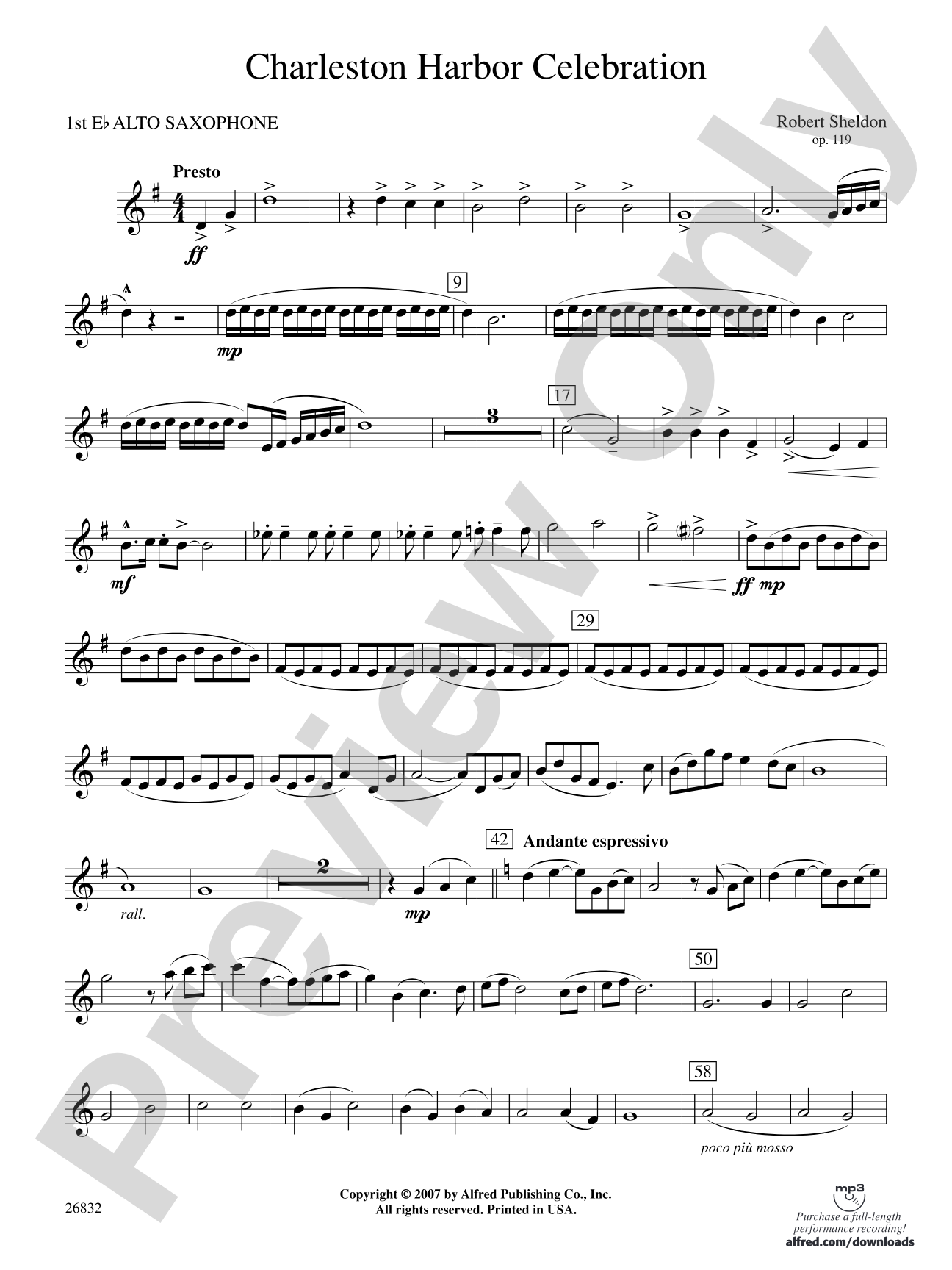

Charleston Harbor Celebration: E-flat Alto Saxophone
By Robert Sheldon
Grade: 4 (Medium Difficult)
Item: 00-PC-0001270_AX1
$3.00
Pickup currently not available
Description
Charleston Harbor Celebration was commissioned by the Charleston Community Band of Charleston, South Carolina (Stephen B. Giove, Conductor). The band commissioned the piece to honor its past conductors -- Earl R. Mays, Edwin S. Toporek, Herbert L. Day and John R. Spitler -- for their faithful service to education, music and musicians. The piece itself is a concert overture that captures the beauty and energy of Charleston's important and historic harbor. This title is available in MakeMusic Cloud.


Don't just read it, hear it, play along with it, and watch your students grow with it. In MakeMusic Cloud, Charleston Harbor Celebration: E-flat Alto Saxophone comes alive with professional accompaniment, adjustable tempo, and built-in practice tools that turn solo practice into real progress.
Open in the Player
Jump straight in and assign it today.
Start Your Free Trial
Open this title and explore the full library in minutes.
Sample Audio
1
Audio File
--:--
0:00
0:00
Sample Video
No sample videos found.
Additional Details
Series:
Alfred Concert Band
Publisher:
Alfred Music
Page Count:
177
SKU:
00-PC-0001270_AX1
More about this title
About the Composer: Robert Sheldon

Robert Sheldon's wind band compositions appear on contest and concert stages across the globe with remarkable frequency. His music has earned recognition from the American School Band Director's Association, Phi Beta Mu, and ASCAP, and performances of his works have graced Carnegie Hall, Orchestra Hall, Boston Symphony Hall, the Sydney Opera House, and the Kennedy Center. Beyond composing, Sheldon co-authored Sound Innovations for Concert Band and maintains an active schedule as guest conductor for All-State and Regional Honor Bands.
Sheldon's influence extends through his work as a clinician and educator. He has led seminars and presentations at universities and state music education conferences across North America, Europe, Asia, and Australia. In 2020, VanderCook College of Music awarded him an honorary doctorate in recognition of his contributions to wind band education and composition.
Why we love this
This concert overture marries narrative purpose with accessible Grade 4 writing, allowing your band to play music that matters without sacrificing musicality. The piece honors real educators while giving your students a work that challenges them to shape dynamic energy and sustain lyrical passages, making rehearsals feel genuinely purposeful. Sheldon writes with clarity and craft at this level; every section has work to do.
What to expect
Charleston Harbor Celebration evokes the vitality and historic weight of its setting, moving between moments of lyrical beauty and spirited forward motion. The piece feels celebratory without being brassy, and its energy is grounded in respect for the educators it honors.
Who it's for
Concert bands at the Grade 4 (Medium Difficult) level that want a piece with genuine musical substance and a story worth telling. This works equally well for groups preparing for contest or those seeking a strong concert opener that speaks to both audience and ensemble.
How to get the most out of it
- Balance the thematic material between sections so that melodic lines cut through the harmonic foundation; conductors often need to remind brass that accompaniment figures don't require aggressive volume.
- Shape the legato passages with direction and breath, especially in the quieter moments that frame the harbor imagery; sustained chords can flatten without conductor attention to phrase arc.
- Anchor the rhythm section early and frequently so that the piece's energy feels propulsive rather than scattered when tempo and texture shift.
- Let the recorded accompaniment (if available through MakeMusic Cloud) guide sectional rehearsals; many bands benefit from hearing Sheldon's own conception of the piece's dramatic arc.
How to use it
Open a concert with this piece to establish both musicality and purpose; the overture format gives you momentum into a varied program. It also serves well in a educational or commemorative concert, where the story of its commission resonates with your audience and enriches the listening experience.
Skills your students will build
- Sustaining legato phrasing across phrase lengths
- Balancing melodic lines against harmonic accompaniment
- Responding to tempo and texture changes without losing ensemble cohesion
- Shaping dynamic contours in both lyrical and energetic passages
- Reading and executing articulation and expression markings that drive character