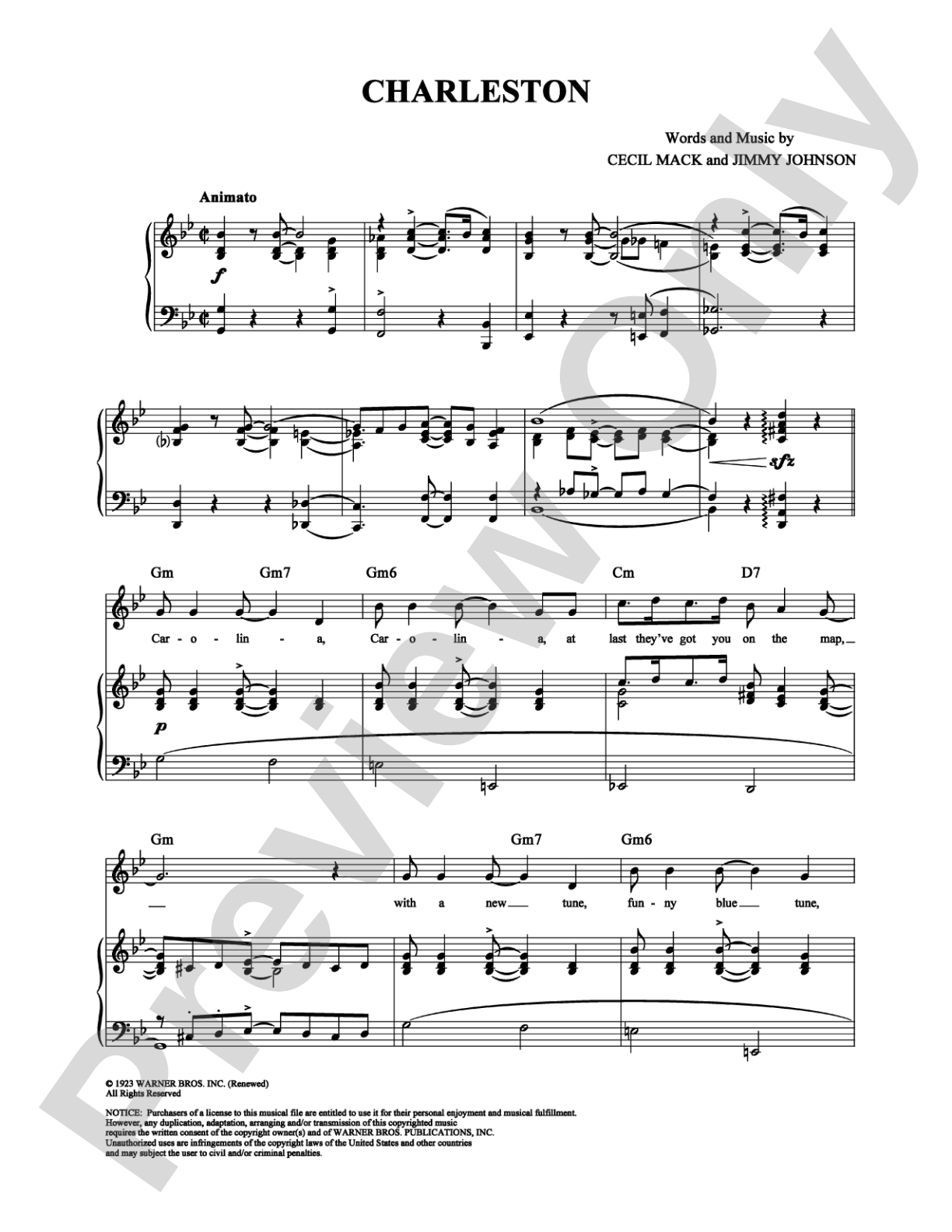
Charleston: Piano/Vocal/Chords Digital Sheet Music

Charleston: Piano/Vocal/Chords Digital Sheet Music

Cecil Mack, Jimmy Johnson

Item: 00-PS-0005259

Digital Download
$3.99
Description

Charleston: Piano/Vocal/Chords Digital Sheet Music isn't in MakeMusic Cloud just yet...but it could be. Let us know you'd like to see it, and you'll help shape what comes next. In the meantime, start a free trial and dive into thousands of interactive titles your students can play along with today.

Sample Audio
No sample audio found.
Sample Video
Additional Details
SKU: 00-PS-0005259

More about this title

Why we love this

Charleston sits at the intersection of jazz history and pure fun, giving pianists and singers a standard that swings hard without demanding virtuosic pyrotechnics. The piano/vocal/chords format means your students can focus on phrasing, swing feel, and rhythmic precision rather than wrestling with overly complex voicings. It's a piece that teaches jazz vocabulary through actual playing and singing, not explanation.

What to expect

Charleston bounces with irresistible energy, full of syncopation and chromatic movement that captures the exuberance of the 1920s jazz age. The melody dances over swung rhythms, inviting the singer to play with phrasing and the pianist to voice chords with personality and rhythmic bite.

Who it's for

Pianists and singers working together in jazz combos, jazz choir settings, or small ensemble contexts. This resource suits students developing their jazz interpretation skills and performers who want a straightforward, playable version of a jazz standard without excessive notation clutter.

How to get the most out of it

  • Establish the rhythm section feel first. The piano player should lock in a consistent swing pattern before the vocalist enters; this gives the singer a solid foundation for laying back or pushing ahead of the beat.
  • Listen closely to your vocalist's phrasing and adjust the chord voicings to support their melodic choices rather than compete with them.
  • Experiment with different tempos in rehearsal. Charleston works at several speeds, and finding the right groove for your group will make the difference between competent and compelling.
  • Plant rhythmic punch in the left hand. The walking bass line or steady accompaniment pattern is what makes this standard live; don't let it become wallpaper.

How to use it

Pair this with other jazz standards to build a short set for a jazz night concert or cabaret-style performance. It also works well as a teaching piece mid-year when students have developed enough jazz vocabulary to handle interpretation and feel, and it can anchor a unit on jazz history spanning the 1920s through contemporary jazz.

Skills your students will build

  • Swing feel and rhythmic interpretation in a jazz context
  • Vocal phrasing and microrhythmic placement (laying back, pushing the beat)
  • Jazz chord voicing and comping on piano
  • Listening and responding between vocalist and accompanist
  • Reading lead-sheet notation and understanding chord symbols

You May Also Like