
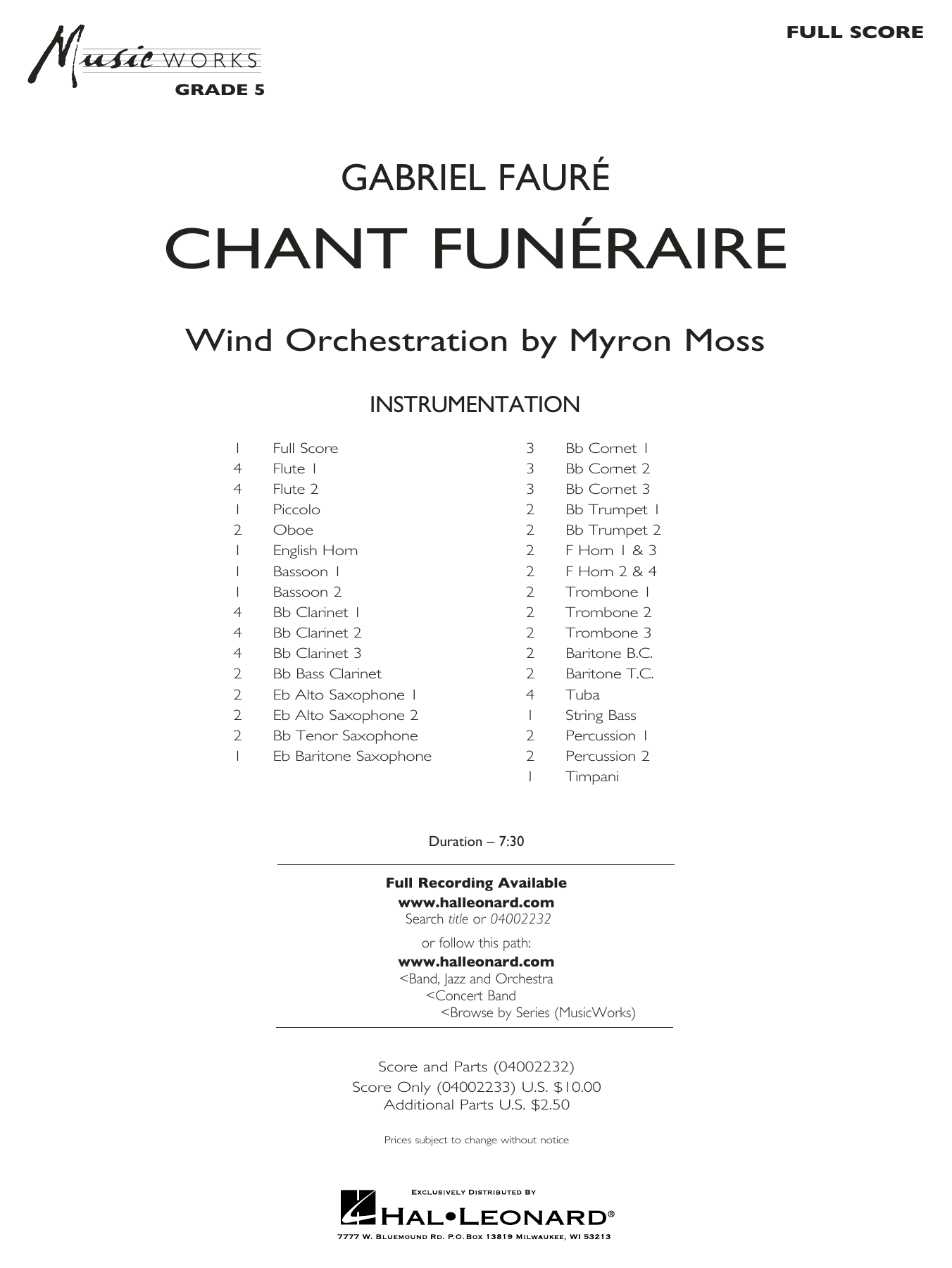

Chant Funeraire (arr. Myron Moss): Concert Band Conductor Score & Parts
By Gabriel Faure / Arranged by Myron Moss
Grade: 5
Item: 35-PK01395751
$85.00
Pickup currently not available
Buy Extra Parts (Digital PDF Download)
Parts Added to Cart!
Description
MusicWorks Grade 5
This hauntingly beautiful piece by Fauré was commissioned by the French government in 1921 as a memorial for the centenary of Napoleon's death. It has been magnificently orchestrated for wind band by Myron Moss, and is already garnering national attention with several important performances including The Midwest Clinic in Chicago, December 2003. Expansive and rich-sounding, this piece demands a mature group but delivers an impressive and rewarding musical experience. (7:30)


Chant Funeraire (arr. Myron Moss): Concert Band Conductor Score & Parts isn't in MakeMusic Cloud just yet...but it could be. Let us know you'd like to see it, and you'll help shape what comes next. In the meantime, start a free trial and dive into thousands of interactive titles your students can play along with today.
Request This Title
Tell us you want it.
Start Your Free Trial
Explore everything that's ready to play right now.
Sample Audio
No sample audio found.
Sample Video
No sample videos found.
Additional Details
Publisher:
Hal Leonard
SKU:
35-PK01395751
More about this title
About the Composer: Gabriel Faure
Gabriel Fauré (1845–1924) shaped French musical identity through four decades as organist at the Madeleine church in Paris and director of the Conservatoire. His harmonic language, marked by fluid voice leading and subtle chromaticism, departed from Romantic convention and influenced generations of 20th-century composers. In the concert band world, Fauré's works gain new life through skilled arrangement, revealing the lyrical sophistication that made him a towering figure in French musical culture.
Fauré's sacred and ceremonial music carries particular weight in education. Pieces like Chant Funeraire demonstrate how formal constraint (a work commissioned for national commemoration) can produce art of genuine emotional depth rather than mere pageantry. This balance between structural discipline and expressive warmth offers students a masterclass in how restraint serves music.
Why we love this
Myron Moss's orchestration captures Fauré's harmonic subtlety without losing the grandeur the piece demands for a state funeral context. At grade 5, the writing sits at that rare intersection where ensemble maturity actually shapes the expressive outcome; a less developed group will play the notes, but a confident band will feel the weight of what they're performing. The 7:30 duration and national performance history signal repertoire worth claiming.
What to expect
A procession moving through quiet dignity. The piece unfolds with the ceremonial patience of state mourning, its harmonies shifting like candlelight, creating moments of unexpected harmonic richness before returning to austere simplicity. There is no triumph here; instead, a profound acceptance of loss expressed through restrained beauty.
Who it's for
Concert bands with secure fundamentals and the maturity to sustain longer lines without losing focus. This is appropriate for advanced high school ensembles, college bands seeking substantial repertoire, and semi-professional groups building a classical foundation.
How to get the most out of it
- Balance the middle voices carefully. Fauré's harmony sits in the inner voices, and if clarinets and saxophones overshadow the altos and tenors, the chord progressions flatten. Conductor scores should mark these inner lines distinctly during rehearsal.
- Shape phrases around the harmonic rhythm rather than the melodic line alone. Many passages breathe at unexpected places because the underlying harmony is shifting; let your ensemble feel when chords change, not just when notes move.
- Resist the impulse to rush the rubato sections. French music of this era values precise ensemble coordination even when the tempo feels flexible; discuss whether ritardandos happen together or unfold gradually, then commit to that choice.
- Invest in the softer dynamics. Grade 5 students often assume 'impressive' means loud, but Chant Funeraire proves that control of pianissimo passages and transparent textures impresses far more than volume.
How to use it
Position this as an anchor for a concert exploring grief, memory, or 20th-century classical voices. It pairs naturally with other memorial or sacred works and commands enough musical substance to stand alone as a concert centerpiece. Consider programming it in the second half, where its length and emotional intensity will create a genuine program arc rather than feel like filler.
Skills your students will build
- Reading and balancing chromatic voice leading across four or more parts simultaneously
- Sustaining focus and breath control through extended lyrical passages
- Responding to subtle conducting gestures that shape rubato and harmonic pacing
- Interpreting dynamic contrast as a tool for harmonic clarity rather than surface expression
- Coordinating ensemble entries and releases with precision in slower tempos where ensemble cohesion is more exposed