
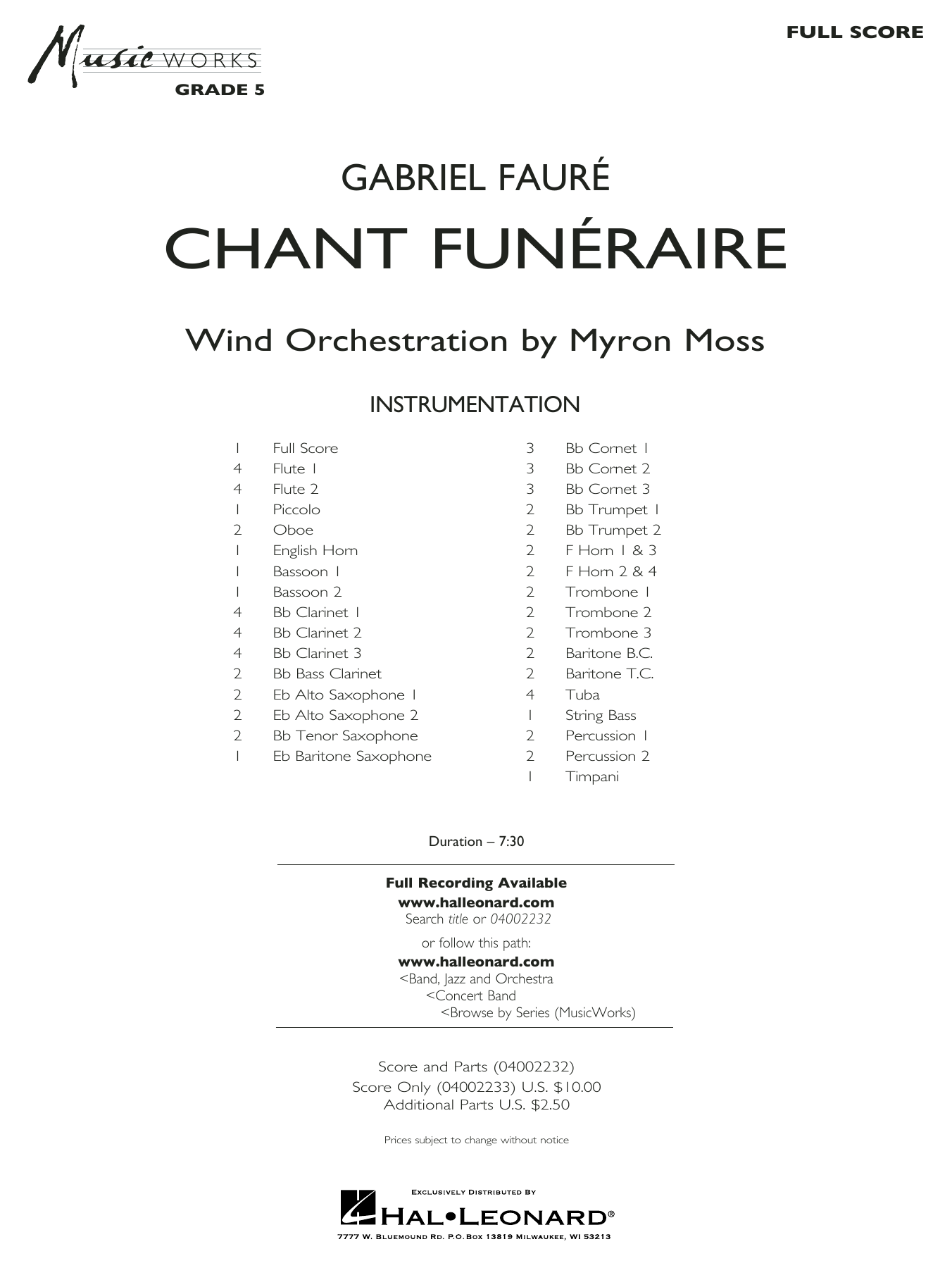

Chant Funeraire (arr. Myron Moss): Concert Band Conductor Score & Parts
By Gabriel Faure / Arranged by Myron Moss
Grade: 5
Item: 35-PK01362693
$85.00
Pickup currently not available
Buy Extra Parts (Digital PDF Download)
Parts Added to Cart!
Description
MusicWorks Grade 5
This hauntingly beautiful piece by Fauré was commissioned by the French government in 1921 as a memorial for the centenary of Napoleon's death. It has been magnificently orchestrated for wind band by Myron Moss, and is already garnering national attention with several important performances including The Midwest Clinic in Chicago, December 2003. Expansive and rich-sounding, this piece demands a mature group but delivers an impressive and rewarding musical experience. (7:30)


Chant Funeraire (arr. Myron Moss): Concert Band Conductor Score & Parts isn't in MakeMusic Cloud just yet...but it could be. Let us know you'd like to see it, and you'll help shape what comes next. In the meantime, start a free trial and dive into thousands of interactive titles your students can play along with today.
Request This Title
Tell us you want it.
Start Your Free Trial
Explore everything that's ready to play right now.
Sample Audio
No sample audio found.
Sample Video
No sample videos found.
Additional Details
Publisher:
Hal Leonard
SKU:
35-PK01362693
More about this title
About the Composer: Gabriel Faure
Gabriel Fauré (1845–1924) shaped French music through a career that spanned from the salon to the concert hall to the director's office at the Paris Conservatoire. His gift for melody and harmonic refinement made him a bridge figure between Romanticism and modernism, influencing generations of composers who followed. In the classroom, his works serve as touchstones for understanding how traditional forms can contain profound emotional depth without resorting to grandeur or excess.
Fauré's sacred and memorial works hold particular power in music education because they demonstrate restraint as a compositional strength. Students who study his writing learn that maturity in music often means knowing what to leave out, a lesson that applies across all ensemble settings and skill levels.
Why we love this
Myron Moss's orchestration captures the elegance of Fauré's original concept while giving it the textural weight and blend that makes wind band scoring distinctive. A Grade 5 piece that actually sounds Grade 5 in its sophistication rather than its difficulty is rare, and this arrangement delivers that balance. The piece has proven itself in major venues, which means your students will be learning something with real pedigree and presence.
What to expect
A quiet procession through autumn light. The piece unfolds with the inevitability of a ceremony, never rushing, never forcing emotion but instead allowing it to accumulate through sustained tones, careful voice leading, and Fauré's subtle harmonic shifts. There is dignity here, and a sense of honoring something lost without surrendering to despair.
Who it's for
Advanced high school bands and college concert ensembles ready to tackle material that demands both technical control and interpretive maturity. Groups that have performed successfully at Grade 4 and want to step into serious concert repertoire will find this piece both achievable and genuinely impressive.
How to get the most out of it
- Shape the opening with a quiet, centered focus in the lower voices. The piece establishes its atmosphere through density and color rather than volume, so resist the impulse to fill the silence with extra sound.
- Balance the solo lines that emerge from the ensemble texture. In Moss's scoring, important melodic material often lives in unexpected voices, so mark these moments clearly for your players and ensure they hear themselves within the full sound.
- Allow the piece to breathe during longer phrases. French Romantic music benefits from subtle tempo flexibility and space between sections; your interpretation should feel inevitable rather than metronomic.
- Work backward from the final moments to establish the overall architecture. This piece unfolds over 7.5 minutes, and each section draws its meaning from where it leads, so rehearse with the ending's quiet resolution always in mind.
How to use it
Place this as the centerpiece of a concert devoted to memorial or reflective music, or program it as the final piece of an evening to send the audience out with something that lingers. It works beautifully alongside other French wind band literature, or as the anchor point in a program that otherwise leans toward American or contemporary works. The 7:30 duration gives it weight without overwhelming a full concert's pacing.
Skills your students will build
- Sustaining lyrical lines with consistent tone and breath control across long phrases
- Balance and blend in multi-layered harmonic textures
- Interpreting period-appropriate phrasing and vibrato choices in French Romantic music
- Responding to subtle dynamic gradations and timbral shifts
- Maintaining ensemble cohesion at soft dynamic levels
- Understanding how orchestration creates emotional weight without relying on volume