
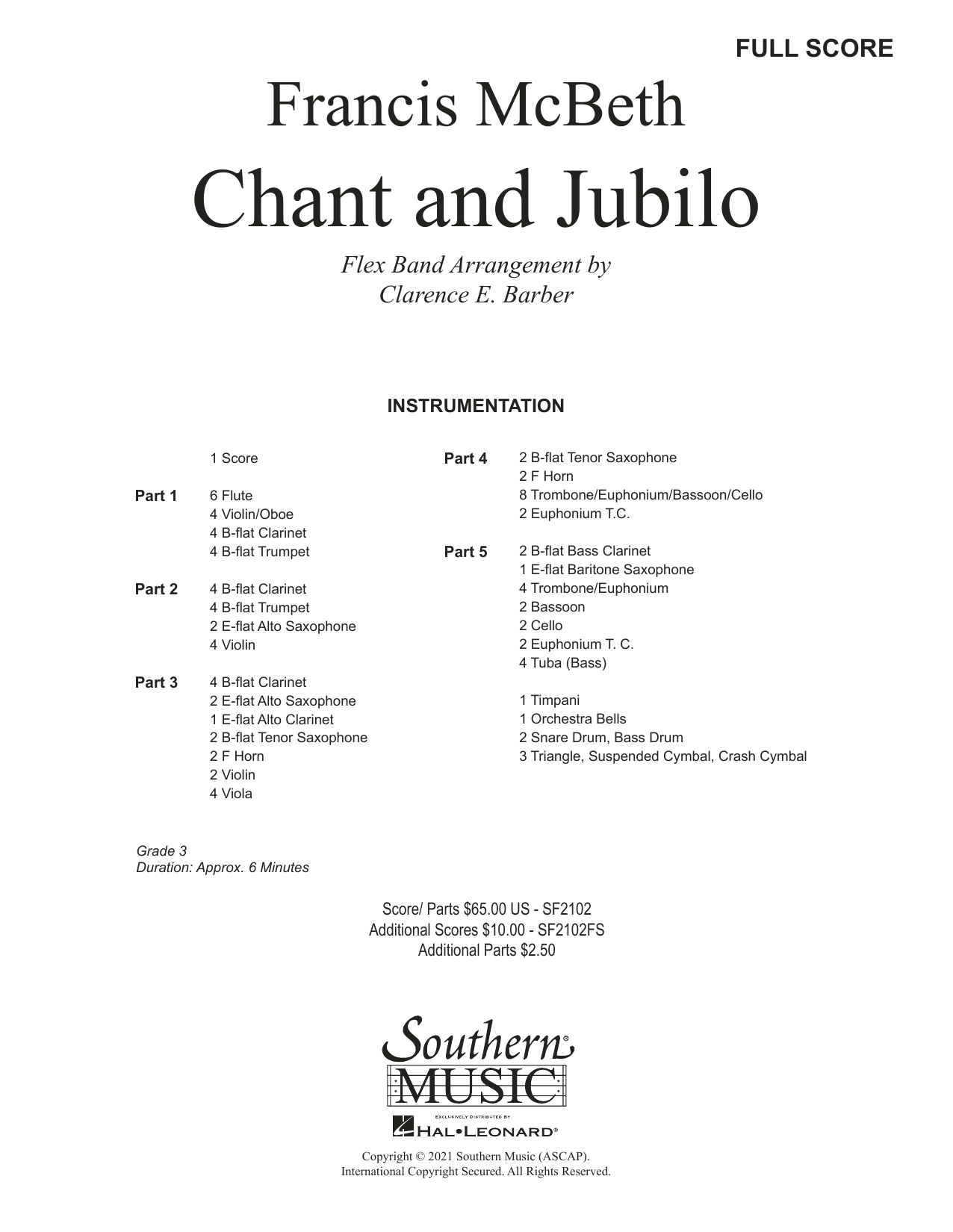

Chant and Jubilo: Flex Ensemble Conductor Score & Parts
By Francis McBeth / Arranged by Clarence Barber
Item: 35-PK00680019
$80.00
Pickup currently not available
Buy Extra Parts (Digital PDF Download)
Parts Added to Cart!
Description
New flex band arrangement by Clarence Barber, playable on any SSATB combination of woodwind, brass, or string players with optional percussion. This title has been recognized as one of the most outstanding of the composer's works and is justly regarded as one of the classics of the band repertoire. In anticipation of the composer's 35th Anniversary with Southern Music, the editors reexamined this masterwork in 1996 in order to prepare a new edition embodying the composers experience in conducting this work for many years.


Chant and Jubilo: Flex Ensemble Conductor Score & Parts isn't in MakeMusic Cloud just yet...but it could be. Let us know you'd like to see it, and you'll help shape what comes next. In the meantime, start a free trial and dive into thousands of interactive titles your students can play along with today.
Request This Title
Tell us you want it.
Start Your Free Trial
Explore everything that's ready to play right now.
Sample Audio
No sample audio found.
Sample Video
No sample videos found.
Additional Details
Publisher:
Hal Leonard
SKU:
35-PK00680019
More about this title
About the Composer: Francis McBeth
Francis McBeth stands as one of the most prolific and performed American band composers of the late 20th century. His output spans over 200 works for wind ensemble, orchestra, and chamber groups, establishing him as a foundational voice in the modern concert band repertoire.
McBeth's compositions are prized in music education for their musicality, technical accessibility across skill levels, and genuine dramatic impact. His works balance compositional sophistication with the practical realities of school and community ensembles, making him a staple in programming from middle school through professional groups.
Why we love this
Chant and Jubilo ranks among McBeth's most enduring works, and Clarence Barber's flex arrangement removes the barrier of instrumentation entirely. You can finally program this canonical piece whether you have a traditional band, strings, a mixed ensemble, or anything in between. The 1996 revision ensures you're working from McBeth's own conducting experience with the work, bringing interpretive clarity that generations of ensembles have benefited from.
What to expect
The work opens with quiet, reverent chanting that gradually gathers strength and transforms into jubilant affirmation. There's a spiritual quality to the arch of the piece; the musical journey feels both inevitable and earned, moving from introspection to celebration with conviction.
Who it's for
Directors managing instrumentation changes mid-year or working with non-traditional ensemble makeups will find this arrangement essential. It's equally suited for experienced programs seeking a work of genuine musical substance that speaks to audiences and challenges student musicians across multiple levels.
How to get the most out of it
- Balance the opening chant section by keeping inner voices present; the work's architecture depends on hearing all four parts even when soloists carry the melody.
- Allow the jubilo section to breathe with controlled energy rather than racing through; the excitement comes from rhythmic precision and clarity, not tempo.
- Use the optional percussion parts selectively. They enhance color and definition but aren't necessary for the work's impact if your ensemble lacks players.
- Shape the harmonic movement in the slower passages with attention to voice leading; McBeth's part writing rewards legato phrasing and attention to chord quality.
How to use it
This pairs naturally with liturgical or spiritually themed concert programming. It also functions beautifully as a centerpiece concert work that demonstrates ensemble artistry and musicianship; the combination of lyrical writing and energetic passages showcases your group's range across a single piece.
Skills your students will build
- Sustaining tone quality in legato, chant-like passages
- Balancing inner voice independence with ensemble blend
- Rhythmic control and precision during accelerating tempos
- Stylistic contrast between meditative and jubilant sections
- Part-to-whole awareness in music with equal melodic interest across all voices