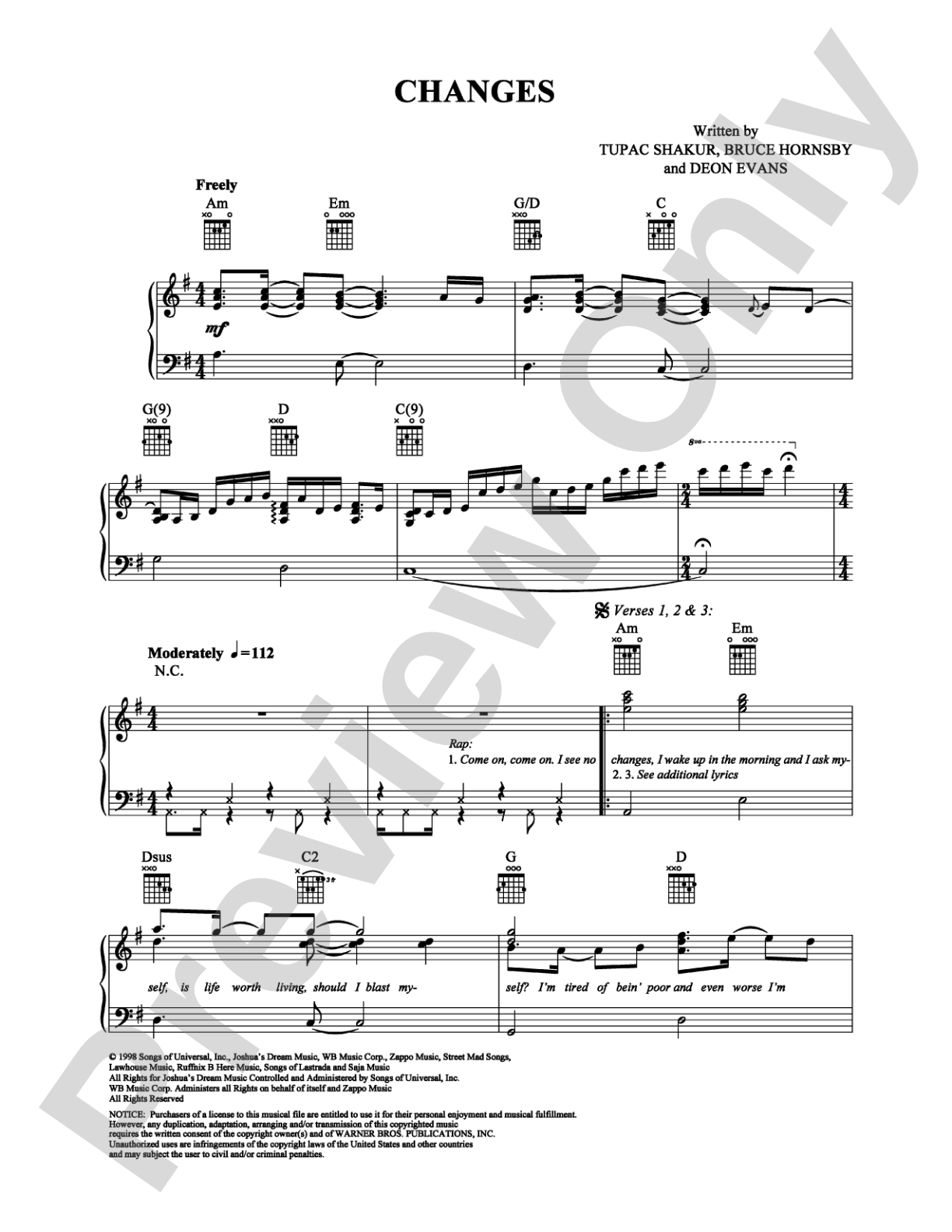
Changes: Piano/Vocal/Chords Digital Sheet Music

Changes: Piano/Vocal/Chords Digital Sheet Music

Bruce Hornsby, Tupac Shakur, Deon Evans

Item: 00-PS-0001540

Digital Download
$2.95
Description

Changes: Piano/Vocal/Chords Digital Sheet Music isn't in MakeMusic Cloud just yet...but it could be. Let us know you'd like to see it, and you'll help shape what comes next. In the meantime, start a free trial and dive into thousands of interactive titles your students can play along with today.

Sample Audio
No sample audio found.
Sample Video
Additional Details
SKU: 00-PS-0001540

More about this title

About the Artist: Tupac Shakur

Tupac Shakur (1971, 1996) was a rapper, actor, and poet whose work shaped hip-hop and popular culture during the 1990s. His lyrics addressed social inequality, violence, and personal struggle with rare emotional depth for the genre, making his catalog relevant far beyond commercial success.

As a musical figure in education, Tupac represents a bridge between poetry and performance. His compositions invite serious engagement with narrative structure, internal rhyme schemes, and the relationship between spoken word and instrumental accompaniment, skills that transfer across musical disciplines.

Why we love this

Changes bridges the gap between contemporary popular music and traditional piano/vocal study by offering a song students actually want to learn. The piano/vocal/chords arrangement gives pianists and singers a legitimate path into hip-hop literature, while the lyrical depth rewards close listening and interpretation in performance.

What to expect

A moment of reflection wrapped in rhythm. The song carries the weight of personal and communal struggle, moving between introspection and hope. Piano and voice together create an intimate setting for a message that refuses to look away from difficult truths.

Who it's for

Pianists and singers interested in contemporary music that goes beyond traditional popular song standards. This arrangement works for intermediate to advanced students who want to expand their repertoire into hip-hop and popular music with literary and social substance.

How to get the most out of it

  • Study the original recording to understand the song's emotional arc and phrasing conventions in rap delivery; this informs how you shape the melody and support the vocalist's interpretation.
  • Balance the piano accompaniment to stay behind the vocal line rather than competing with it; the chords provide harmonic foundation, not decoration.
  • Work with the vocalist on breath placement and articulation that honors both the rap cadence and the melodic contour written in the score.
  • Use dynamics to emphasize the song's message; allow quieter moments to land with intention and build intensity where the lyrical content demands it.

How to use it

Consider this for a concert exploring social justice themes in music, pairing it with art songs or contemporary works that grapple with similar material. It also serves as a bridge piece for recitals that blend classical and popular traditions, signaling to audiences that great music exists across genres.

Skills your students will build

  • Interpreting contemporary vocal phrasing within a written score
  • Understanding hip-hop as a serious compositional and lyrical tradition
  • Coordinating piano accompaniment with rap/spoken delivery
  • Reading and performing from chord charts alongside traditional notation
  • Emotional and narrative interpretation of socially conscious lyrics

You May Also Like