
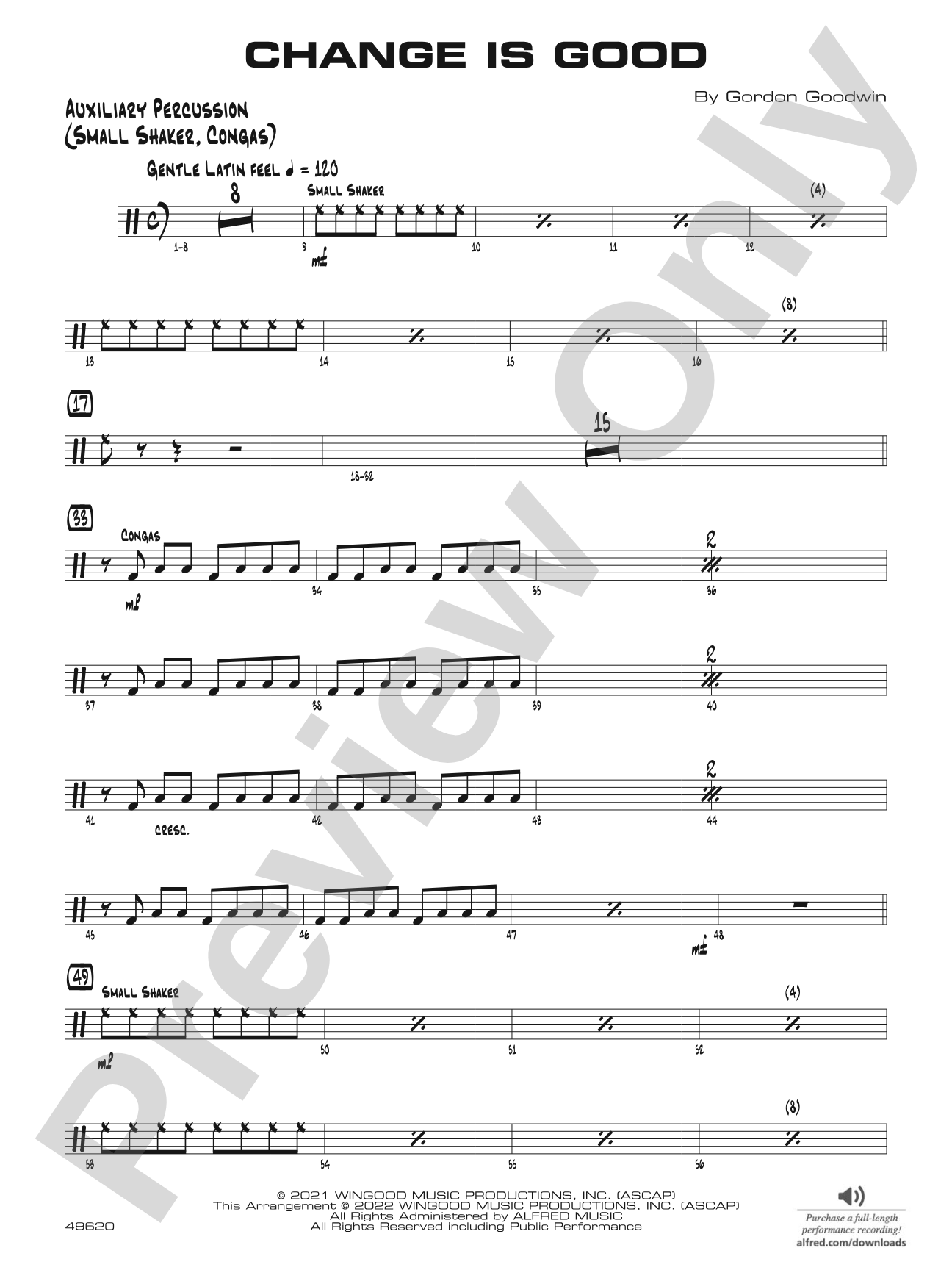

Change Is Good: Auxiliary Percussion
By Gordon Goodwin
Grade: 3.5
Item: 00-PC-0018848_APC
$3.00
Pickup currently not available
Description
A Latin straight-eighth groove played at 125 BPM. Lead trumpet range is to written G-sharp on the staff, suggested written solos provided for flexibility for C, B-flat, E-flat, and bass clef instruments. Includes auxiliary percussion and vibes. Change Is Good by Gordon Goodwin is a refreshing and mellow chart that will appeal to everyone. (5:27)


Don't just read it, hear it, play along with it, and watch your students grow with it. In MakeMusic Cloud, Change Is Good: Auxiliary Percussion comes alive with professional accompaniment, adjustable tempo, and built-in practice tools that turn solo practice into real progress.
Open in the Player
Jump straight in and assign it today.
Start Your Free Trial
Open this title and explore the full library in minutes.
Sample Audio
1
Audio File
--:--
0:00
0:00
Sample Video
Additional Details
Series:
Jazz Band Series
Publisher:
Alfred Music
SKU:
00-PC-0018848_APC
More about this title
About the Composer: Gordon Goodwin

Gordon Goodwin has been composing since childhood, writing complete compositions rather than fragments from the age of five. By thirteen, he had already penned his first big band chart, a precociousness that would define his career across jazz, television, and film scoring. His work on major motion pictures including Bad Boys II, Con Air, Remember the Titans, and Star Trek: Nemesis earned him three Emmy Awards and multiple Grammy nominations.
Beyond Hollywood, Goodwin has arranged and performed with some of music's most distinguished artists, from Quincy Jones and Ray Charles to Christina Aguilera and David Foster. Since 2000, he has led Gordon Goodwin's Big Phat Band, a Los Angeles-based ensemble that has become a Grammy-nominated force in contemporary jazz. His dual mastery of composition and orchestration continues to set the standard for big band writing in the twenty-first century.
Why we love this
Goodwin's writing here strikes an unusually difficult balance: it feels completely accessible to a 3.5-level ensemble yet avoids any suggestion of simplification. The Latin straight-eighth groove sits naturally under the band's sound, and the generous solo vehicle options (five different transpositions) mean your soloists won't spend rehearsal time scrambling to adapt the part to their instrument. This is the kind of chart that plays well without becoming a concert staple by overexposure.
What to expect
Change Is Good settles into a warm, unhurried groove that feels both contemporary and deeply rooted in jazz tradition. The vibraphone and percussion colors give the piece a breezy sophistication, while the straight-eighths Latin feel provides enough rhythmic interest to keep the band engaged without turning the chart into a feature showcase.
Who it's for
Jazz ensembles at the intermediate level who need a chart that sounds sophisticated without demanding virtuosic chops. The multiple solo options make it equally valuable for a program with strong soloists across several instruments or an ensemble still developing its solo roster.
How to get the most out of it
- Lock the straight-eighth feel early. The 125 BPM Latin groove needs to sit on the beat without rushing; have the rhythm section rehearse independently first to establish the pocket before the full band joins.
- Balance the auxiliary percussion and vibes carefully during arrangement runs. These colors can disappear in full sound or overwhelm the ensemble depending on seating; use a walk-through to find the right dynamic level for each section.
- Feature the solos strategically. With five transposition options built in, choose which soloists take which solo ahead of time rather than improvising on the fly, which keeps the arrangement's architecture clear.
- Emphasize the mellowness Goodwin baked into the harmonies. This isn't a hard-charging Latin chart; let the voicings breathe and resist the urge to drive the tempo.
How to use it
Program this mid-set to shift the energy after a more demanding opening chart. Its five-and-a-half-minute length and mellow character make it ideal as a palate cleanser before moving into uptempo closers, and the built-in flexibility means you can rotate soloists across multiple performances without rewriting parts.
Skills your students will build
- Playing straight-eighth feels in a Latin context
- Responding to vibraphone and auxiliary percussion colors without losing ensemble balance
- Executing the suggested solo adaptations for C, B-flat, E-flat, and bass clef transpositions
- Maintaining a relaxed, behind-the-beat phrasing typical of contemporary jazz writing