
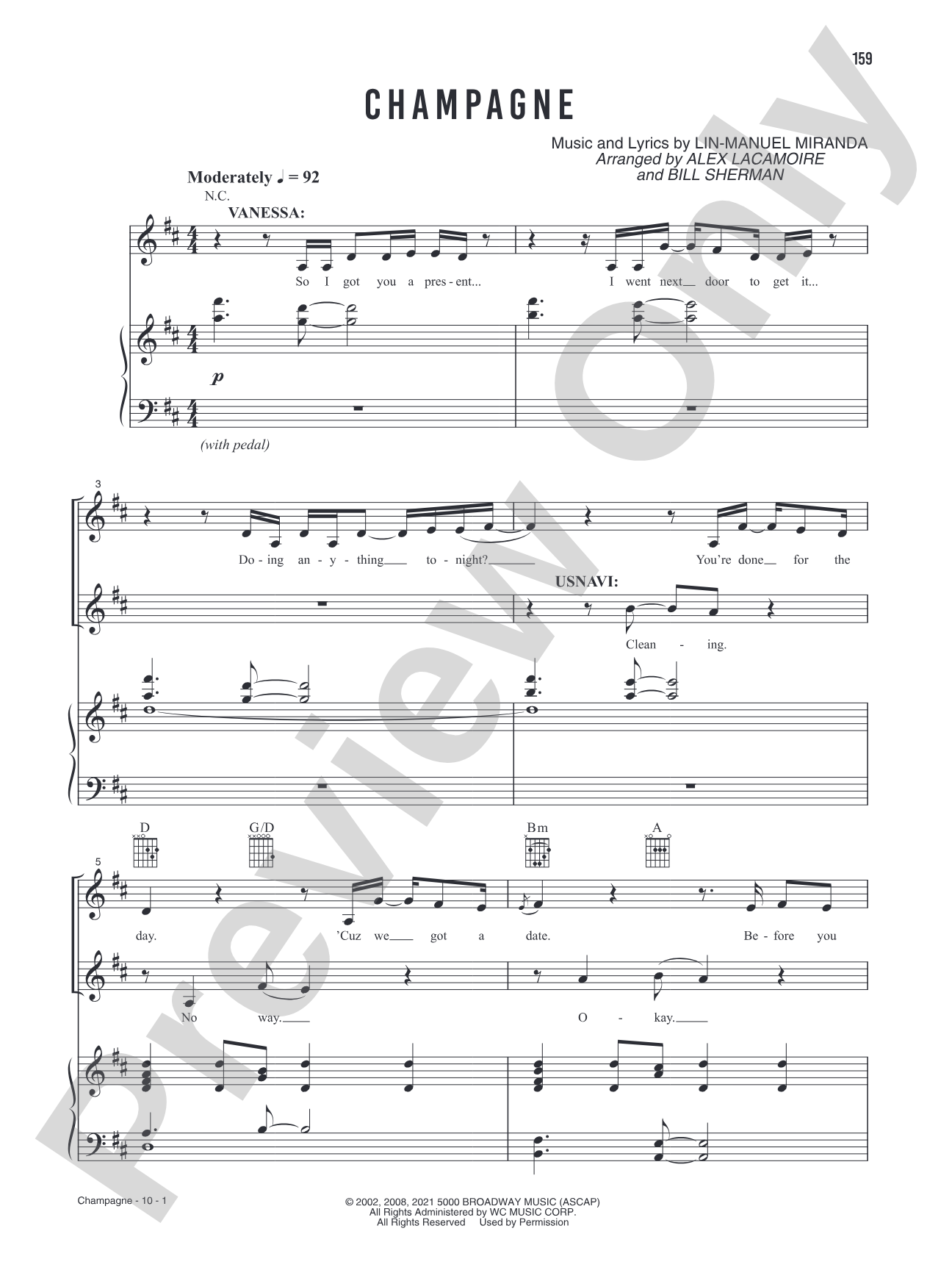
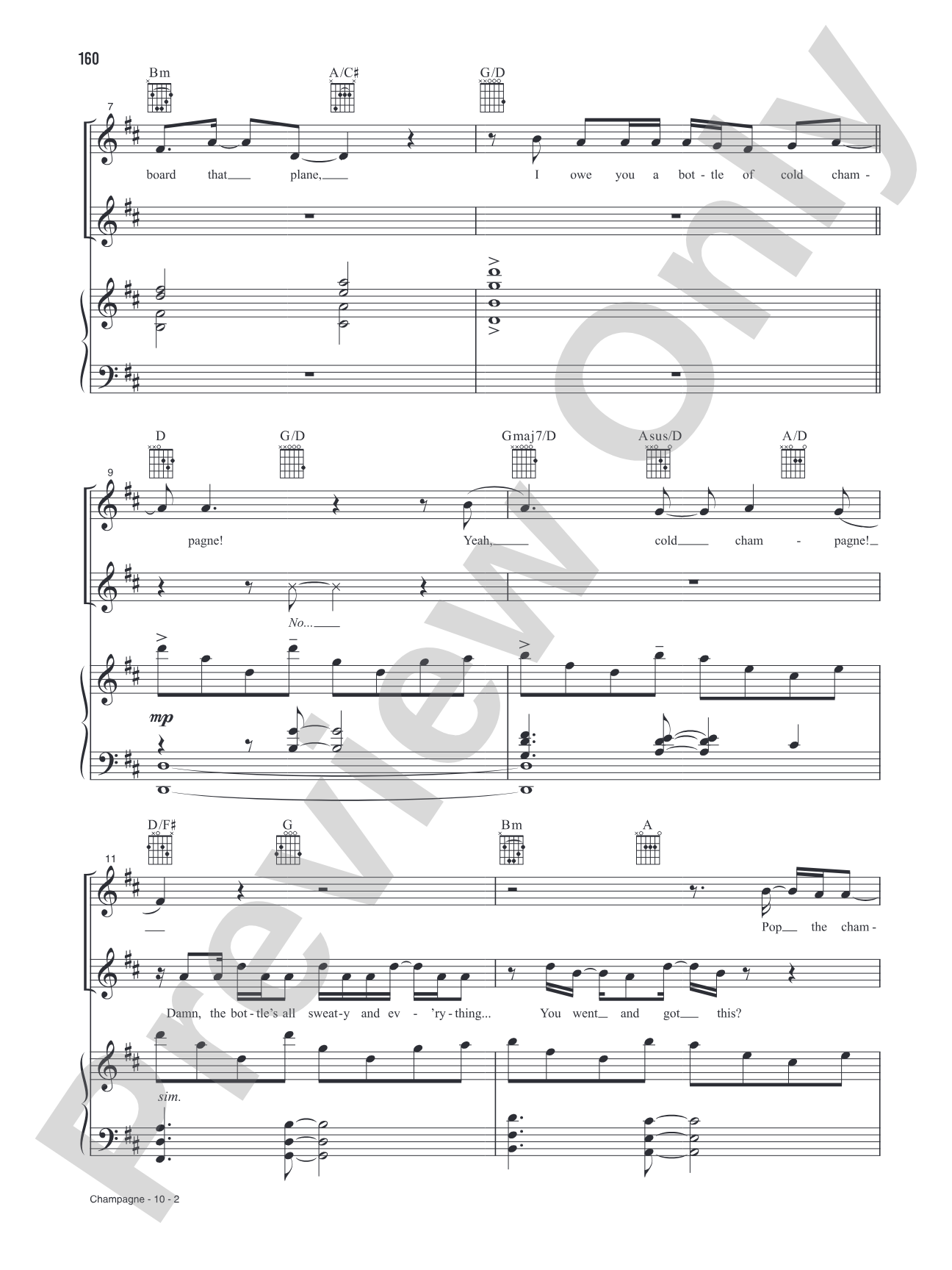

Champagne (Music from the Original Motion Picture Soundtrack, In The Heights): Piano/Vocal/Guitar
Music from the Original Motion Picture Soundtrack
Music and Lyrics by Lin-Manuel Miranda
Item: 00-PS-0016381
$4.99
One moment…
Related Items
In The Heights (Music from the Original Motion Picture Soundtrack, In The Heights): Piano/Vocal/Guitar |
$4.99
|
View | |
Breathe (Music from the Original Motion Picture Soundtrack, In The Heights): Piano/Vocal/Guitar |
$4.99
|
View | |
¡No Me Diga! (Music from the Original Motion Picture Soundtrack, In The Heights): Piano/Vocal/Guitar |
$4.99
|
View | |
It Won't Be Long Now (Music from the Original Motion Picture Soundtrack, In The Heights): Piano/Vocal/Guitar |
$4.99
|
View | |
96,000 (Music from the Original Motion Picture Soundtrack, In The Heights): Piano/Vocal/Guitar |
$4.99
|
View | |
Piragua (Music from the Original Motion Picture Soundtrack, In The Heights): Piano/Vocal/Guitar |
$4.99
|
View | |
When You're Home (Music from the Original Motion Picture Soundtrack, In The Heights): Piano/Vocal/Guitar |
$4.99
|
View | |
Blackout (Music from the Original Motion Picture Soundtrack, In The Heights): Piano/Vocal/Guitar |
$4.99
|
View | |
¡Paciencia Y Fe! (Music from the Original Motion Picture Soundtrack, In The Heights): Piano/Vocal/Guitar |
$4.99
|
View | |
Alabanza (Music from the Original Motion Picture Soundtrack, In The Heights): Piano/Vocal/Guitar |
$4.99
|
View | |
When the Sun Goes Down (Music from the Original Motion Picture Soundtrack, In The Heights): Piano/Vocal/Guitar |
$4.99
|
View | |
Home All Summer (Music from the Original Motion Picture Soundtrack, In The Heights): Piano/Vocal/Guitar |
$4.99
|
View | |
In The Heights: Piano/Vocal/Guitar Book |
$24.99
|
View |
Description
From the creator of Hamilton, and the director of Crazy Rich Asians we invite you to a cinematic event where the streets are made of music and little dreams become big . . . In The Heights. Our piano/vocal selections songbook features 13 songs from the 2021 film based on the four-time Tony Award-winning show. Original, full-color photography and movie artwork are included within this beautifully packaged portfolio. Lin-Manuel Miranda's kinetic music and lyrics capture a world very much of its place, but universal in its experience. Titles: In The Heights * Breathe * ¡No Me Diga! * It Won't Be Long Now * 96,000 * Piragua * When You're Home * Blackout * ¡Paciencia Y Fe! * Alabanza * When the Sun Goes Down * Champagne * Home All Summer


Champagne (Music from the Original Motion Picture Soundtrack, In The Heights): Piano/Vocal/Guitar isn't in MakeMusic Cloud just yet...but it could be. Let us know you'd like to see it, and you'll help shape what comes next. In the meantime, start a free trial and dive into thousands of interactive titles your students can play along with today.
Request This Title
Tell us you want it.
Start Your Free Trial
Explore everything that's ready to play right now.
Sample Audio
No sample audio found.
Sample Video
No sample videos found.
Additional Details
Publisher:
Alfred Music
Page Count:
180
SKU:
00-PS-0016381
More about this title
About the Composer: Lin-Manuel Miranda
Lin-Manuel Miranda has reshaped contemporary musical theater by bringing hip-hop, Latin music, and pop sensibilities into conversations typically dominated by traditional Broadway orchestration. His work as composer and lyricist on Hamilton changed what audiences expect from stage music, demonstrating that formal storytelling and street-level vernacular can coexist powerfully in the same work. In The Heights, which he created for the stage before adapting it for film, reflects his commitment to centering Latinx narratives and musical traditions within mainstream American entertainment.
Miranda's compositions are built on rhythmic sophistication and memorable melody. He writes with specific communities in mind while crafting songs that resonate across cultural boundaries. His approach to arranging—whether for theater or film—prioritizes clarity and accessibility without sacrificing harmonic interest or emotional depth.
Why we love this
This collection captures songs that move seamlessly between intimate storytelling and anthemic celebration, giving pianists and singers material that feels contemporary without chasing trends. The arrangements by Alex Lacamoire and Bill Sherman preserve the cinematic energy of the film while remaining playable in a recital or studio setting. Whether your student is drawn to pop-influenced harmonic language or the rhythmic drive of Latin percussion patterns, these songs reward both careful listening and fearless performance.
What to expect
These songs pulse with the energy of a New York summer: urgent, joyful, occasionally bittersweet, and deeply rooted in community. The harmonic language feels fresh and propulsive, moving away from standard pop chord progressions while remaining intuitive under the hands. Whether playing a quiet moment like 'When You're Home' or the kinetic drive of 'In The Heights,' you inhabit a world where everyday life is worthy of celebration and music itself is a form of resistance and love.
Who it's for
Pianists and vocalists studying contemporary musical theater repertoire, from strong high school students through adult learners, will find both technical challenges and emotional payoff in these arrangements. Musicians exploring hip-hop and Latin music influences within a traditional piano/vocal/guitar format gain concrete examples of how those styles integrate into modern songwriting. Studio teachers and music directors building recital programs with film or stage music will appreciate having an authoritative, beautifully presented collection from one of the most significant musical theater creators of the past decade.
How to get the most out of it
- Study the film versions alongside these arrangements to understand how rhythmic feel and percussion interact with your keyboard part; the sheet music captures melody and harmony, but the groove lives in how you phrase within the beat.
- Pay attention to syncopation in the vocal line, particularly in songs like '96,000' and 'Piragua,' where the melody rides across bar lines intentionally. Lock your accompaniment to support those displaced accents rather than fighting them.
- Balance the role of the guitar part if you're performing solo at piano. Some songs feature guitar as a rhythmic anchor; others use it as a textural layer. Decide whether you're doubling it, complementing it, or handling the full harmonic responsibility yourself.
- Let the lyrics inform your tempo and dynamics even as an instrumentalist. Lin-Manuel Miranda's words are storytelling first; his melodies follow that emotional arc. A song about waiting ('It Won't Be Long Now') moves differently than one about celebration ('Champagne').
How to use it
Build a recital around the emotional arc of the film itself: open with 'In The Heights' to establish place and energy, move through character-driven moments like 'Piragua' or 'When You're Home,' and close with a high-energy selection like 'Champagne.' These songs also work beautifully in a thematic program exploring musical theater music of the 2010s-2020s or music that centers Latinx voices and stories. Consider pairing them with related repertoire from other contemporary composers or with classical music that shares similar harmonic language; the arrangements are sophisticated enough to stand alongside more traditional art song.
Skills your students will build
- Reading syncopated rhythms and displaced vocal lines over steady harmonic accompaniment
- Executing Latin-influenced percussion patterns and rhythmic feels (montuno, tumbao) on piano
- Balancing melody, harmony, and rhythm as a pianist accompanying a singer
- Interpreting contemporary pop and hip-hop inflected harmonic language
- Sustaining ensemble feel and groove across extended phrases without a drummer or rhythm section
- Interpreting stage directions and character subtext through musical choices