Chamber Suite in D: 2nd Violin Sheet Music Preview

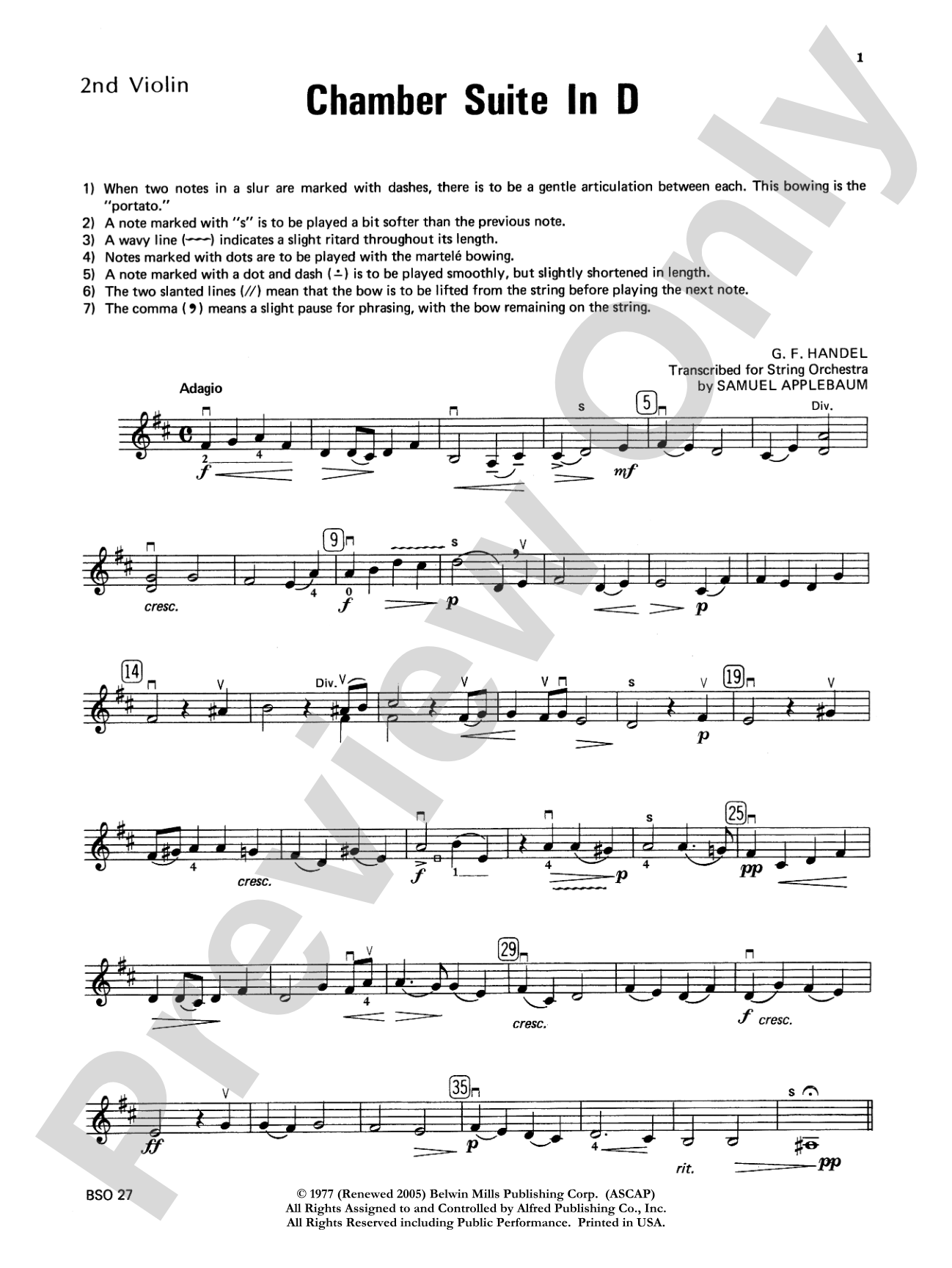
Chamber Suite in D: 2nd Violin

By George Frideric Handel / ed. Samuel Applebaum

Item: 00-PC-0002242_VN2

Digital Download
$5.99
Description

Don't just read it, hear it, play along with it, and watch your students grow with it. In MakeMusic Cloud, Chamber Suite in D: 2nd Violin comes alive with professional accompaniment, adjustable tempo, and built-in practice tools that turn solo practice into real progress.

Sample Audio
No sample audio found.
Sample Video
Additional Details
Series: Belwin Beginning String Orchestra
Publisher: Alfred Music
Page Count: 148
SKU: 00-PC-0002242_VN2

More about this title

About the Composer: G. F. Handel

George Frideric Handel (1685, 1759) was a master of vocal and instrumental writing whose music defined the Baroque era across Europe. He composed with remarkable fluency across opera, oratorio, and instrumental genres, establishing forms and textures that student musicians still learn from today. His ability to craft memorable melodies and clear harmonic progressions makes his work ideal for developing musicians seeking music of genuine artistic substance.

Why we love this

Applebaum's arrangement opens Handel's compositional language to beginning string orchestras without sacrificing the elegance and clarity that make these works endure. The suite format gives you flexibility to program individual movements or the full work, and the writing sits comfortably under the hands of younger players while maintaining the contrapuntal sophistication Handel was known for.

What to expect

These movements unfold with the refined elegance of chamber music scaled for a larger ensemble. Transparent textures let you hear the intricate voice leading, while the D major tonality gives the music an open, luminous quality that feels both formal and approachable.

Who it's for

This suite works well for beginning to early intermediate string orchestras ready to tackle Baroque repertoire with harmonic and textural depth. It's an excellent choice if you're introducing students to a composer whose music will serve them throughout their musical education.

How to get the most out of it

  • Shape the phrase lines with attention to the harmonic rhythm rather than mechanical beat divisions; Baroque phrasing often sits slightly differently than students initially expect.
  • Balance the inner voices carefully during passage work so that countermelodic lines don't disappear behind the first violin part.
  • Approach articulation with clarity and lightness; too much weight in the bow will obscure the graceful character Handel intended.
  • Listen for opportunities to shape dynamics through the arc of each movement rather than applying uniform dynamic levels throughout.

How to use it

Consider pairing individual movements with other Baroque selections to create a thematic concert, or program the complete suite as a bridge between lighter introductory material and more complex classical repertoire. It also serves as strong material for concert or festival performance when you need something substantial yet pedagogically sound.

Skills your students will build

  • Reading Baroque phrasing conventions and harmonic analysis
  • Balancing contrapuntal lines within an ensemble texture
  • Understanding period-appropriate articulation and bow control
  • Maintaining rhythmic precision while conveying stylistic character

You May Also Like