
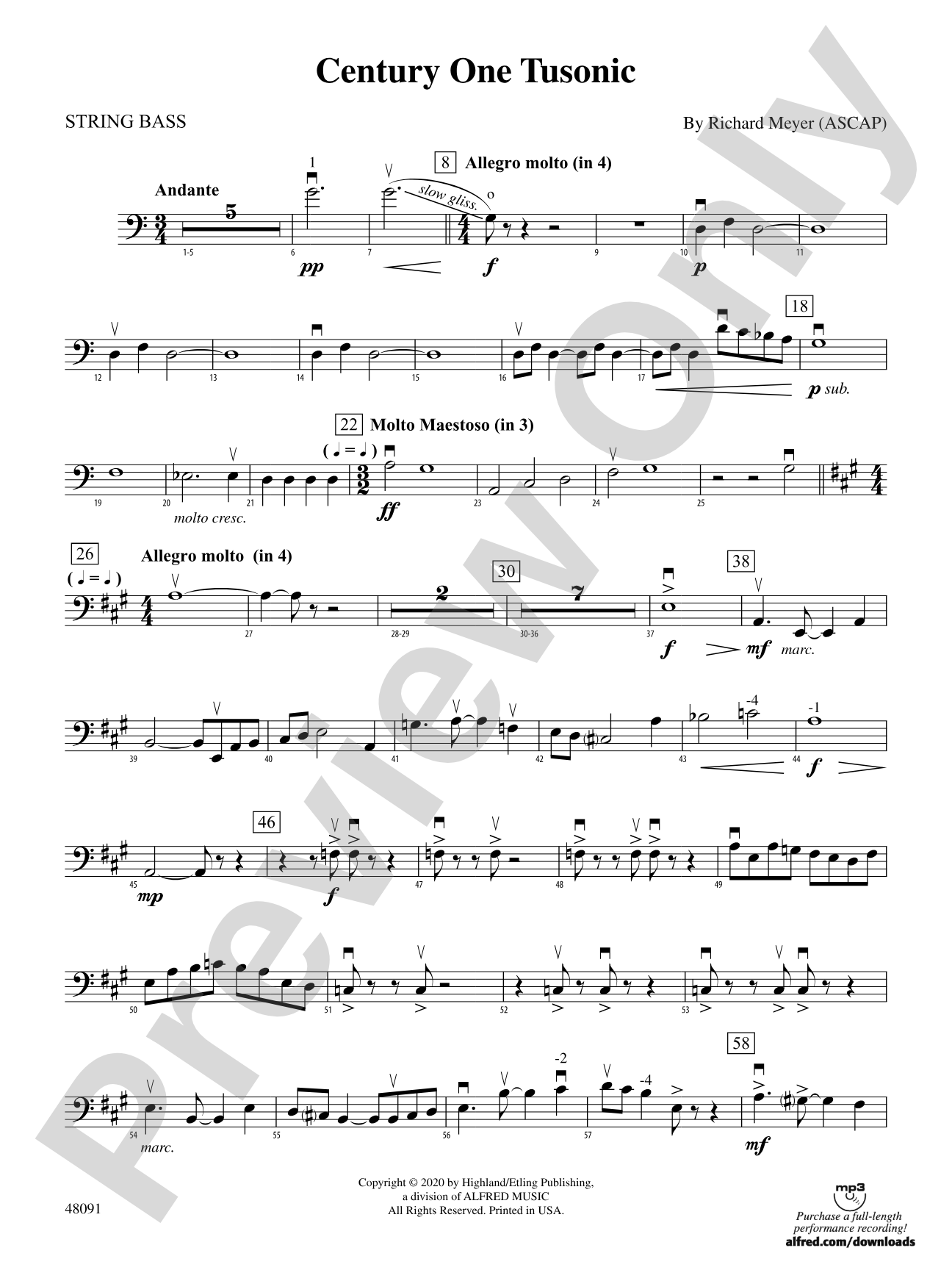

Century One Tusonic: String Bass
By Richard Meyer
Grade: 4
Item: 00-PC-0018526_SB
$3.00
Pickup currently not available
Description
Century One Tusonic by Richard Meyer will take your students on an amazing journey. This celebratory and futuristic-sounding overture is the perfect opener or closer for any concert. Tuneful, energetic, and highly emotional, the piece presents a sonic kaleidoscope of playing styles that will challenge every section of the advanced string orchestra. The unexpected harmonies and exotic rhythms give this selection a cinematic sound that is sure to intrigue your students and your audience. Brief solos for violin and cello are included. (6:00)


Don't just read it, hear it, play along with it, and watch your students grow with it. In MakeMusic Cloud, Century One Tusonic: String Bass comes alive with professional accompaniment, adjustable tempo, and built-in practice tools that turn solo practice into real progress.
Open in the Player
Jump straight in and assign it today.
Start Your Free Trial
Open this title and explore the full library in minutes.
Sample Audio
1
Audio File
--:--
0:00
0:00
Sample Video
Additional Details
Series:
Highland/Etling String Orchestra
Publisher:
Alfred Music
Page Count:
124
SKU:
00-PC-0018526_SB
More about this title
About the Composer: Richard Meyer

Richard Meyer brings three decades of string teaching experience into his compositions, having shaped orchestra programs from elementary through high school in Southern California public schools. His tenure directing orchestras at Oak Avenue Intermediate School transformed a program of 29 students into a thriving ensemble of 200, while his "Giving Bach" initiative pioneered interactive concerts for underserved communities throughout the region. Meyer has guest-conducted All-State orchestras across multiple states and served as a clinician at major conferences including the A.S.T.A. National Conference and the Texas Orchestra Directors' Association. His work as string editor for Alfred Publishing and co-author of the String Explorer Series reflects his commitment to accessible, pedagogically sound string education.
As a composer and arranger, Meyer has an active catalog of over 190 published works and maintains a schedule of guest conducting and clinical work. He led the Pasadena Youth Symphony Orchestra for 16 years, directing international performances in Vienna, Australia, Canada, and major U.S. cities. Meyer and his wife, Rose, reside in Sierra Madre, California.
Why we love this
Meyer writes string music that respects advanced players without asking them to sacrifice musicality for difficulty. The exotic harmonies and cinematic orchestration here create a piece that sounds far more ambitious than its Grade 4 level suggests, giving your students the satisfaction of performing something genuinely sophisticated while remaining within their technical reach. It's the kind of opener that commands an audience's attention from the first measure.
What to expect
Century One Tusonic unfolds like a musical journey through unfamiliar sonic territory. The piece opens with energy and celebration but pivots into moments of introspection, layering exotic rhythmic patterns and unexpected harmonies that evoke a cinematic, almost otherworldly quality. It feels forward-looking and adventurous without losing the warm, tuneful core that makes it engaging rather than austere.
Who it's for
Advanced string orchestras ready to tackle unconventional harmonic language and mixed rhythmic textures. Ensembles with strong technical facility in all sections and players who thrive on interpretive challenge will engage most fully with Meyer's compositional voice.
How to get the most out of it
- Establish the futuristic sound world early in rehearsal by having the ensemble listen to the opening section together, focusing on how Meyer layers different rhythmic elements to create energy without relying on speed.
- Highlight the featured violin and cello solos during sectionals so those players can own their moments; Meyer's solo writing is lyrical rather than showy, but it requires confident intonation and tone.
- Balance the cinematic harmonies by encouraging sustained tones with consistent vibrato across all sections; the unexpected harmonic movement will land more clearly when the sustained voices are singing through.
- Shape the piece's arc by identifying the emotional peaks and valleys in your conducting; this is celebratory music, but Meyer builds drama through contrast, not just volume.
How to use it
Position this as a season opener to signal to your audience that you're programming music with substance and artistic ambition. The 6-minute runtime makes it a strong anchor piece on a concert, and its celebratory character pairs well with both classical masterworks and contemporary pieces. Contest and festival programs benefit from its combination of technical demands and audience appeal.
Skills your students will build
- Reading and executing mixed meters and unexpected harmonic progressions
- Sustaining tone and intonation across chromatic and exotic harmonic movement
- Balancing ensemble sound across multiple rhythmic layers
- Interpreting cinematic and programmatic musical gestures without text or lyrics
- Solo performance skills (violin and cello featured parts)
- Responding to varied articulations and playing styles within a single piece