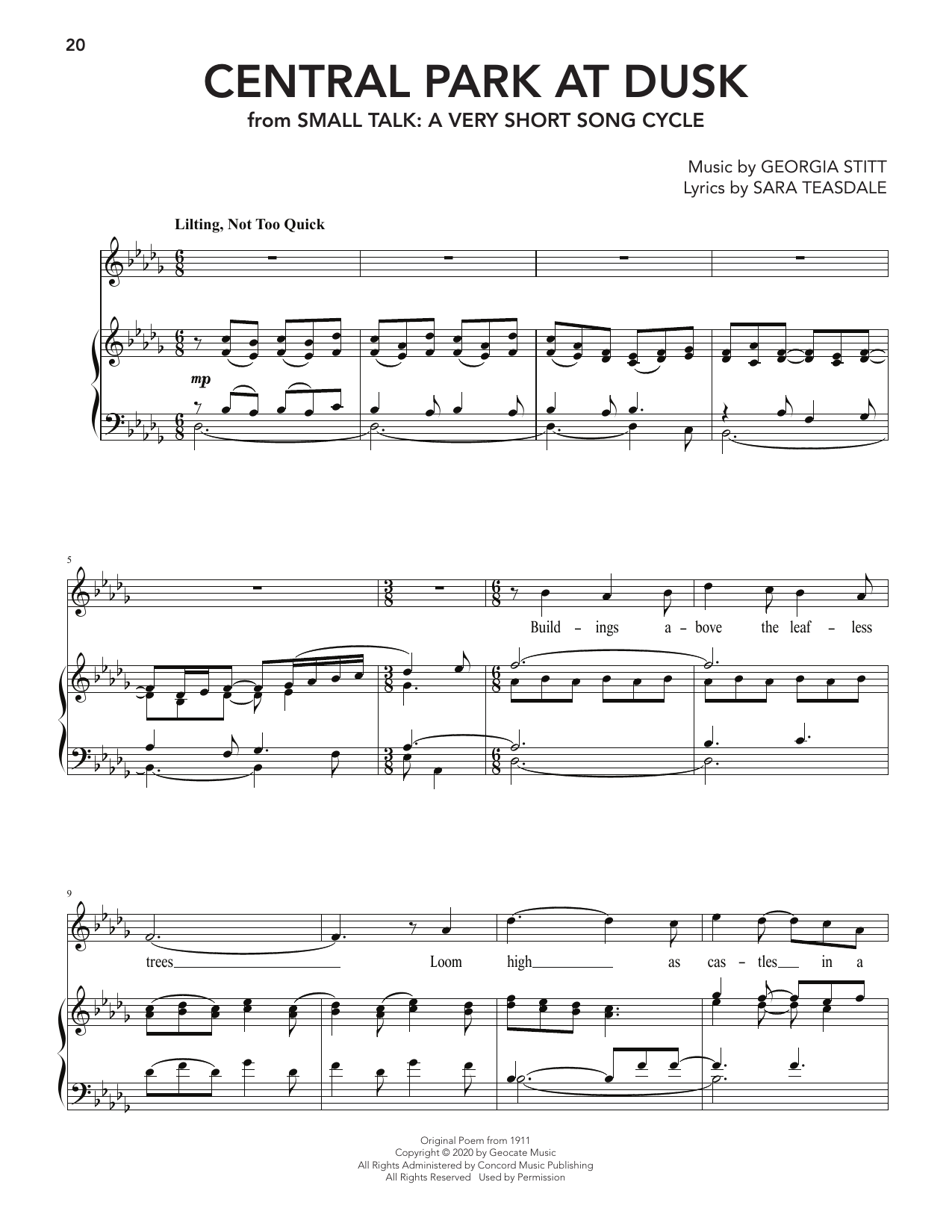
Central Park At Dusk (from Small Talk: A Very Short Song Cycle) Sheet Music Preview

Central Park At Dusk (from Small Talk: A Very Short Song Cycle): Piano Vocal

As performed by Georgia Stitt

Item: 35-DS01905434

Digital Download
$5.99
Description

Central Park At Dusk (from Small Talk: A Very Short Song Cycle): Piano Vocal isn't in MakeMusic Cloud just yet...but it could be. Let us know you'd like to see it, and you'll help shape what comes next. In the meantime, start a free trial and dive into thousands of interactive titles your students can play along with today.

Sample Audio
No sample audio found.
Sample Video
Additional Details
Publisher: Hal Leonard
Page Count: 4
SKU: 35-DS01905434

More about this title

About the Artist: Georgia Stitt

Georgia Stitt is a composer and lyricist whose work spans musical theatre, art song, and choral music. Her compositions are known for their sophisticated harmonic language, text-setting clarity, and emotional directness. Stitt's pieces are staples in vocal competitions and recital programs, valued by singers and teachers for their musicality and accessibility across multiple performance levels.

Why we love this

This movement from Small Talk captures an intimate urban moment with harmonic subtlety and a melodic line that rewards careful shaping. The four-page format makes it substantial enough to showcase vocal artistry without demanding an extensive memorization or rehearsal commitment. Stitt's text-setting respects the natural speech patterns while maintaining lyrical momentum, which means singers can focus on interpretation rather than wrestling with awkward prosody.

What to expect

Twilight stillness in a crowded city. The music moves gently between observation and feeling, with harmonic moments that catch you off guard, the way a sudden vista does. There is quiet sophistication here, not spectacle.

Who it's for

Solo singers preparing for recitals, voice studio students, and advanced high school vocalists seeking contemporary art song with literary substance. The piece suits singers with secure middle and upper range extension and the maturity to handle subtle emotional storytelling.

How to get the most out of it

  • Shape the vocal line with attention to the poetry's pacing. Stitt's accompaniment supports but does not lead; the singer's phrasing choices shape the overall arc.
  • Balance intimacy with projection in the hall. This piece works best when the audience feels they are overhearing a private moment, not watching a performance.
  • Collaborate closely with your pianist on the accompaniment's textural role. The piano is conversational, not decorative, and its rhythmic independence requires synchronized ensemble listening.

How to use it

Pair this with other art songs or art song cycles in a voice recital, or slot it into a contemporary music showcase where intimate scale amplifies rather than diminishes impact. It works equally well as a brief rest moment in a longer program or as a standalone encore after more demanding repertoire.

Skills your students will build

  • Sustaining legit vocal production across a lyrical phrase without losing textual clarity
  • Interpreting harmonic color choices and responding musically to unexpected chord movements
  • Coordinating with a pianist whose accompaniment follows independent rhythmic logic
  • Conveying narrative specificity in a short song without oversinging or sentimentality

You May Also Like