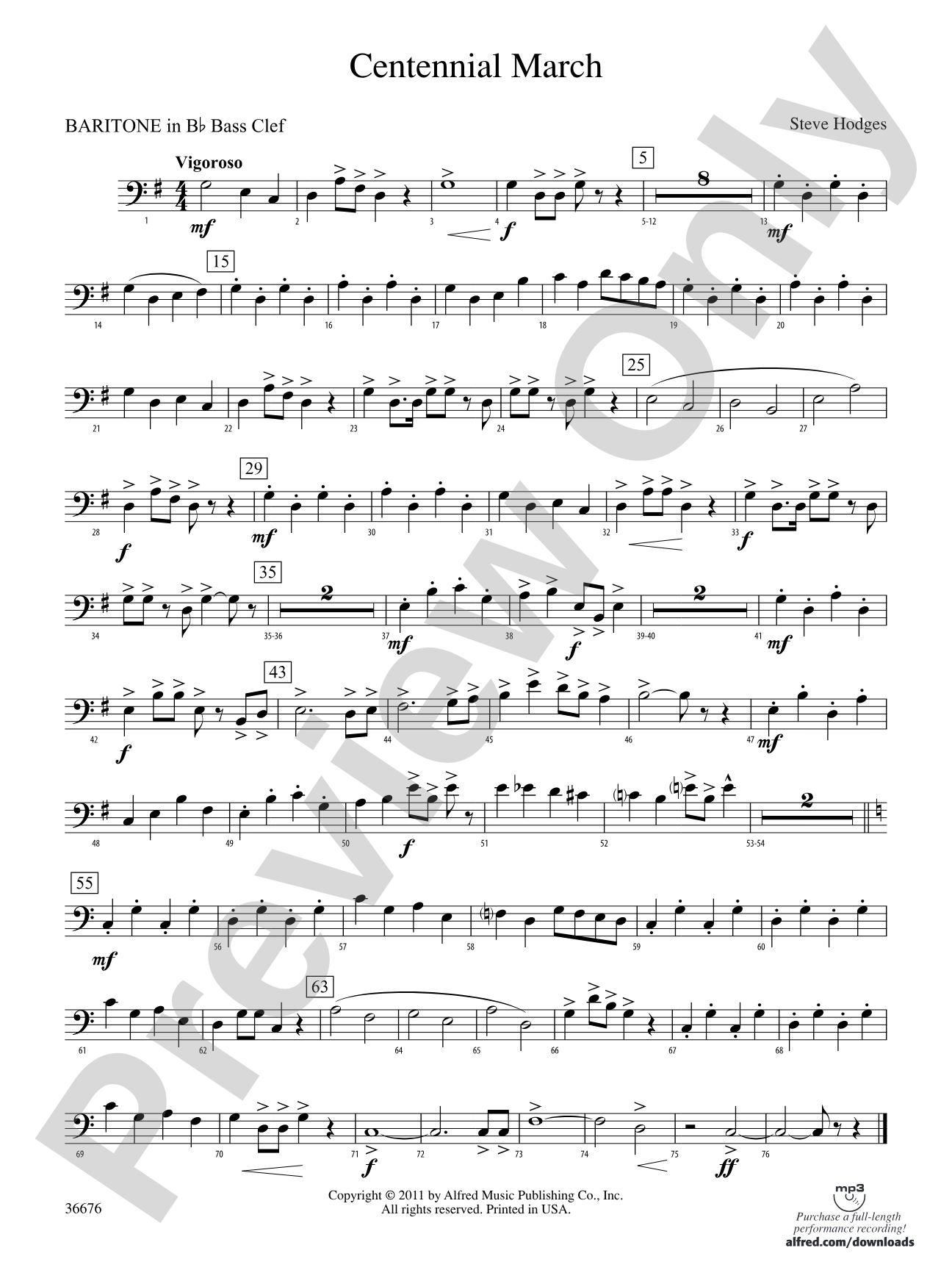
Centennial March: (wp) B-flat Baritone B.C. Sheet Music Preview

Centennial March: (wp) B-flat Baritone B.C.

By Steve Hodges

Grade: 1.5 (Easy)

Item: 00-PC-0015104_wpBBBC

Digital Download
$3.00
Description
This uplifting march begins with the clarinets presenting the melody over a single snare drum accompaniment. The textures increase as the melody is developed, leading to a heavier minor section featuring strong lines by the low brass and woodwinds. A modified "roll-off" by the percussion section leads to a seamless modulation and the final presentation of the melody. A dynamic augmentation of the melody brings the march to a stirring conclusion.

Don't just read it, hear it, play along with it, and watch your students grow with it. In MakeMusic Cloud, Centennial March: (wp) B-flat Baritone B.C. comes alive with professional accompaniment, adjustable tempo, and built-in practice tools that turn solo practice into real progress.

Sample Audio
0:00
0:00
Sample Video
Additional Details
Series: Challenger Band Series
Publisher: Alfred Music
Page Count: 122
SKU: 00-PC-0015104_wpBBBC

More about this title

About the Composer: Steve Hodges

Steve Hodges

Steve Hodges holds degrees from Western Oregon University (Bachelor of Science) and Central Washington University (Master of Music Education). Over four decades, he directed bands, choirs, and chamber ensembles across public school settings before retiring from full-time teaching.

Since 1986, Hodges has composed more than 120 concert band works published through Alfred Music, along with choral arrangements released by Staff Music and Shawnee Press. His compositions have appeared at festivals and state conventions internationally, with commissions from honor bands and schools in Virginia, Iowa, Winnipeg, British Columbia, Oregon, Washington, and North Carolina. His catalog has also been featured on TBS and ESPN programming. A member of ASCAP with multiple standard awards to his name, Hodges now resides in The Dalles, Oregon, where he remains active in community music alongside his wife, Teddie, and their extended family.

Why we love this

Centennial March delivers accessible march writing without sacrificing musical substance. The deliberate texture building from sparse clarinets-and-snare opening through the minor section and back to the climactic final statement gives students genuine experience with orchestration and formal development, all at a level that freshman and sophomore bands can execute cleanly.

What to expect

Centennial March has the optimistic lift of a traditional ceremonial march, opening with clarity and simplicity before growing into something more complex and dramatic. The minor section adds character and emotional depth, while the final return feels earned and celebratory.

Who it's for

This march suits developing concert bands at the 1.5 grade level, particularly ensembles building confidence with contrasting sections and ensemble balance. It works well for groups ready to explore texture and form without the technical demands of higher-grade repertoire.

How to get the most out of it

  • Balance the opening clarinet melody carefully against the single snare drum; the snare should anchor without overpowering the lyrical line.
  • Shape the transition into the minor section by allowing the low brass and woodwind lines to sing with weight; this contrast makes the return to the original melody more effective.
  • Treat the percussion roll-off as a bridge moment, not a dividing line; keep the ensemble engaged through the modulation to maintain momentum into the final statement.
  • In the closing augmentation, resist the urge to rush; let the expanded melodic contour breathe and allow dynamics to carry the weight of the conclusion.

How to use it

Program this as an opener to a concert, where its uplifting character sets a positive tone. Alternatively, place it in the middle of a set to provide contrast between more lyrical or challenging pieces, or use it as a finale for a shorter program where the stirring conclusion leaves audiences satisfied.

Skills your students will build

  • Balancing melodic and accompaniment textures
  • Executing contrasts between major and minor tonalities
  • Sustaining ensemble tone across a full range of dynamics
  • Navigating key modulations smoothly
  • Responding to orchestration changes and scoring density

You May Also Like