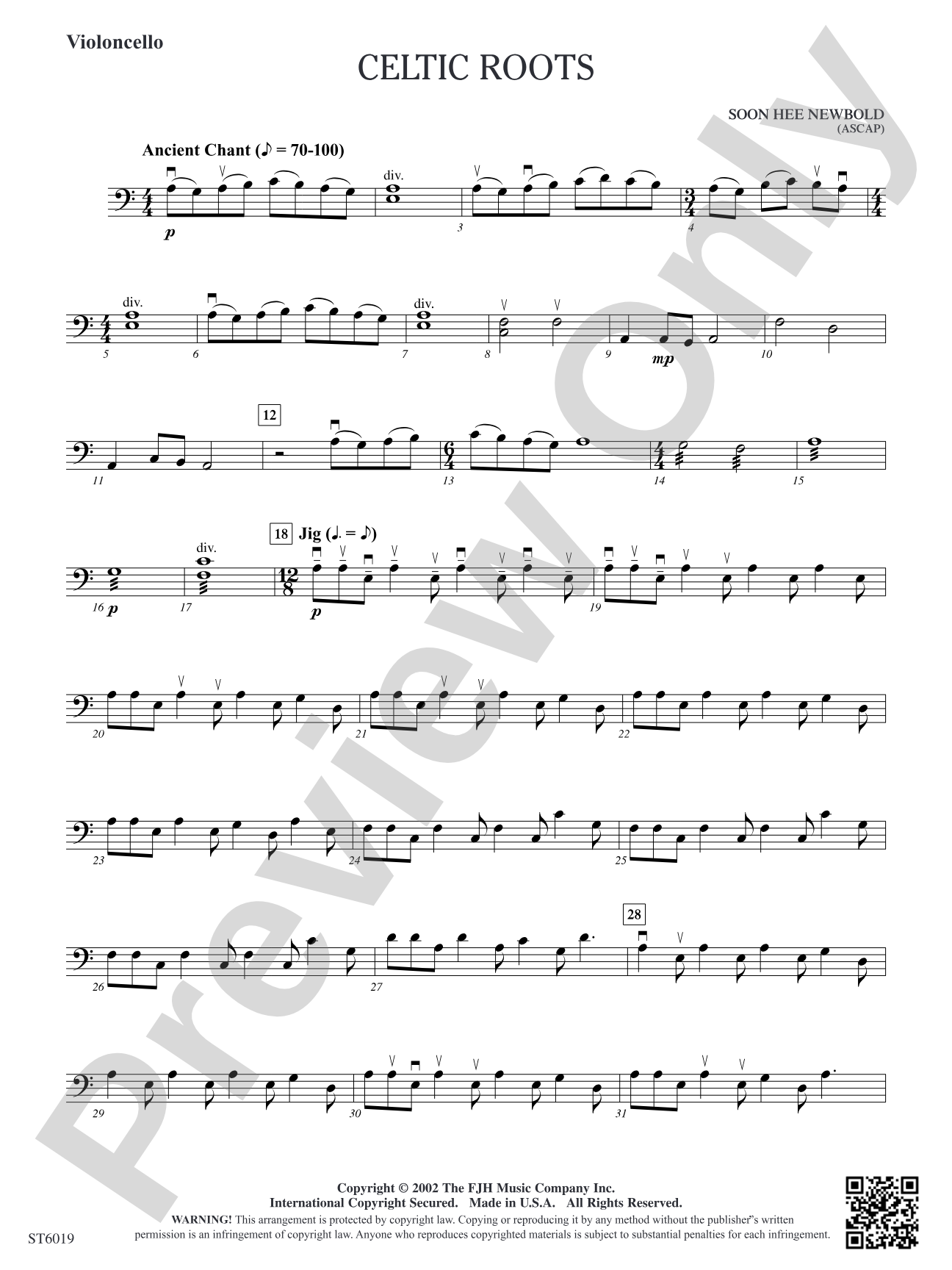
Celtic Roots: Violoncello
By Soon Hee Newbold
Grade: 3
Item: 98-PC-DST6019_VC1
Pickup currently not available
Description
Don't just read it, hear it, play along with it, and watch your students grow with it. In MakeMusic Cloud, Celtic Roots: Violoncello comes alive with professional accompaniment, adjustable tempo, and built-in practice tools that turn solo practice into real progress.
Jump straight in and assign it today.
Open this title and explore the full library in minutes.
Sample Audio
Sample Video
Additional Details
More about this title
About the Composer: Soon Hee Newbold

Soon Hee Newbold draws on a lifetime of musical immersion across multiple cultures and continents to create works that speak to ensembles at every level. Her compositional voice emerged from early training in piano and violin, followed by years performing as a concert artist and later conducting orchestras and bands in the United States, Europe, Asia, and Australia. Her ability to distill the essence of world musical traditions into accessible yet sophisticated scores has made her a sought-after clinician and keynote speaker at major festivals and conferences.
Beyond the concert stage, Newbold has extended her reach into film and recording projects as a composer and filmmaker in Hollywood. Whether writing for a professional symphony or a beginning elementary ensemble, her music consistently honors the cultural roots she draws from while meeting ensembles where they are. Her works have graced stages including Carnegie Hall, the Kennedy Center, Lincoln Center, and Disney Hall.
Why we love this
Newbold captures the rhythmic energy and melodic character of Celtic music without requiring your students to navigate overly complex fingering patterns or awkward string crossings. The solo violin part creates a natural focal point while the ensemble provides a secure harmonic and rhythmic foundation, making this an ideal vehicle for developing solo-ensemble balance and awareness in a Grade 3 setting.
What to expect
The opening invites listeners into a reflective, almost sacred space with its sparse bass and cello dialogue. The jig erupts with infectious energy and forward motion, establishing a groove that feels both ancient and immediately accessible, while the final reel accelerates into a celebration that leaves audiences grinning.
Who it's for
String orchestra directors at the Grade 3 level who want to introduce students to world music traditions while building their ability to play as both soloists and ensemble members. This work engages advanced beginners through early intermediate players, offering solo opportunity without creating a bottleneck in your rehearsal process.
How to get the most out of it
- Shape the opening chant-like section with deliberate breath pauses between phrases; let the bass and cello establish a grounded, almost liturgical quality before the tempo lifts.
- In the jig section, lock the rhythmic groove by having the ensemble maintain steady bow contact and consistent articulation; this rhythmic precision becomes the stage for the solo violin to dance over the top.
- Encourage the soloist to lean into the reel's driving energy without rushing; the final acceleration works best when it feels inevitable rather than sudden, so build momentum gradually through the third section.
- Balance the solo violin forward in rehearsals, but remember that once ensemble confidence grows, the soloist can pull back slightly and let the string orchestra's collective texture support the line.
How to use it
Program this on a concert exploring music from around the world, or pair it with other culturally inspired pieces to create a thematic set. It works equally well as a mid-concert lifter that shifts the mood toward joy and movement, and its moderate length makes it an excellent vehicle for ensemble showcase programming.
Skills your students will build
- Maintaining steady rhythm in jig and reel meters
- Balancing solo line against ensemble accompaniment
- Executing clean articulation in fast Celtic-influenced passages
- Responding to tempo changes and acceleration cues
- Listening across sections to lock ensemble groove