Celtic Dance: String Bass Sheet Music Preview

Celtic Dance: String Bass

By Mark Williams

Grade: 1

Item: 00-PC-0000337_SB

Digital Download
$5.99
Description
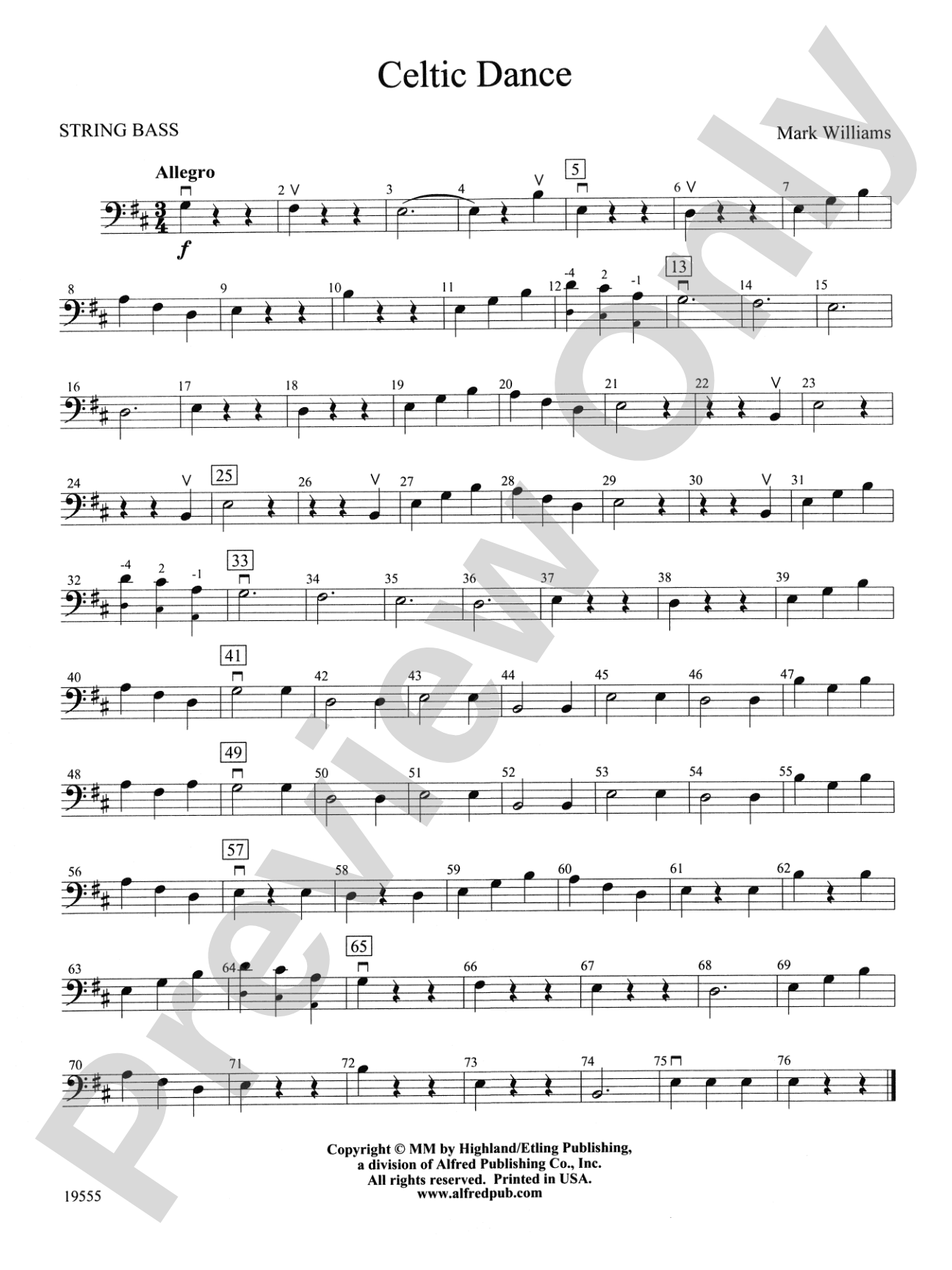
This tuneful original in the E Dorian mode will help your beginning string orchestra sound its very best. Written in 3/4 time, this engaging work uses only the notes of a one-octave D major scale (plus open E) and no eighth notes! A great introduction to 3/4 meter and modal harmonies. This title is available in MakeMusic Cloud.

Don't just read it, hear it, play along with it, and watch your students grow with it. In MakeMusic Cloud, Celtic Dance: String Bass comes alive with professional accompaniment, adjustable tempo, and built-in practice tools that turn solo practice into real progress.

Sample Audio
0:00
0:00
Sample Video
Additional Details
Series: Highland/Etling Strictly Strings
Publisher: Alfred Music
Page Count: 72
SKU: 00-PC-0000337_SB

More about this title

About the Composer: Mark Williams

Mark Williams

Mark Williams built a career composing accessible, engaging music for school orchestras and bands. With over 200 published works and degrees from Eastern Washington University, he became known for understanding exactly what young musicians need to sound confident and musical. His work as a clinician and guest conductor took him across North America and to Australia, where he observed firsthand what works in rehearsal.

Beyond the page, Williams performed bassoon professionally and served as conductor for the Spokane British Brass Band. He earned recognition including the Gralia Competition and multiple ASCAP Special Awards, cementing his reputation as a composer who could write for learners without sacrificing musicianship or joy.

Why we love this

This piece solves a real pedagogical problem: beginning string orchestras need repertoire that introduces 3/4 meter and modal harmony without overwhelming players with technical demands. Williams strips away complexity deliberately (one-octave D major scale, no eighth notes) so your focus stays on intonation, listening, and meter, not fingering patterns. The result is music that feels genuinely Irish and danceable, not like a textbook exercise.

What to expect

Bright and buoyant, with the lilt of a traditional Celtic reel. The E Dorian mode gives it a slightly exotic, minor-tinged quality that feels folk-rooted without sounding dark or melancholy. It's the musical equivalent of a skip.

Who it's for

Beginning string orchestras ready to step into meter and modal thinking without struggling with extended range or rhythmic complexity. This works equally well for third or fourth graders encountering 3/4 for the first time and for sixth graders in their first year of orchestra.

How to get the most out of it

  • Establish 3/4 firmly in your conducting before rehearsal begins. String players picking up a waltz feel for the first time need absolute clarity about where the beat lives.
  • Let the E Dorian mode breathe by emphasizing the relationship between E and the D major scale beneath it. This is the whole point of the arrangement, so highlighting that color makes the piece sing.
  • Keep the tempo dance-like and consistent. A Celtic dance lives in forward motion; drag it even slightly and the tune loses its character.
  • Balance the melody across your section carefully. With limited range, any single voice standing out will throw off the blend you've worked hard to build.

How to use it

Program this early in a concert aimed at younger audiences or families. It works beautifully as an opener to set a bright mood, or as the gateway piece before tackling more complex arrangements later in the set. Festival and contest schedules often feature Grade 1 string orchestra classes, and this title's Contest/Festival designation makes it ideal for those venues.

Skills your students will build

  • Reading and performing in 3/4 meter with a secure pulse
  • Understanding modal harmony (E Dorian mode versus major/minor tonality)
  • Matching and blending tone across limited range with precision
  • Maintaining consistent intonation in unison and simple harmonic textures
  • Building ensemble listen skills without the distraction of complex rhythms

You May Also Like