
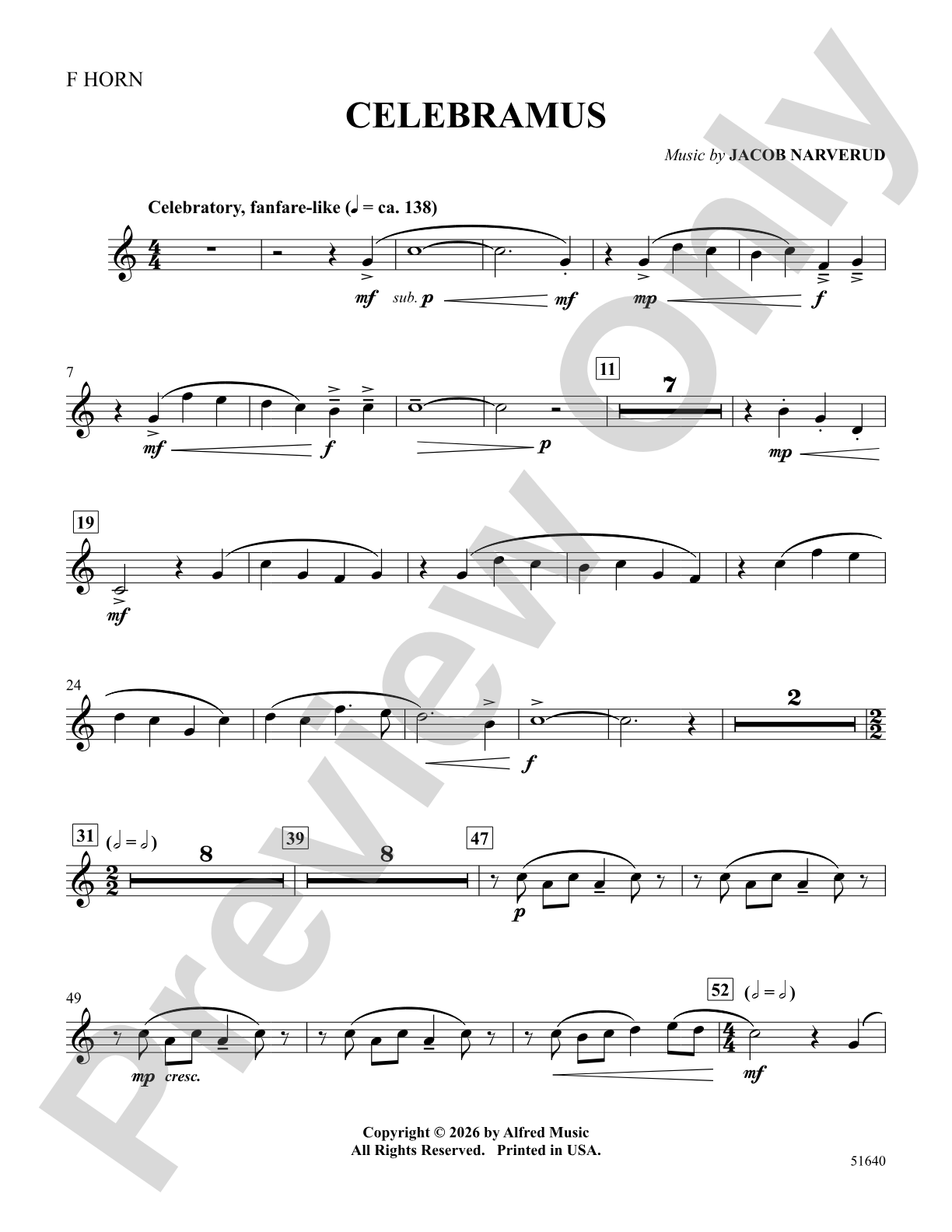

Celebramus: 1st F Horn
By Jacob Narverud
Item: 00-PC-0019723_H1
$3.00
Pickup currently not available
Description
In this impressive festival work by Jacob Narverud, a fanfare-like introduction sets an exuberant tone for the celebratory secular Latin text. Crisp, accented vocal motives echo to build layered textures before transitioning to a sophisticated B-section with legato lines. The piano accompaniment provides a solid foundation and many jubilant flourishes, with or without the optional cello and French horn obbligatos. An extraordinary selection for concert or contest!


Celebramus: 1st F Horn isn't in MakeMusic Cloud just yet...but it could be. Let us know you'd like to see it, and you'll help shape what comes next. In the meantime, start a free trial and dive into thousands of interactive titles your students can play along with today.
Request This Title
Tell us you want it.
Start Your Free Trial
Explore everything that's ready to play right now.
Sample Audio
No sample audio found.
Sample Video
No sample videos found.
Additional Details
Series:
Alfred Choral Designs
SKU:
00-PC-0019723_H1
More about this title
About the Composer: Jacob Narverud

Jacob Narverud was born in Kansas in 1986 and has established himself as one of the most frequently performed contemporary choral composers in North America. He founded and directs the Tallgrass Chamber Choir, a professional ensemble drawing singers from across the Great Plains, and serves as editor for Santa Barbara Music Publishing, bringing curatorial expertise to the works he champions in addition to his own prolific output.
Narverud's commissions span over fifty American choral organizations alongside ensembles in Australia and Japan, reflecting the international reach of his music. His compositions have become staples in concert halls and festival circuits worldwide, performed by choirs ranging from community groups to university programs. You can explore his work at jnarverud.com, Spotify, and YouTube.
Why we love this
The architecture here is impeccable. Narverud opens with genuine swagger (that fanfare feels earned, not generic), then builds momentum through layered vocal motives before shifting into a more introspective legato section that gives singers room to breathe and shine. The optional cello and French horn parts add sophistication without becoming mandatory, making this work adaptable to your ensemble's resources while the piano part remains purposeful and energetic throughout.
What to expect
The opening announces celebration with unmistakable confidence, all bright fanfare and rhythmic precision. When the layered motives pile in, the texture becomes luminous and alive; by the time you reach the B-section's legato writing, the mood deepens into something more reflective and sustained, creating real musical contrast within a single arc.
Who it's for
Choirs seeking a secular Latin text work that balances festive energy with compositional sophistication. This piece suits advanced high school, college, and community choirs preparing for concert performances or festival competition, where technical polish and musical maturity will be heard and valued.
How to get the most out of it
- Shape the opening fanfare with crisp articulation and precise rhythmic unison; the accented motives need clarity to cut through the layered texture that builds immediately after.
- Treat the B-section's legato lines as a genuine shift in character, not a simple tempo change; draw your singers' attention to the sustained quality and phrase contour before returning to the more percussive opening material.
- Balance the accompaniment thoughtfully: the piano flourishes should enhance rather than overshadow the vocal writing, and if you're using the optional cello and French horn, rehearse them separately first so the ensemble understands their role as enrichment rather than essential support.
- Lock in the rhythmic precision of the accented motives during full rehearsals; these echoing figures form the harmonic and textural backbone, and any looseness will diminish the fanfare's impact.
How to use it
This works beautifully as an opener for a concert featuring contemporary choral works, establishing energy and sophistication from your first piece. Alternatively, position it as a strong mid-program selection that bridges lighter repertoire with more substantial works, or prepare it for festival competition where its combination of technical demands and musical substance will impress adjudicators.
Skills your students will build
- Layered vocal texture awareness and blend in multi-motif writing
- Contrast in articulation and legato singing within a single work
- Rhythmic precision and accentuation in fanfare-style writing
- Latin pronunciation and text delivery in secular context
- Balanced ensemble sound when singing against optional instrumental obbligatos