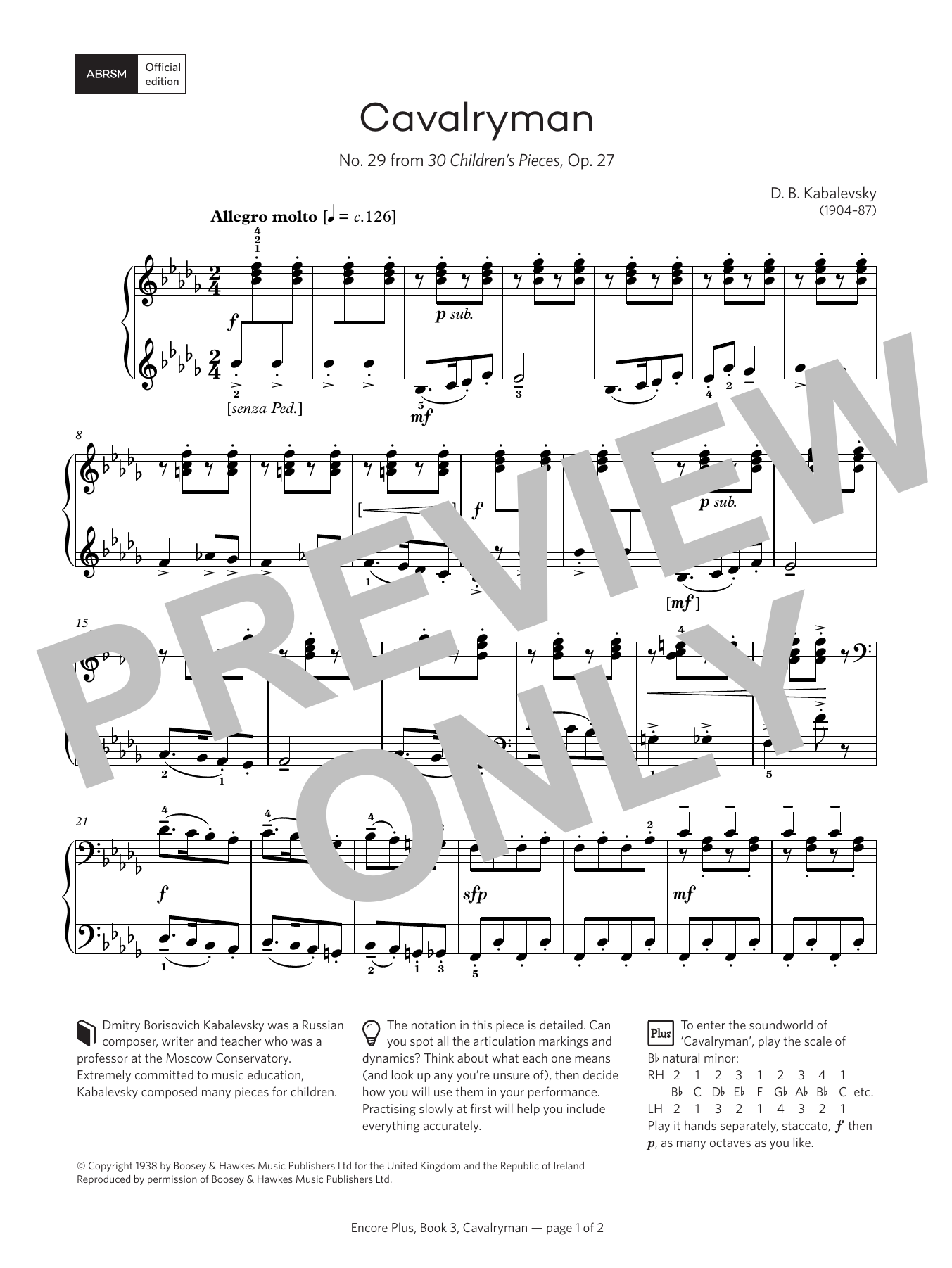
Dmitry Borisovich Kabalevsky (1904-1987) was a Soviet composer whose pedagogical vision shaped music education across generations. Beyond his symphonies and concertos, he devoted significant energy to writing accessible repertoire for young pianists, believing that children deserved music of genuine artistic merit rather than trivial exercises.
Why we love this
Kabalevsky's gift for depicting character through sparse, elegant means shines in this piece. The musical storytelling is immediate and vivid without resorting to technical pyrotechnics, making it a standout choice when you want students to experience genuine compositional craft at an intermediate level.
What to expect
A dashing, purposeful journey on horseback. The music captures both the confident swagger of a mounted rider and moments of reflection, shifting between spirited passages and more lyrical interludes that show the human side of the character.
Who it's for
Grade 5 pianists ready to interpret character pieces with musical intention. This work suits students who've mastered basic technique and want to explore how composers convey mood and narrative at an intermediate level.
How to get the most out of it
Establish a steady, confident tempo from the opening; the cavalryman's character depends on rhythmic stability and forward momentum.
Shape the dynamic contrasts deliberately rather than abruptly, allowing each phrase to breathe within the energetic character.
Balance hand independence carefully so that supporting figures don't overpower the main melodic line.
Experiment with slight rubato in the lyrical sections to add personality without sacrificing the martial quality of the piece.
How to use it
Feature this in a recital celebrating character pieces from the Romantic era forward, or pair it alongside other selections from Kabalevsky's children's collections to showcase his pedagogical mastery. It works equally well as a concert solo or as a teaching showcase when your student needs a piece that combines accessibility with genuine artistic substance.
Skills your students will build
Character interpretation and musical storytelling through contrasting sections
Dynamic shaping and phrase direction
Hand independence and texture clarity
Rubato and expressive timing within a driven tempo
You May Also Like
Scan to Complete Your Purchase
Use your phone's camera to scan the code below
You'll log in on your phone and the order will be added to your account