

Caterpillar: 2-Part Choral Octavo
Based on a poem by Christina Rossetti, music and additional words by Ruth Morris Gray
Item: 00-PO-0003575
$1.90
Minimum order quantity: 20 copies
Pickup currently not available
Description
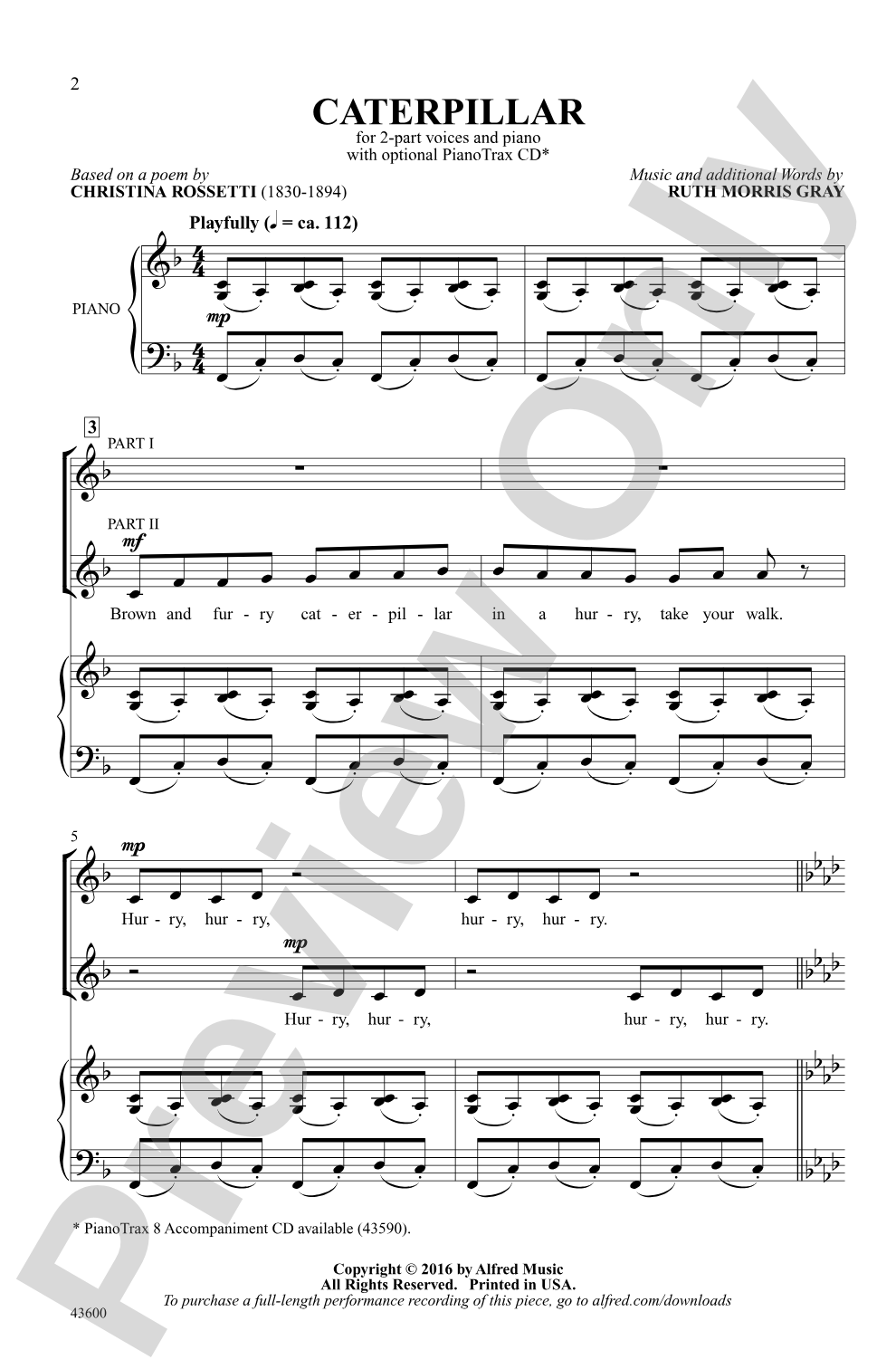
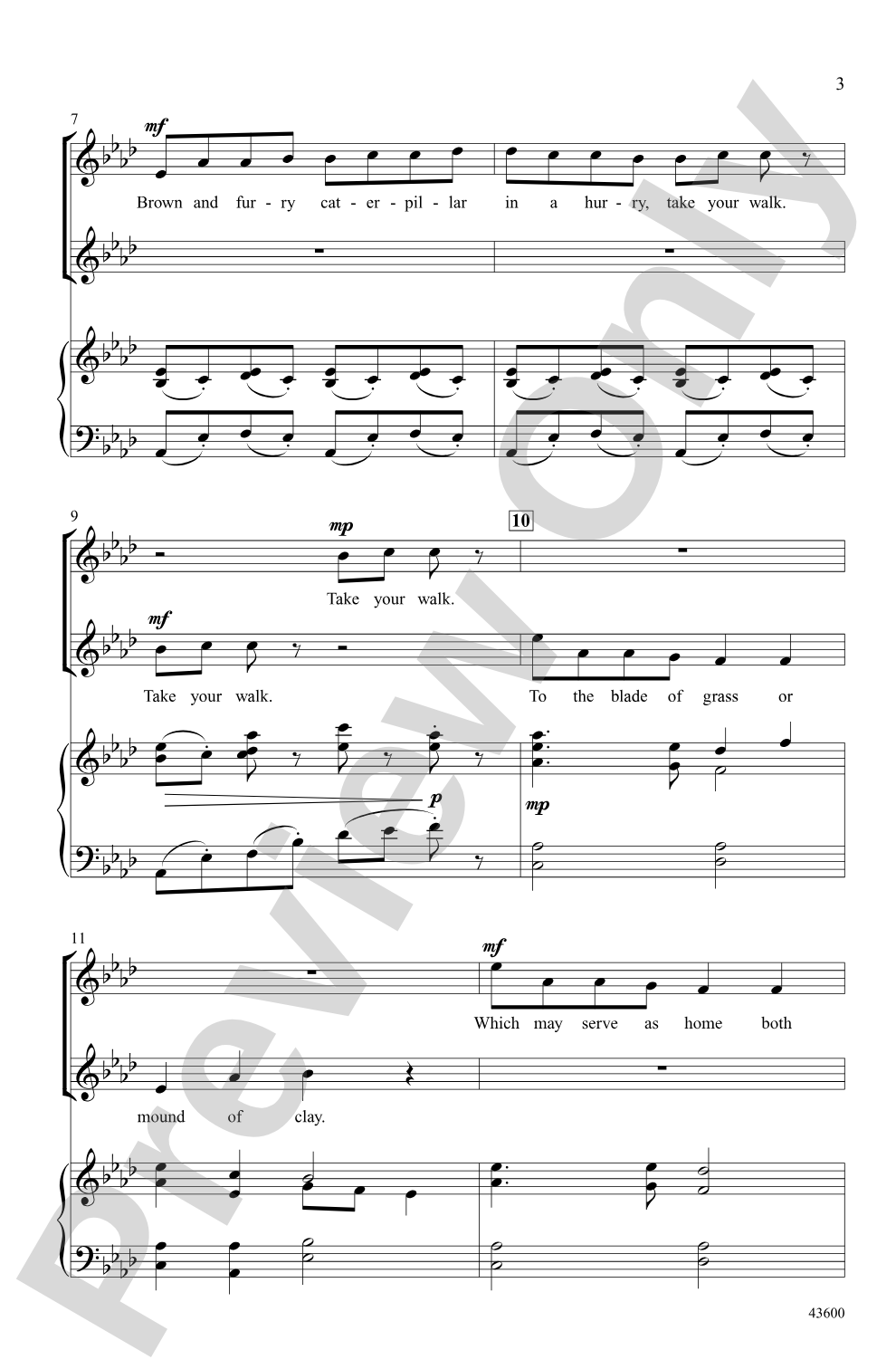
Based on a poem by Christina Rossetti, this creative treble choral will both educate and entertain. A playful piano accompaniment and agile choral parts reflect the inching of a caterpillar in motion. Sensible two-part writing allows every singer to take a turn on the main melody as well as a contrasting counterline. Delightful!


Caterpillar: 2-Part Choral Octavo isn't in MakeMusic Cloud just yet...but it could be. Let us know you'd like to see it, and you'll help shape what comes next. In the meantime, start a free trial and dive into thousands of interactive titles your students can play along with today.
Request This Title
Tell us you want it.
Start Your Free Trial
Explore everything that's ready to play right now.
Sample Audio
1
Audio File
--:--
0:00
0:00
Sample Video
Additional Details
Series:
Alfred Choral Designs
Publisher:
Alfred Music
Page Count:
8
SKU:
00-PO-0003575
More about this title
About the Composer: Ruth Morris Gray

Ruth Morris Gray has directed choirs at Rosemead High School in California since 2004, where she also teaches piano. She holds a Bachelor of Music in Piano Performance and Composition from Biola University and a Master of Arts in Music Composition from UC Santa Barbara, along with her California Single Subject Music Credential from Cal State Northridge.
With over 100 published choral compositions to her name, Gray has established herself as a prolific voice in choral literature. Her work balances musicality with accessibility, creating pieces that engage singers while serving the practical needs of directors working with students at all levels.
Why we love this
Gray captures the physical world of a poem through genuinely clever musical writing. Rather than simply setting words, she uses rhythmic motion and part-trading to embody the caterpillar's movement, which means your singers aren't just singing about something; they're enacting it. The two-part design gives every voice a moment with the melody, eliminating hierarchy and keeping engagement high across the entire choir.
What to expect
The music wiggles and creeps with genuine charm. Each part gets its turn in the spotlight, and the accompaniment stays playful throughout, never letting the mood settle into anything heavy. It reads as inventive rather than clever-for-its-own-sake, capturing something real about Rossetti's poem while keeping the mood light.
Who it's for
This piece works beautifully with younger treble choirs (middle school and early high school) and community choirs seeking accessible but sophisticated repertoire. Directors looking for concert or festival material that feels fresh and literary without requiring advanced vocal technique will find this an efficient choice.
How to get the most out of it
- Shape the rhythmic figures as discrete inching motions rather than smooth legato phrases. Think of each cluster of notes as a small forward movement, with tiny breath spaces between phrases.
- Balance the playful piano part into the blend rather than under it. The accompaniment's character is essential to the work, and singers need to hear it without straining.
- Trade the melody passage by passage between parts. Mark your scores clearly so singers know exactly when they're carrying the tune and when they're supporting, building confidence in both roles.
How to use it
Program this after a more substantial or emotionally demanding piece to reset the concert's energy and bring the audience back to lighter ground. It pairs well with other literature-based choral works on a concert themed around poetry or nature, and its modest length makes it ideal for festivals where programming time is tight.
Skills your students will build
- Two-part independence and secure part singing with frequent melody trading
- Rhythmic precision in articulated figures with attention to phrasing as small gestures
- Listening to accompaniment and blending around a partner who carries contrasting material
- Text painting and connecting musical choices to poetic imagery