
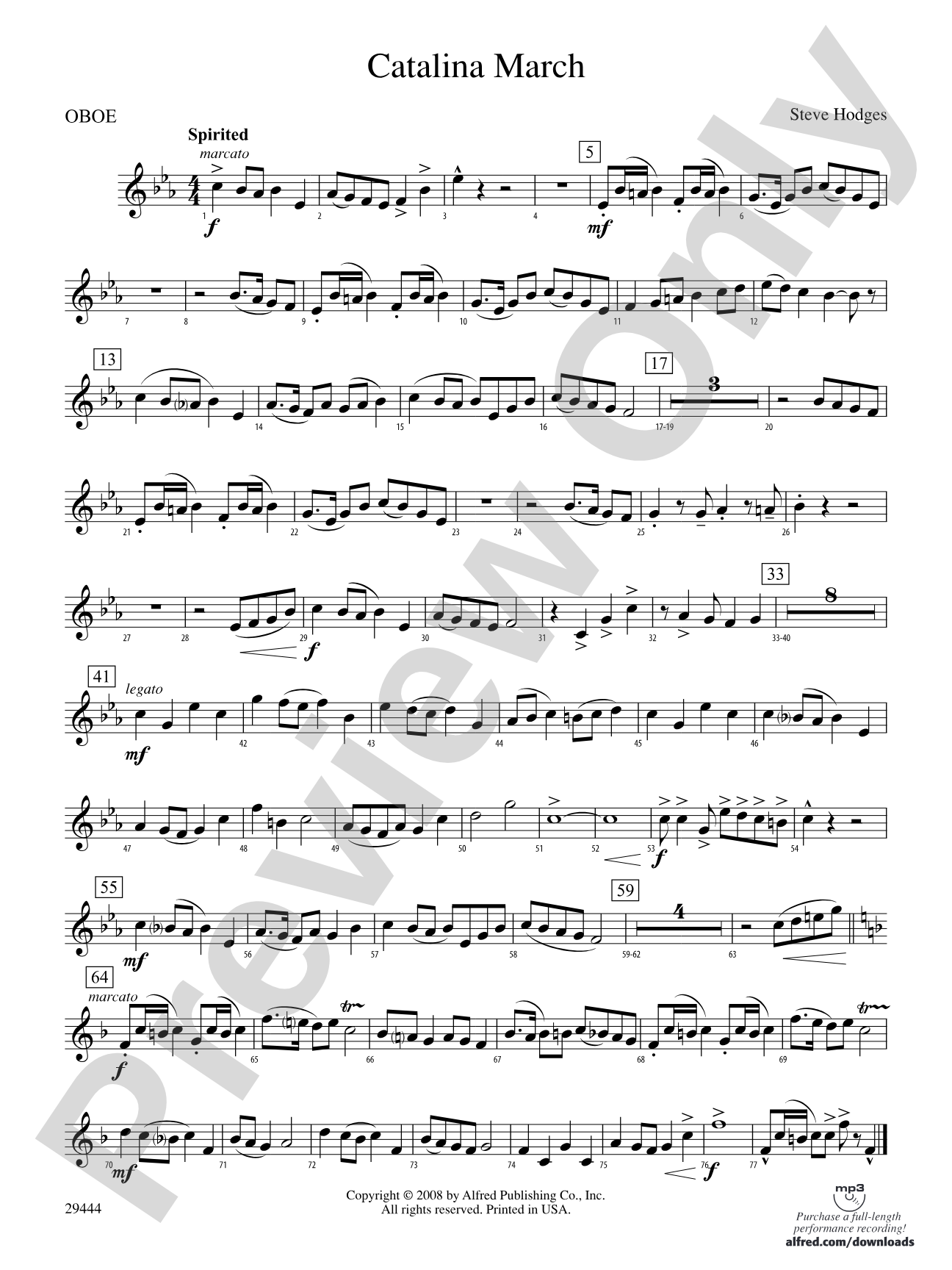

Catalina March: Oboe
By Steve Hodges
Grade: 1.5 (Easy)
Item: 00-PC-0001401_O1
$3.00
Pickup currently not available
Description
Catalina March, an original composition by Steve Hodges, contains elements of both traditional and contemporary marches. The spirited opening theme features a playful give-and-take between the brass and the upper woodwinds. A contrasting minor trio section is presented by the clarinets, saxophones and horns before returning to a charming woodwind variation of the initial presentation. Following an effective modulation, the piece finishes with a powerful restatement of the opening theme with woodwind countermelodies complementing the strong brass and percussion. This exciting march would be an excellent way to begin a concert! (2:35)


Don't just read it, hear it, play along with it, and watch your students grow with it. In MakeMusic Cloud, Catalina March: Oboe comes alive with professional accompaniment, adjustable tempo, and built-in practice tools that turn solo practice into real progress.
Open in the Player
Jump straight in and assign it today.
Start Your Free Trial
Open this title and explore the full library in minutes.
Sample Audio
1
Audio File
--:--
0:00
0:00
Sample Video
No sample videos found.
Additional Details
Series:
Challenger Band Series
Publisher:
Alfred Music
Page Count:
126
SKU:
00-PC-0001401_O1
More about this title
About the Composer: Steve Hodges

Steve Hodges holds degrees from Western Oregon University (Bachelor of Science) and Central Washington University (Master of Music Education). He spent four decades in public school music education, directing concert bands, choirs, and chamber ensembles across all ability levels before retiring from classroom teaching.
Since 1986, Hodges has composed more than 120 concert band works published by Alfred Music, along with choral arrangements released through Staff Music and Shawnee Press. His compositions have appeared at festivals and state conventions internationally, and he has received commissions from honor bands and schools across Virginia, Iowa, Winnipeg, British Columbia, Oregon, Washington, and North Carolina. His music has also been featured on TBS and ESPN broadcasts. Hodges holds membership in ASCAP and continues to engage with community music in The Dalles, Oregon, where he watches his grandchildren perform his works in their own school bands.
Why we love this
Catalina March opens a concert with immediate energy and genuine musicality, never feeling like mere filler. The interplay between brass and woodwinds in the opening statement gives each section something engaging to play, and the minor trio offers welcome contrast without losing forward momentum. Hodges balances accessibility with musical substance, making this a piece where beginning and intermediate bands sound polished and purposeful.
What to expect
Catalina March moves with the vitality and charm of a well-crafted traditional march, but with enough contemporary orchestration to keep it fresh. The piece radiates optimism and forward motion, with moments of gentle introspection in the trio before building toward a satisfying, brass-driven finale that leaves audiences energized.
Who it's for
This march works perfectly for bands at the 1.5 grade level who are developing ensemble cohesion and sectional independence. It's ideal for groups ready to program something that sounds confident without technical overreach, and for directors seeking a strong opening number that engages multiple sections equally.
How to get the most out of it
- Balance the playful brass-woodwind dialogue in the opening by having the upper woodwinds sit slightly forward; they should be conversational, not overpowered.
- Shape the minor trio as a complete musical thought with a gentle swell through the middle section; the clarinets, saxophones, and horns benefit from ensemble blend work during sectionals before full-band rehearsals.
- Articulate the return to the opening woodwind variation crisply to distinguish it from the first statement, even though the thematic material is familiar.
- Give the final restatement time to build; the woodwind countermelodies should weave through without obscuring the brass statement, so clarity in both dynamics and part balance matters here.
How to use it
Open your concert with this march to set an upbeat tone and establish ensemble confidence immediately. Its two-and-a-half-minute duration also makes it useful as a companion piece with a longer work, or as the opening salvo in a set of contrasting selections that showcase your band's range.
Skills your students will build
- Balancing independent melodic lines between brass and woodwind sections
- Maintaining steady ensemble pulse through key changes and modulations
- Executing clear articulation in contrasting sections (spirited opening, lyrical trio, powerful finale)
- Reading and performing harmonic parts that support but do not overshadow the primary melodic material