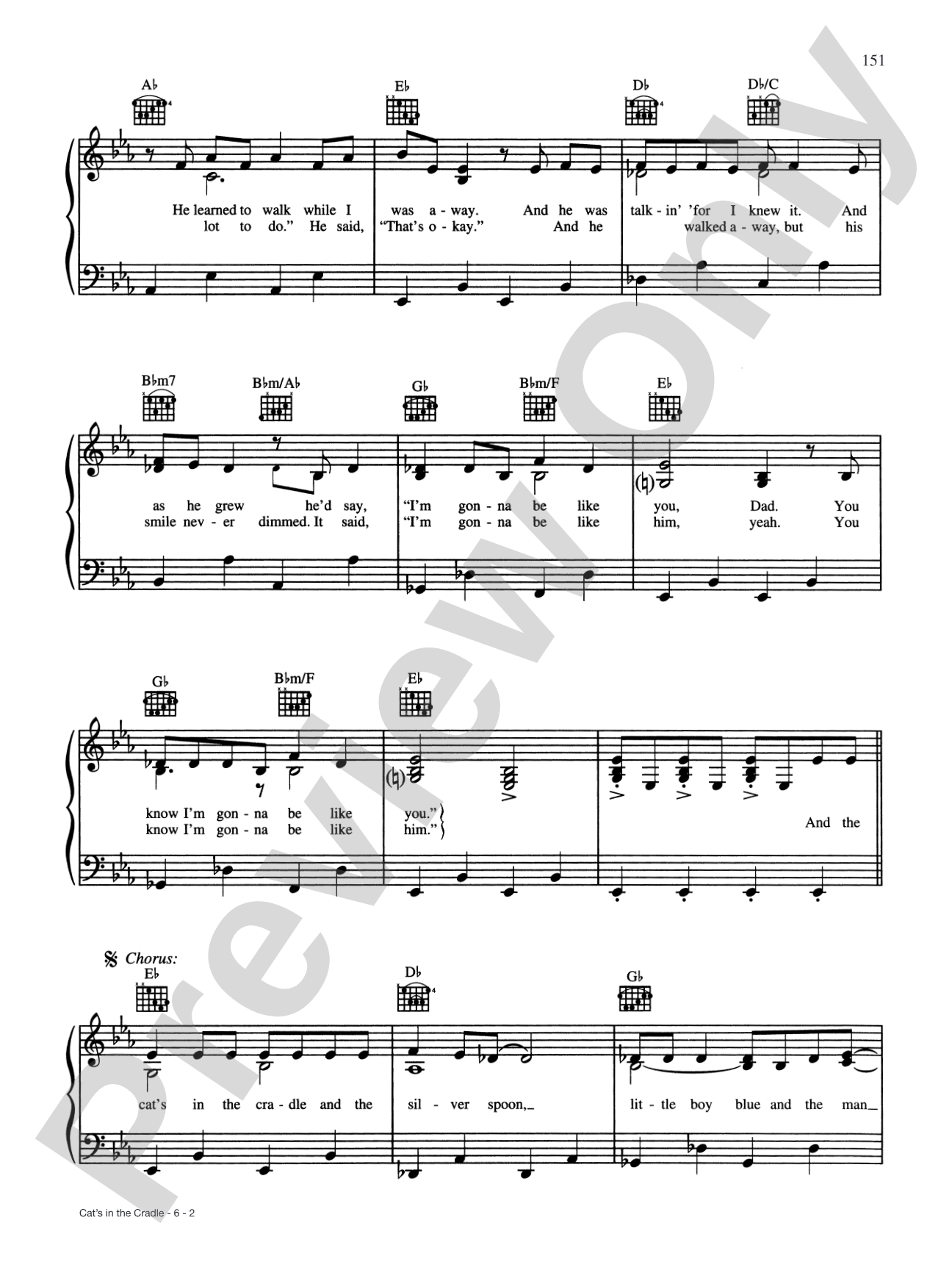
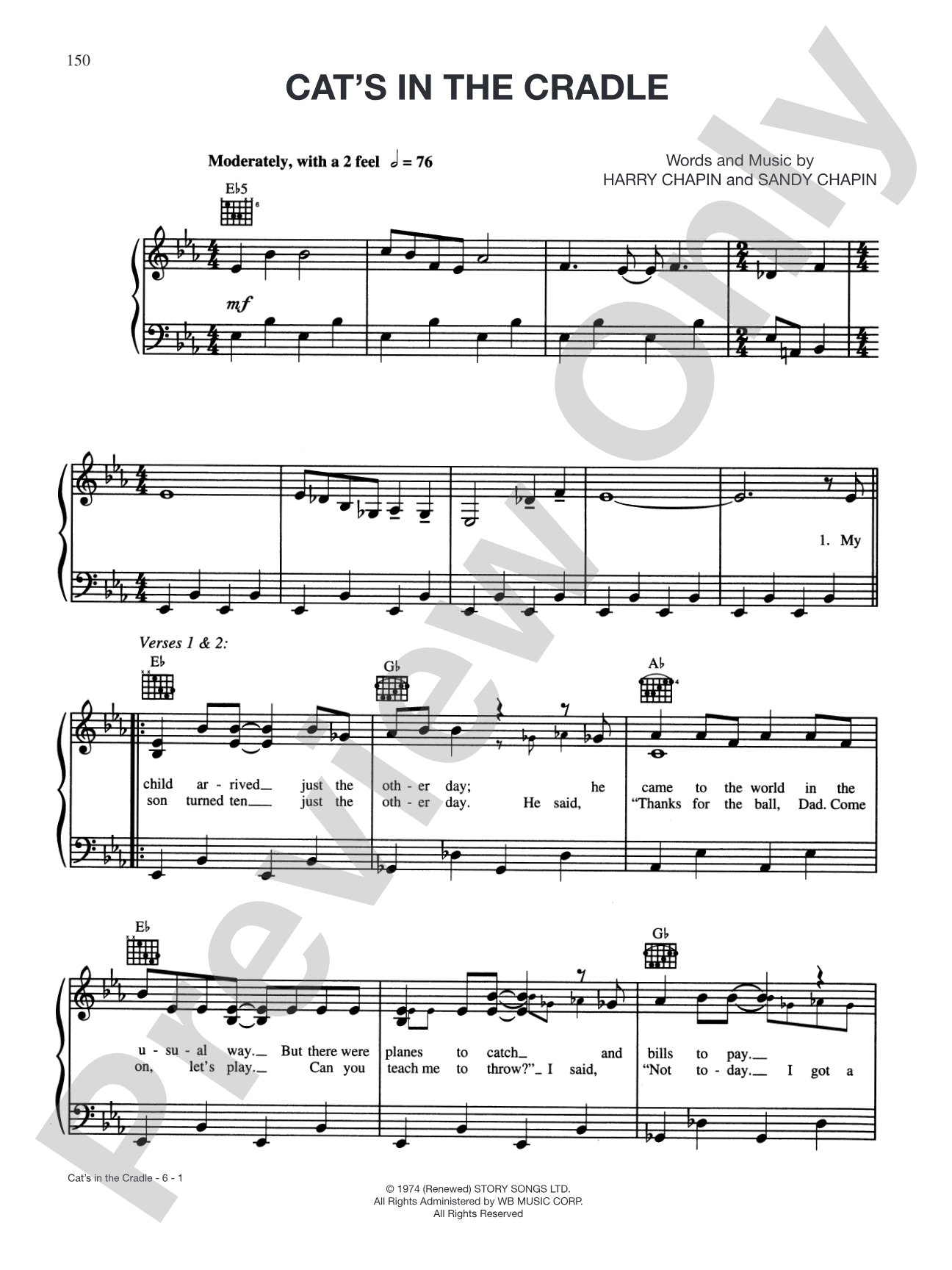
Cat's in the Cradle Sheet Music Preview

Cat's in the Cradle: Piano/Vocal/Chords

Recorded by Harry Chapin

Item: 00-PIP-000235

Digital Download
$3.99

One moment…

Description

Cat's in the Cradle: Piano/Vocal/Chords isn't in MakeMusic Cloud just yet...but it could be. Let us know you'd like to see it, and you'll help shape what comes next. In the meantime, start a free trial and dive into thousands of interactive titles your students can play along with today.

Sample Audio
No sample audio found.
Sample Video
Additional Details
Publisher: Alfred Music
Page Count: 8
SKU: 00-PIP-000235

More about this title

About the Artist: Harry Chapin

Harry Chapin (1942-1981) was a folk-pop singer-songwriter whose narrative-driven songs became anthems for a generation concerned with social issues and human connection. His gift for storytelling through music made him a fixture on radio and in concert halls throughout the 1970s, and his work remains a cornerstone of American popular music education.

Why we love this

This piano/vocal arrangement captures the emotional weight of Chapin's original while keeping the accompaniment accessible for classroom and recital settings. The song's narrative arc makes it ideal for teaching lyrical interpretation and emotional phrasing to singers who want to move beyond technical exercises into genuine storytelling.

What to expect

The music unfolds like a quiet conversation between generations, with gentle harmonic movement that underscores the poignancy of the lyrics. There's an almost conversational intimacy to the melody, supported by a piano part that feels more like accompaniment than commentary.

Who it's for

Solo singers preparing for recitals, auditions, or classroom performances will find this arrangement grounded and singable. Piano students accompanying vocalists, as well as classroom teachers using contemporary pop-folk repertoire to engage singers in meaningful interpretation, will benefit from the straightforward chart.

How to get the most out of it

  • Let the verse melody sit naturally in the singer's range; resist the urge to rush the tempo, as the conversational pacing between father and son demands space and clarity.
  • Use the chord symbols to guide harmonic movement at the piano without over-complicating the accompaniment; the song's power comes from its simplicity and emotional directness.
  • Shape dynamics carefully through the narrative sections so that the repeated musical phrases feel like genuine conversation rather than repetition.
  • Pay attention to the lyrical punctuation and phrasing marks; they will guide natural breath placement and emotional emphasis in the vocal line.

How to use it

This works beautifully as a solo feature in a mixed recital or concert where contemporary music balances classical repertoire. It also serves well in themed programs exploring storytelling in song or American musical heritage.

Skills your students will build

  • Narrative interpretation and emotional phrasing in solo vocal performance
  • Reading and executing chord symbols at the piano
  • Balancing vocal melody with supportive piano accompaniment
  • Breathing and phrasing across longer melodic lines with conversational intent

You May Also Like