
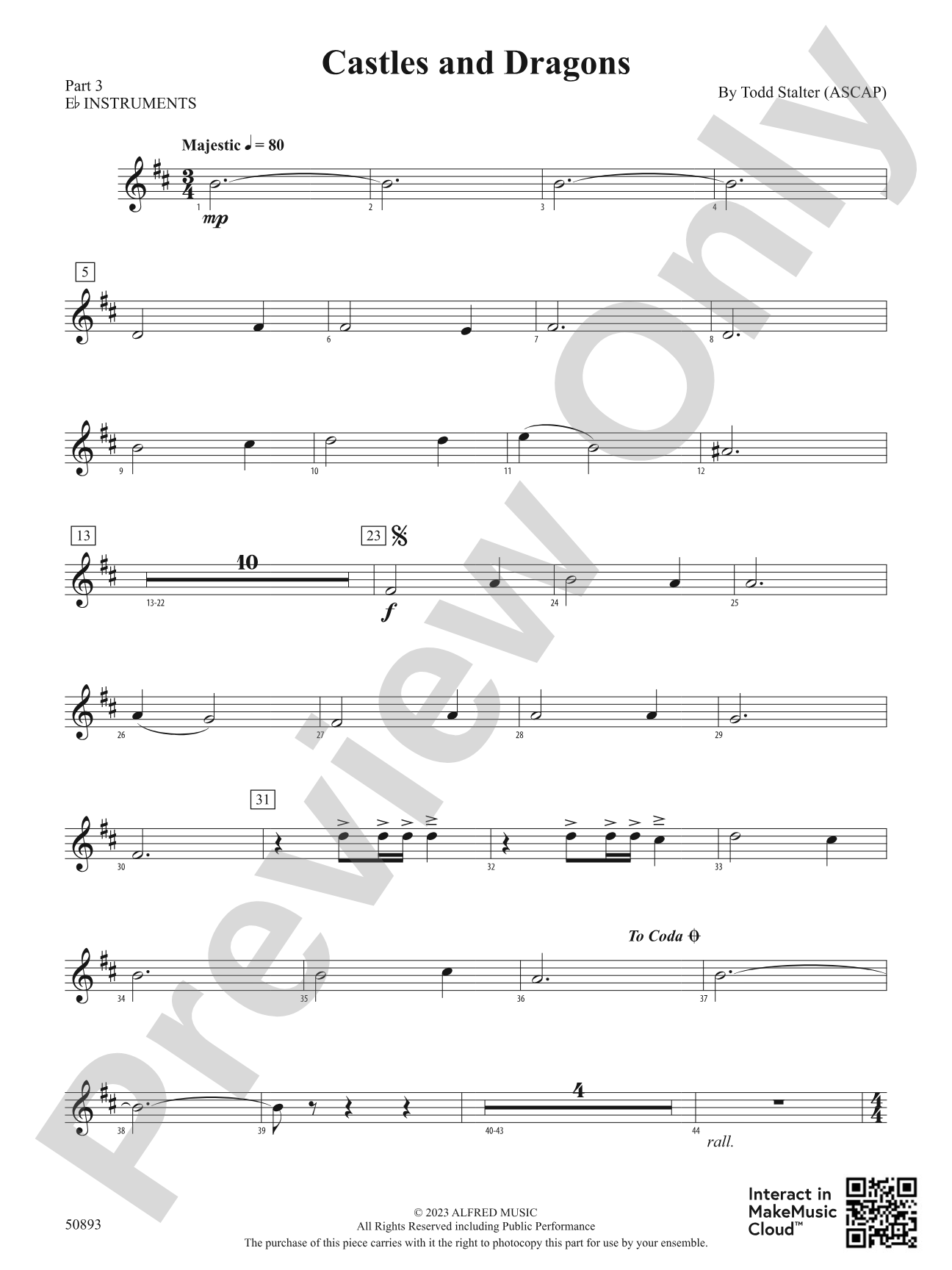

Castles and Dragons: Part 3 - E-flat Instruments
By Todd Stalter
Grade: 1
Item: 00-PC-0019113_PART3_EFLAT
$3.00
Pickup currently not available
Description
Castles and Dragons, by Todd Stalter, is a piece your students will love! The knights must confront and slay a dragon threatening the local village. The ensuing battle ends with the dragon's defeat, and the victorious knights return in a noble procession to their castle. This best-selling composition is an ideal introduction to program music and is available in FLEX format for just about any combination of four instruments. (3:40)
Percussion Accompaniment Track Downloads:
with click
without click


Percussion Accompaniment Track Downloads:
with click
without click
Don't just read it, hear it, play along with it, and watch your students grow with it. In MakeMusic Cloud, Castles and Dragons: Part 3 - E-flat Instruments comes alive with professional accompaniment, adjustable tempo, and built-in practice tools that turn solo practice into real progress.
Open in the Player
Jump straight in and assign it today.
Start Your Free Trial
Open this title and explore the full library in minutes.
Sample Audio
1
Audio File
--:--
0:00
0:00
Sample Video
Additional Details
Series:
Alfred Debut Series
Publisher:
Alfred Music
SKU:
00-PC-0019113_PART3_EFLAT
More about this title
About the Composer: Todd Stalter

Todd Stalter built a storied 34-year tenure as Director of Bands at Eureka High School in Illinois, where his ensembles earned statewide recognition: the Marching Band captured 16 Class 1A state titles, the Concert Band garnered consistent Superior ratings at IHSA contests, and both groups performed at Orchestra Hall in Chicago and Walt Disney World. His work as a clinician and adjudicator spans the Midwest, and he has led All-State Bands in multiple states while presenting on composition and music education at state conferences and university workshops.
Stalter earned his Bachelor of Music Education (cum laude) and Master of Music in Trumpet Performance from Illinois State University, where he studied with Richard Lehman of the President's Own United States Marine Band and conducted under Dr. Stephen K. Steele. His compositions for band and string orchestra appear on state festival and contest lists nationwide and are featured in the "Teaching Music Through Performance in Band" series published by GIA.
Why we love this
Castles and Dragons succeeds where many Grade 1 pieces fall short: it tells a genuine story with musical clarity. The programmatic arc (confrontation, battle, victory, return) unfolds naturally without melodic sacrifice or forced complexity, and the flexible instrumentation means every student plays an essential part in the narrative, not a padding role.
What to expect
A musical storybook come to life. The piece captures the heroic sweep of medieval adventure with straightforward melodies and rhythms that let students focus on character and drama rather than technical fireworks. It feels like an overture to an imagined kingdom.
Who it's for
Grade 1 bands and flexible ensembles seeking repertoire that genuinely engages young students. It works equally well for concert bands with mixed instrumentation, string ensembles, or any ensemble using the FLEX format.
How to get the most out of it
- Set the stage clearly from the opening. The first musical idea establishes the castle world; commit to the tempo and articulation so students feel the setting before the knights even appear.
- Shape the battle sequence for maximum drama. This is where ensemble balance matters most; keep the accompaniment supportive so the main melodic material cuts through without drowning in accompaniment noise.
- Conduct the final procession with ceremonial weight. The victory return deserves a feeling of resolution and pride, not a sprint to the finish.
How to use it
Use this as an opener for a family concert or festival program where community audiences appreciate accessible but engaging storytelling. It also works as the centerpiece of a thematic concert exploring programmatic music, paired with other descriptive works at slightly higher levels to show how the genre grows in sophistication.
Skills your students will build
- Following a musical narrative and responding to programmatic content
- Balancing melodic and accompaniment roles within an ensemble
- Coordinating flexible instrumentation with score and parts
- Executing clear articulation and dynamic contrast to support storytelling
- Reading parts independently while maintaining ensemble cohesion