
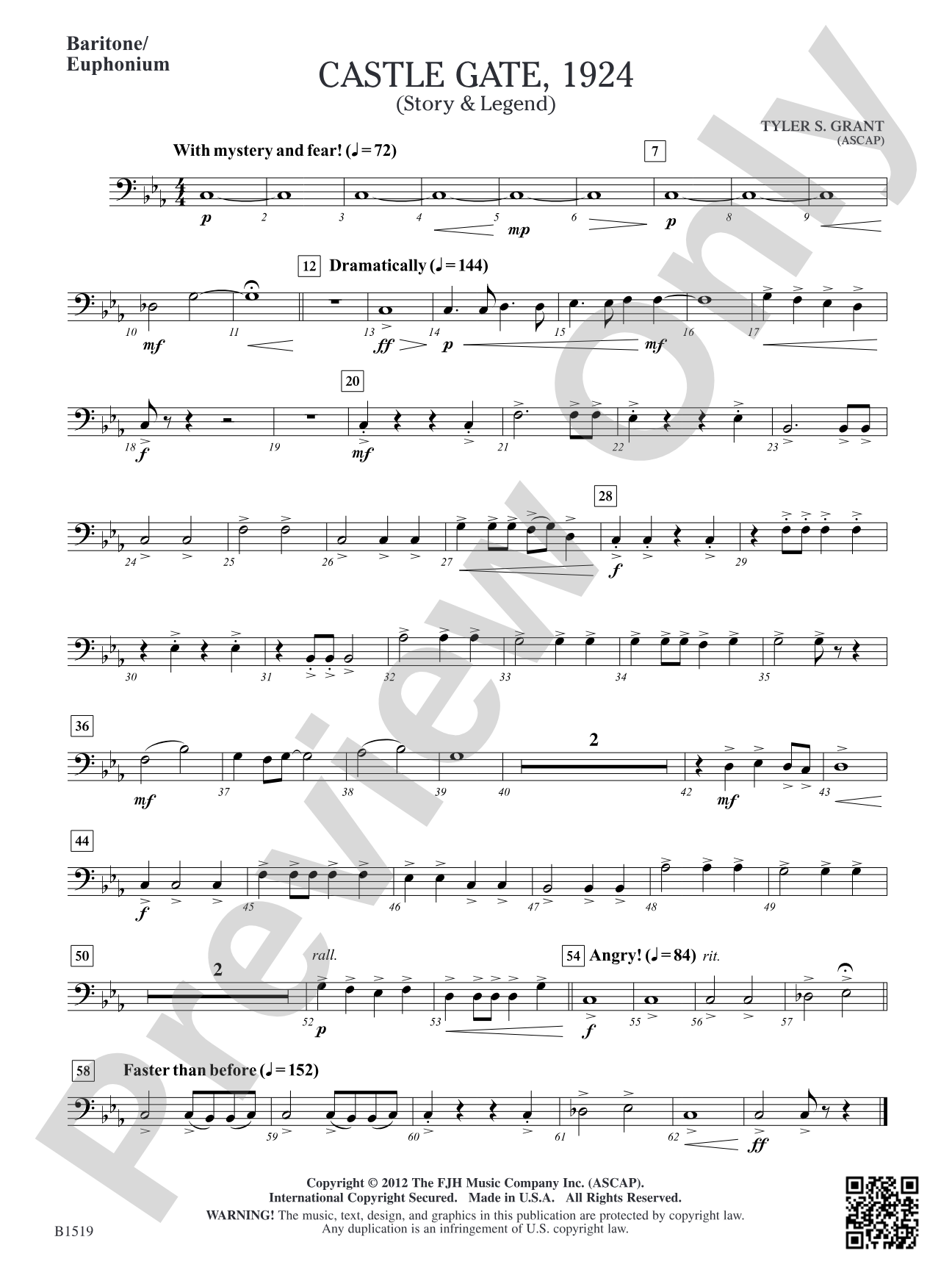

Castle Gate, 1924: Baritone/Euphonium
By Tyler S. Grant
Grade: 1.5
Item: 98-PC-DB1519_BBC1
$7.00
Pickup currently not available
Description
This dramatic work portrays the events in Castle Gate, Utah; a coal mining town that was rocked by a series of explosions in 1924. Young composer Grant tells the epic story of disaster and also reflects the legend left behind by the miners. Powerful and adventurous, this is an ideal opportunity for students to experience music written by one of their peers!


Don't just read it, hear it, play along with it, and watch your students grow with it. In MakeMusic Cloud, Castle Gate, 1924: Baritone/Euphonium comes alive with professional accompaniment, adjustable tempo, and built-in practice tools that turn solo practice into real progress.
Open in the Player
Jump straight in and assign it today.
Start Your Free Trial
Open this title and explore the full library in minutes.
Sample Audio
1
Audio File
--:--
0:00
0:00
Sample Video
No sample videos found.
Additional Details
Series:
FJH Developing Band
Publisher:
The FJH Music Company, Inc.
SKU:
98-PC-DB1519_BBC1
More about this title
About the Composer: Tyler S. Grant

Tyler S. Grant has built a reputation as a composer and arranger whose works appear regularly on honor ensemble programs and annual publisher's choice lists across North America. His compositions have been premiered at major venues including Carnegie Hall, The Midwest Clinic, and the Meyerson Symphony Center, and his Panoramic Fanfare won the Dallas Wind Symphony's 2014 "Call for Fanfares" Competition. Since 2010, he has maintained an active commission practice, releasing new works annually for bands and orchestras at all levels.
Beyond the page, Grant has conducted clinics with over 100 school music programs across 15 states and served as a clinician at the Midwest Clinic and multiple all-state festivals. He holds a bachelor's degree in instrumental music education from the University of Alabama, where he studied conducting with Randall Coleman. Grant has also contributed to Alfred Music's Sound Innovations: Ensemble Development series and regularly writes for publications including School Band & Orchestra Magazine and The Instrumentalist.
Why we love this
Castle Gate arrives at a crucial moment in your band's development. Students at this level rarely encounter programmatic works with this much dramatic weight and musical substance, yet Grant's Grade 1.5 writing makes the story accessible without sacrificing the emotional arc of the narrative. The piece offers your ensemble a chance to connect with a living composer whose work they will hear on professional stages.
What to expect
Castle Gate unfolds like a historical reckoning in sound. The piece begins with the weight of the town itself, builds through the chaos of disaster, and settles into a reflective space that honors what was lost. Grant's orchestration stays muscular and direct throughout, never prettifying the events but allowing the miners' legacy to emerge as the emotional core.
Who it's for
Band directors looking for programmatic repertoire that challenges developing ensembles without oversimplifying the story. Students benefit from experiencing how a peer composer builds narrative tension at an accessible level. This works equally well for concert performance and contest/festival contexts.
How to get the most out of it
- Shape the narrative arc across the full piece. Mark the major story beats in your score so you can conduct the mining disaster as a dramatic event rather than a sequence of unrelated moments.
- Balance the commemorative character of the work with the power Grant intends. This is not sentimental music; it honors miners through honest, forceful orchestration.
- Invest in clean articulation during the transition passages. The story depends on crisp ensemble attacks when the musical texture shifts.
How to use it
Program Castle Gate as the centerpiece of a concert exploring how music documents history and community. Pair it with other programmatic works at different grade levels to show students how composers across skill levels tackle narrative. The piece also fits beautifully in a memorial or heritage concert celebrating local or regional history.
Skills your students will build
- Sustaining a dramatic arc across multiple sections
- Balancing lyrical playing with powerful ensemble sound
- Responding to programmatic cues in the score
- Executing clean articulation and attacks during rapid textural shifts
- Understanding how composers use orchestration to convey emotion and narrative