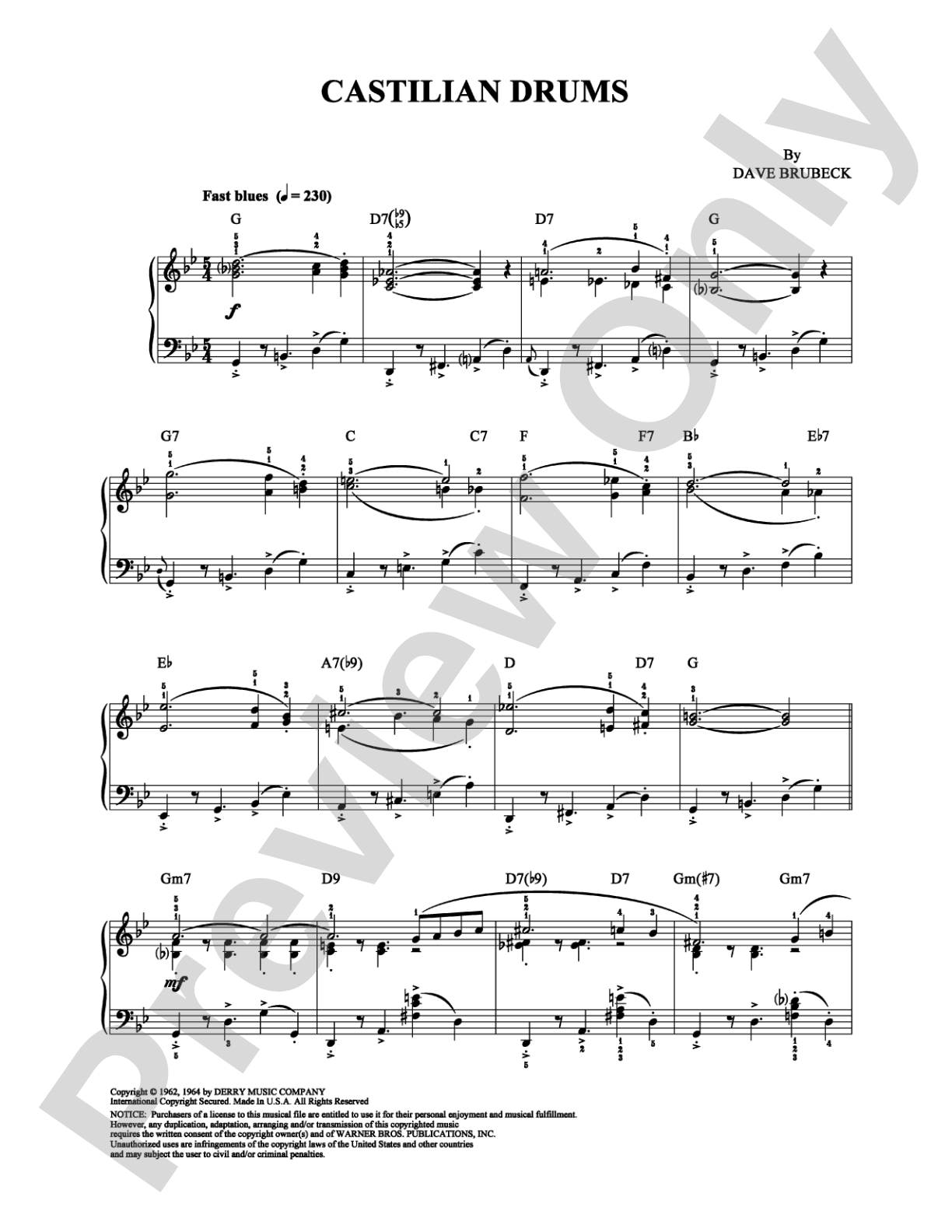
Castilian Drums: Piano Digital Sheet Music

Castilian Drums: Piano Digital Sheet Music

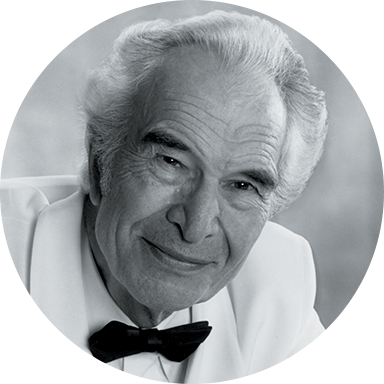
Dave Brubeck

Item: 00-PS-0000774

Digital Download
$3.99
Description

Castilian Drums: Piano Digital Sheet Music isn't in MakeMusic Cloud just yet...but it could be. Let us know you'd like to see it, and you'll help shape what comes next. In the meantime, start a free trial and dive into thousands of interactive titles your students can play along with today.

Sample Audio
No sample audio found.
Sample Video
Additional Details
SKU: 00-PS-0000774

More about this title

About the Artist: Dave Brubeck

Dave Brubeck

Dave Brubeck stands as one of jazz's most consequential figures, equally accomplished as an improviser and a disciplined composer. His catalog spans choral works, orchestral pieces, chamber music, and solo compositions across multiple instruments, all informed by his study with Darius Milhaud at Mills College. Beyond his musical output, Brubeck became a barrier-breaker in mid-twentieth-century America, using his art and visibility to advance racial integration during a pivotal moment in the nation's history.

Brubeck's legacy extends across multiple domains: his 1959 album "Time Out" became the first jazz recording to exceed one million copies sold, anchored by the iconic "Take Five." His sacred works, including the mass "To Hope!" and the oratorios "The Voice of the Holy Spirit" and "Beloved Son," have received performances and recordings by major international ensembles. His honors include the Presidential Medal of the Arts, a Grammy Lifetime Achievement Award, and induction into the American Classical Music Hall of Fame in 2003.

Why we love this

Brubeck's piano writing sits at the intersection of jazz vernacular and classical rigor. This piece channels his gift for combining angular melodic lines with harmonic sophistication, giving pianists material that sounds authentically jazzy while maintaining the notational clarity that makes it learnable and repeatable.

What to expect

The piece evokes a restless energy, its title evoking Spanish percussion and rhythmic drive. Brubeck layers asymmetrical figures over a foundation that feels both grounded and propulsive, creating the sensation of forward momentum punctuated by harmonic surprise.

Who it's for

Intermediate to advanced jazz pianists and classical pianists exploring jazz repertoire will find this a rewarding study. Students familiar with lead sheets and jazz vocabulary, or those building fluency in Brubeck's compositional language, can engage fully with the notated solo line.

How to get the most out of it

  • Approach the rhythmic figures with the precision they demand; Brubeck's notation is specific, and his syncopations land more powerfully when executed with clarity rather than approximation.
  • Let the harmonic motion breathe. Brubeck builds tension through chord substitution and unexpected resolutions, so listening for these shifts will guide your phrasing naturally.
  • Ground yourself in the implied pulse rather than fighting the syncopation. Once you internalize where the beat sits beneath the surface rhythms, the piece locks into place.

How to use it

Pair this with other Brubeck compositions to program a cohesive jazz piano spotlight, or use it as a recital bridge between classical and jazz repertoire. It works equally well as a concert opener that signals a shift in musical idiom or as a study piece within a jazz piano curriculum.

Skills your students will build

  • Reading Brubeck's distinctive syncopated notation and rhythmic displacement
  • Comping and harmonic awareness in a notated jazz context
  • Balancing melodic clarity with rhythmic independence between hands
  • Interpreting implied swing feel and jazz articulation in written form
  • Navigating chromatic voice leading and jazz reharmonization

You May Also Like