
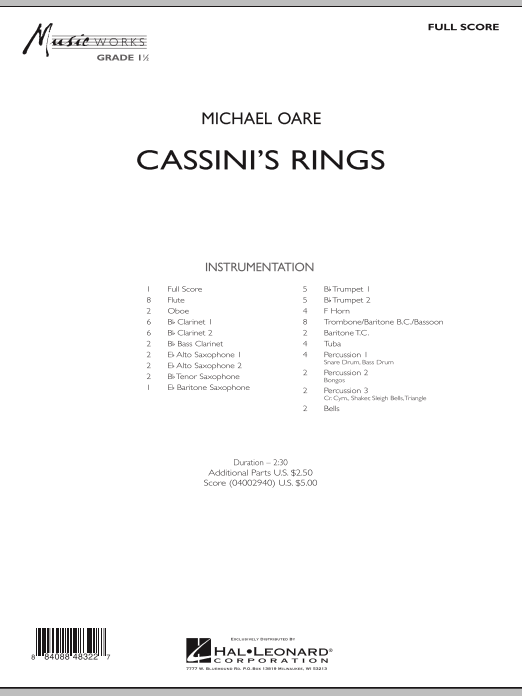

Cassini's Rings: Concert Band Conductor Score & Parts
By Michael Oare
Grade: 1.5
Item: 35-PK00156771
$45.00
Pickup currently not available
Buy Extra Parts (Digital PDF Download)
| Product | Price | Quantity |
|---|---|---|
| Cassini's Rings - Full Score | $6.00 | |
| Cassini's Rings - Flute 1 | $6.00 | |
| Cassini's Rings - Flute 2 | $6.00 | |
| Cassini's Rings - Oboe | $6.00 | |
| Cassini's Rings - Bb Clarinet 1 | $6.00 | |
| Cassini's Rings - Bb Clarinet 2 | $6.00 | |
| Cassini's Rings - Bb Bass Clarinet | $6.00 | |
| Cassini's Rings - Eb Alto Saxophone 1 | $6.00 | |
| Cassini's Rings - Eb Alto Saxophone 2 | $6.00 | |
| Cassini's Rings - Bb Tenor Saxophone | $6.00 | |
| Cassini's Rings - Eb Baritone Saxophone | $6.00 | |
| Cassini's Rings - Bb Trumpet 1 | $6.00 | |
| Cassini's Rings - Bb Trumpet 2 | $6.00 | |
| Cassini's Rings - F Horn | $6.00 | |
| Cassini's Rings - Trombone/Baritone B.C./Bassoon | $6.00 | |
| Cassini's Rings - Baritone T.C. | $6.00 | |
| Cassini's Rings - Tuba | $6.00 | |
| Cassini's Rings - Percussion 1 | $6.00 | |
| Cassini's Rings - Percussion 2 | $6.00 | |
| Cassini's Rings - Percussion 3 | $6.00 | |
| Cassini's Rings - Bells | $6.00 |
Parts Added to Cart!
Description
In 2004, NASA's Cassini spacecraft (named for astronomer Giovanni Domenico Cassini) entered into orbit around the planet Saturn. The famous rings are named for the first seven letters of the alphabet, and in order of their distance from the planet form a melodic tone row used as the basis for this creative and exciting work for beginning players. Dur: 2:20


Cassini's Rings: Concert Band Conductor Score & Parts isn't in MakeMusic Cloud just yet...but it could be. Let us know you'd like to see it, and you'll help shape what comes next. In the meantime, start a free trial and dive into thousands of interactive titles your students can play along with today.
Request This Title
Tell us you want it.
Start Your Free Trial
Explore everything that's ready to play right now.
Sample Audio
No sample audio found.
Sample Video
No sample videos found.
Additional Details
Publisher:
Hal Leonard
SKU:
35-PK00156771
More about this title
About the Composer: Michael Oare

Michael Oare combines three decades of classroom experience with a gift for writing music that works for young ensembles. His teaching career at Great Bridge Middle School spanned 33 years, during which his bands earned superior ratings year after year, including 30 consecutive years performing grade 3 and 4 literature at the highest level. His two compositions, "To Dream in Brushstrokes" and "Equilibrium," appear in GIA Publications' respected "Teaching Music Through Performance" series, cementing his reputation as a composer who understands what students need to grow.
Oare holds degrees in both Music Composition and Music Education from Old Dominion University and has served as conductor of the Bay Youth Orchestras of Virginia Concert Band. He remains active as a performer, adjudicator, and member of the Virginia Wind Symphony. His work has earned recognition including the 2016 Chesapeake Public Schools Middle School Teacher of the Year award and two Citations of Excellence from the National Band Association.
Why we love this
Oare transforms a NASA spacecraft's discovery into a Grade 1.5 work that feels both intellectually engaging and genuinely musical. The tone row concept gives students a real compositional framework to understand rather than just play through; they're experiencing how professional composers build entire pieces from a single melodic idea. For a beginning band, that's remarkable pedagogical depth wrapped in something that sounds exciting and modern.
What to expect
A piece that balances wonder and clarity. The tone row foundation creates an elegant, modern harmonic language that sounds more sophisticated than Grade 1.5 typically allows, while the 2:20 length keeps momentum steady and prevents fatigue for newer players. There's a sense of exploration here, fitting for music inspired by humanity's journey to Saturn.
Who it's for
Beginning concert bands ready to tackle something with real compositional substance. This works for middle school programs introducing students to larger ensemble repertoire and for high school groups looking for accessible concert material with educational depth.
How to get the most out of it
- Highlight the melodic tone row when you first present the piece to your band. Have students identify which letters (A through G) correspond to Saturn's rings and listen for how Oare develops this simple idea throughout the 2:20 duration.
- Balance the upper voice melody with supporting parts during rehearsals. Grade 1.5 writing often calls for careful voicing, so map out which sections carry the primary material at different points.
- Maintain steady articulation and consistent tone quality in the running passages; this repertoire rewards precision without requiring virtuosity from your players.
How to use it
Place this early in a fall concert to set an intellectual tone for your program and show audiences that beginning musicians engage with real compositional ideas. It pairs well alongside traditional Grade 1.5 fare, offering a bridge toward more complex repertoire without overwhelming your ensemble.
Skills your students will build
- Understanding melodic tone rows and how composers develop a single pitch collection across an entire work
- Reading Grade 1.5 concert band parts with balanced voicing and consistent articulation
- Interpreting modern compositional techniques at an introductory level
- Building ensemble cohesion in a piece with active rhythmic movement