Cassandra's Harp Sheet Music Preview

Cassandra's Harp: Piano

By Timothy Brown

Item: 98-DW9295

Digital Download
$3.50
Description
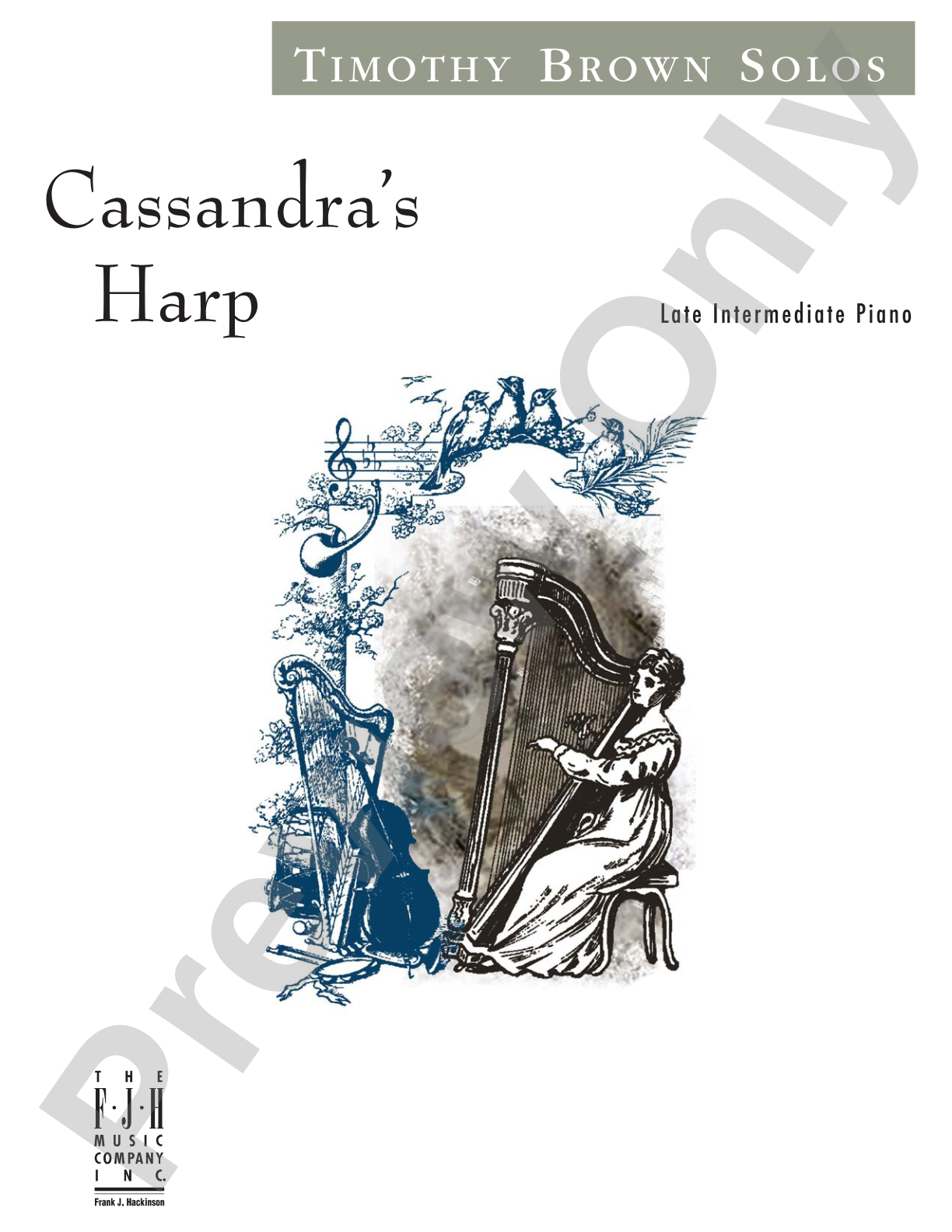
Cassandra's Harp is a lovely late intermediate solo that portrays a harp-like sound effect through long, lyrical, melodic lines and eighth note movement between the hands. The beginning measures contain interesting changes in meter from 3/4 to 6/4 and throughout the A section in 4/4. In the B section the melody is predominately in the LH with melodic doubling in the RH accompaniment part. This piece will serve as a wonderful recital selection or for reinforcement in lyrical playing.

Cassandra's Harp: Piano isn't in MakeMusic Cloud just yet...but it could be. Let us know you'd like to see it, and you'll help shape what comes next. In the meantime, start a free trial and dive into thousands of interactive titles your students can play along with today.

Sample Audio
No sample audio found.
Sample Video
Additional Details
Series: Written For You
Publisher: The FJH Music Company, Inc.
SKU: 98-DW9295

More about this title

Why we love this

Brown writes with a pianist's ear for what sounds idiomatic yet achievable. The harp effect here comes from genuine musical invention, not gimmickry, and the meter changes feel organic rather than imposed. Students leave the practice room understanding how accompaniment texture can carry a piece.

What to expect

Quiet and contemplative, with an almost ethereal quality created by the sustained, harp-like patterns. The melody unfolds like someone plucking strings in soft, deliberate sequences, while the underlying harmonies shimmer beneath.

Who it's for

Late intermediate pianists preparing for recitals or working to deepen their lyrical voice. This piece rewards players who can balance melodic singing with delicate accompaniment figures.

How to get the most out of it

  • Pedal carefully through the eighth note movement between hands to create that floating harp quality without muddying the texture.
  • Pay close attention to where the melody migrates in the B section. Since it lives predominantly in the left hand, resist the urge to over-emphasize the right hand doubling; let the LH line shine.
  • Use the meter changes (3/4 to 6/4 to 4/4) as breathing moments rather than obstacles. Each shift creates a subtle expansion or contraction of phrase length that shapes the overall arc.

How to use it

Pair this with a faster, more assertive piece to create dynamic contrast in a student recital. It also serves as an excellent choice for programs featuring American contemporary composers or for a segment highlighting lyrical solo writing.

Skills your students will build

  • Meter reading and execution (3/4, 6/4, 4/4 transitions)
  • Creating harp-like texture through controlled pedaling and hand coordination
  • Balancing melody in different hands and tracking harmonic movement
  • Legato singing tone at late intermediate level
  • Rhythmic independence between hands (eighth note patterns with melodic lines)

You May Also Like