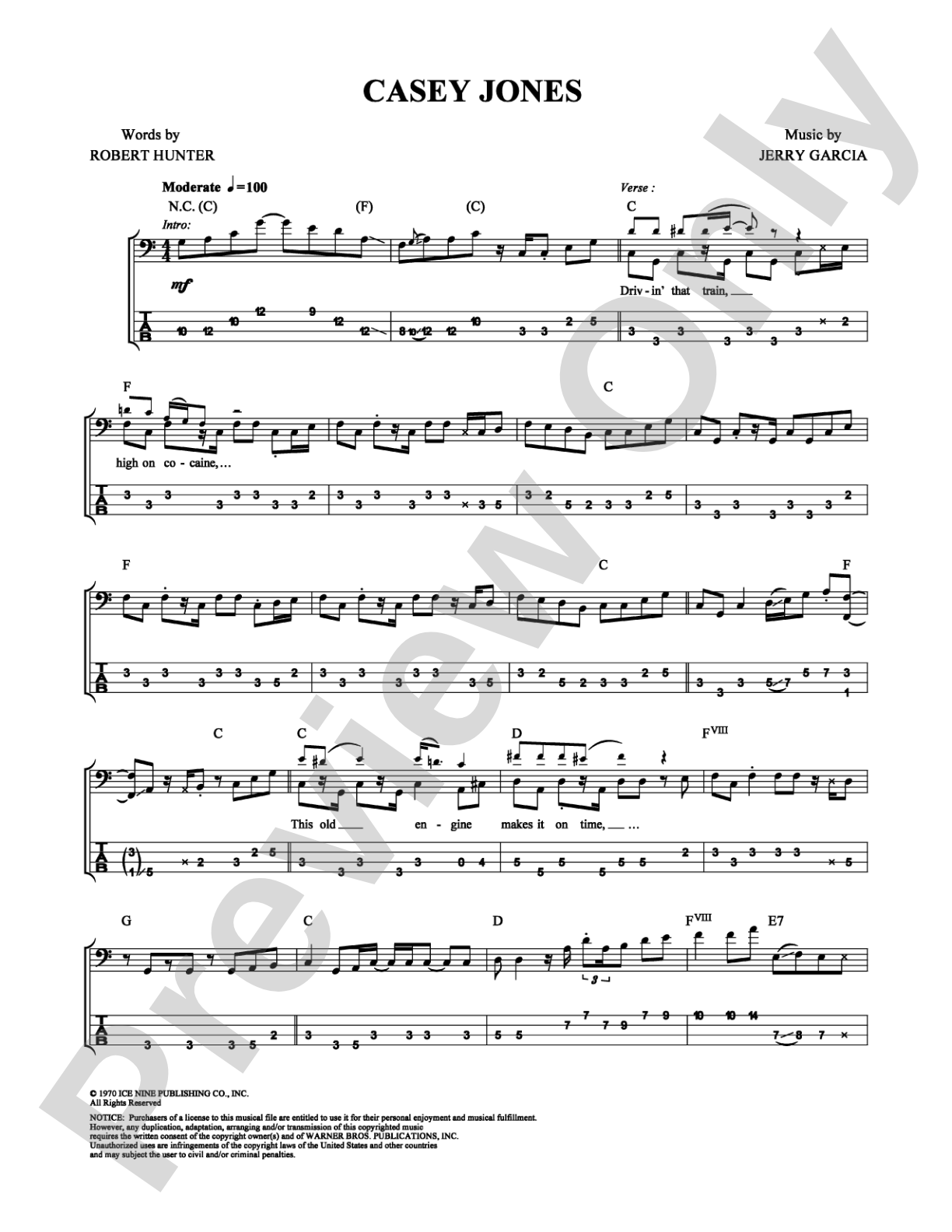
Casey Jones: Bass TAB Digital Sheet Music

Casey Jones: Bass TAB Digital Sheet Music

Jerry Garcia, Grateful Dead

Item: 00-PS-0005500

Digital Download
$2.95
Description

Casey Jones: Bass TAB Digital Sheet Music isn't in MakeMusic Cloud just yet...but it could be. Let us know you'd like to see it, and you'll help shape what comes next. In the meantime, start a free trial and dive into thousands of interactive titles your students can play along with today.

Sample Audio
No sample audio found.
Sample Video
Additional Details
SKU: 00-PS-0005500

More about this title

About the Artist: Grateful Dead

The Grateful Dead emerged from the San Francisco Bay Area in the mid-1960s and became one of the most influential bands in American rock history. Their improvisational approach to live performance and genre-blending compositions drew from rock, folk, country, blues, and jazz traditions. The band's bassist Phil Lesh became renowned for his melodic, harmonic approach to the instrument, treating the bass as a conversation partner rather than a timekeeper alone.

The Dead's catalog spans decades of evolution, from early psychedelic rock to more sophisticated arrangements that showcased complex rhythmic interplay. Their music remains a study in ensemble communication, with each band member listening intently to shape the direction of every performance. For musicians interested in understanding how rock bass can function as both anchor and creative voice, the Dead's recorded legacy offers endless learning opportunities.

Why we love this

Casey Jones sits at that perfect intersection of groove and narrative that makes Grateful Dead material so engaging for bass players. Phil Lesh's bass line propels the song with steady pocket while remaining memorable enough to carry the tune itself, making it an ideal entry point for bassists exploring how melodic phrasing and rhythmic stability coexist. The TAB format lets players focus on the actual notes and fingering without wrestling with staff notation, accelerating the learning curve.

What to expect

Casey Jones has a propulsive, narrative quality that captures the feel of movement and momentum. The groove locks into a steady, almost locomotive quality that makes you want to keep pushing forward, while the melody weaves through with enough character to lodge in your head long after you stop playing. It's the kind of song that feels both instantly accessible and rich enough to reveal new details the more you explore it.

Who it's for

Bass players drawn to rock repertoire with real musical substance will find plenty to sink their teeth into here. This works well for players intermediate enough to navigate TAB fluently and interested in understanding how Grateful Dead bass lines balance rhythmic duty with harmonic awareness. It's equally suited for players building a setlist of era-spanning covers or deepening their knowledge of rock bass tradition.

How to get the most out of it

  • Lock into the pocket early and stay consistent; this groove lives in repetition and feel rather than flashy variation. Once your part is solid, the entire song will breathe differently.
  • Pay close attention to how the bass line supports the vocal melody and harmonic movement. Lesh often mirrors or complements vocal phrases, so sing along as you learn the part.
  • Track the dynamics across the song's sections. The verses sit lower in the mix conceptually, while choruses and bridges often require more presence and punch.
  • Use the recorded version as your primary reference. The Grateful Dead's interpretations vary across live performances, so anchoring to a specific studio or well-known live take will keep your learning focused.

How to use it

This works beautifully in programs celebrating rock history or classic American songwriting. It pairs naturally with other Grateful Dead material if you're building a full set, or stands alone as a conversation starter about how the Dead influenced generations of musicians. For teaching contexts, it's an excellent addition to a semester or unit exploring how bass lines can drive a song while maintaining melodic and harmonic interest.

Skills your students will build

  • Reading and executing bass TAB notation
  • Locking into a consistent pocket groove
  • Tracking harmonic movement and anticipating chord changes
  • Balancing rhythmic responsibility with melodic phrasing
  • Listening to and learning from recorded performances

You May Also Like