
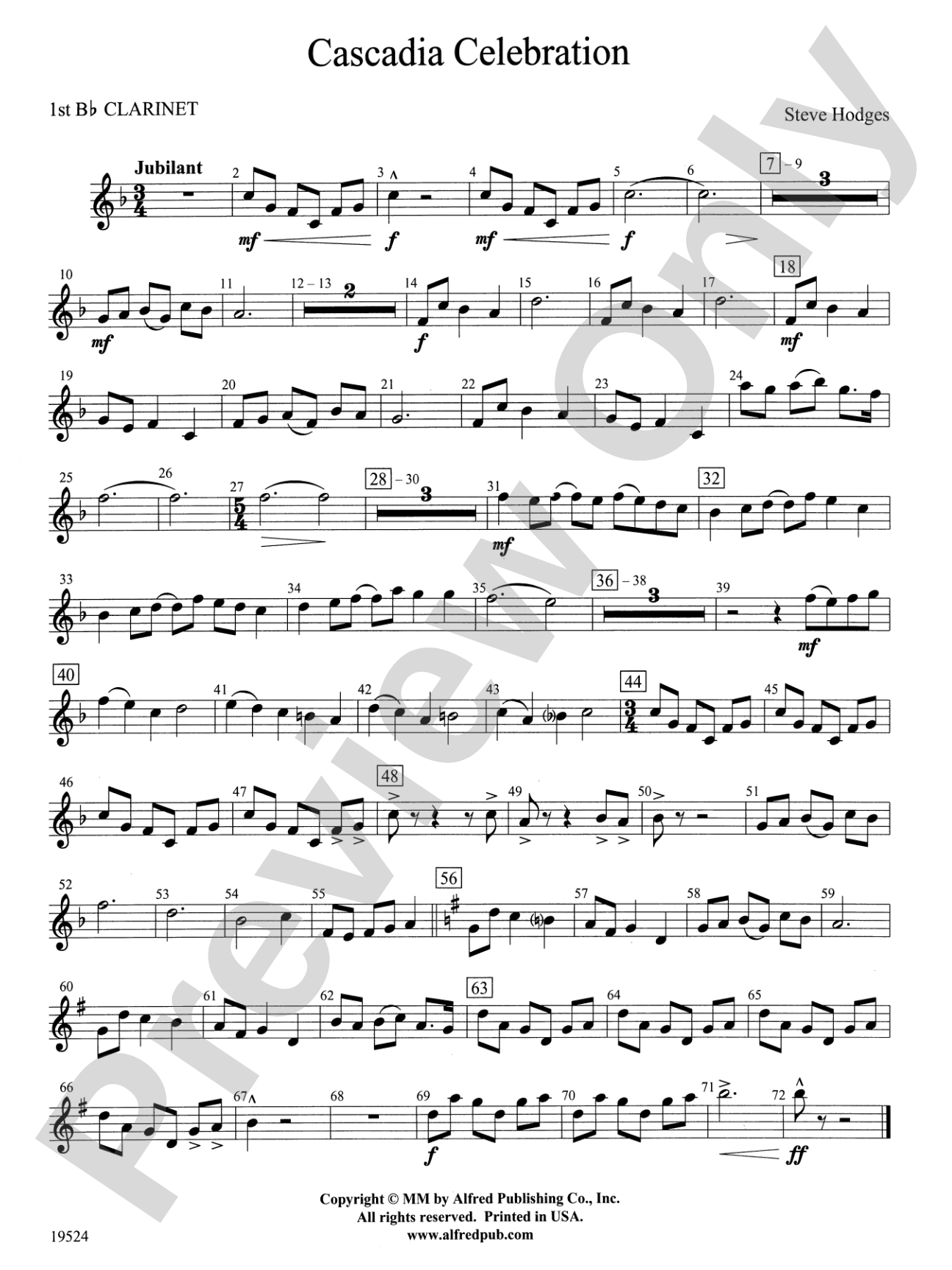

Cascadia Celebration: 1st B-flat Clarinet
By Steve Hodges
Grade: 1.5 (Easy)
Item: 00-PC-0000327_C1
$3.00
Pickup currently not available
Description
Cascadia Celebration is a buoyant piece in triple meter, which provides the young band with many interesting rhythmic and harmonic motives. The energetic A section and the contrasting, flowing B section both feature active rhythmic patterns and memorable themes. The solid scoring provides melodic interest for every section of the band and will make this piece a favorite to rehearse! This title is available in MakeMusic Cloud.


Don't just read it, hear it, play along with it, and watch your students grow with it. In MakeMusic Cloud, Cascadia Celebration: 1st B-flat Clarinet comes alive with professional accompaniment, adjustable tempo, and built-in practice tools that turn solo practice into real progress.
Open in the Player
Jump straight in and assign it today.
Start Your Free Trial
Open this title and explore the full library in minutes.
Sample Audio
1
Audio File
--:--
0:00
0:00
Sample Video
No sample videos found.
Additional Details
Series:
Challenger Band Series
Publisher:
Alfred Music
Page Count:
120
SKU:
00-PC-0000327_C1
More about this title
About the Composer: Steve Hodges

Steve Hodges holds degrees from Western Oregon University (Bachelor of Science) and Central Washington University (Master of Music Education). After four decades directing bands, choirs, and small ensembles across public school systems, he transitioned to full-time composition and has since created over 120 concert band works published by Alfred Music, along with choral arrangements through Staff Music and Shawnee Press.
Hodges's compositions have appeared at festivals and state music conventions worldwide, with commissioned works for honor bands and schools spanning Virginia, Iowa, British Columbia, Oregon, Washington, and North Carolina. His music has also been licensed by major cable networks including TBS and ESPN. An ASCAP member, Hodges now resides in The Dalles, Oregon, where he remains active in community music; one of his greatest joys is hearing his grandchildren perform his pieces in their own school bands.
Why we love this
Hodges writes with a conductor's understanding of what makes a young band rehearsal engaging. The rhythmic vitality and harmonic color in both the A and B sections give every section meaningful material to play, eliminating the common problem of passive accompaniment parts. This piece earns its place on your calendar because it genuinely improves while you teach it.
What to expect
Cascadia Celebration radiates energy and optimism. The triple meter creates an inherent lilt, while the rhythmic motives throughout keep the sound alive and forward-moving even at modest tempos. The contrast between the spirited A section and the more lyrical B section gives the piece breathing room and emotional range.
Who it's for
This piece is designed for young concert bands at the Grade 1.5 level with developing ensemble cohesion and basic harmonic understanding. Directors seeking accessible material with genuine musical substance will find strong score balance and pedagogical value that doesn't require advanced technique from students.
How to get the most out of it
- Balance the rhythmic layers in the A section so the moving figures support rather than overshadow the melodic line; clarity comes from voicing, not dynamics.
- Shape the flowing B section with subtle tempo flexibility, allowing the legato phrasing to breathe naturally without losing forward motion.
- Lock the harmonic foundation early by having the low woodwinds and low brass establish the chord changes precisely during sectionals.
- Use the triple meter to your advantage by conducting it in a way that lets students feel the lilting character; avoid making it feel mechanical or heavy.
How to use it
Program this as a concert opener or as a strong mid-concert lift; its uplifting character works well before or after a contrasting ballad. It also serves as an excellent festival selection at the Grade 1.5 level, giving young ensembles an opportunity to demonstrate both rhythmic precision and musicality in a piece that audiences respond to immediately.
Skills your students will build
- Playing in triple meter with security and independence
- Balancing rhythmic patterns across multiple voices
- Shaping melodic lines within an active harmonic context
- Responding to contrasting sections with appropriate character and articulation
- Building accuracy in harmonic transitions