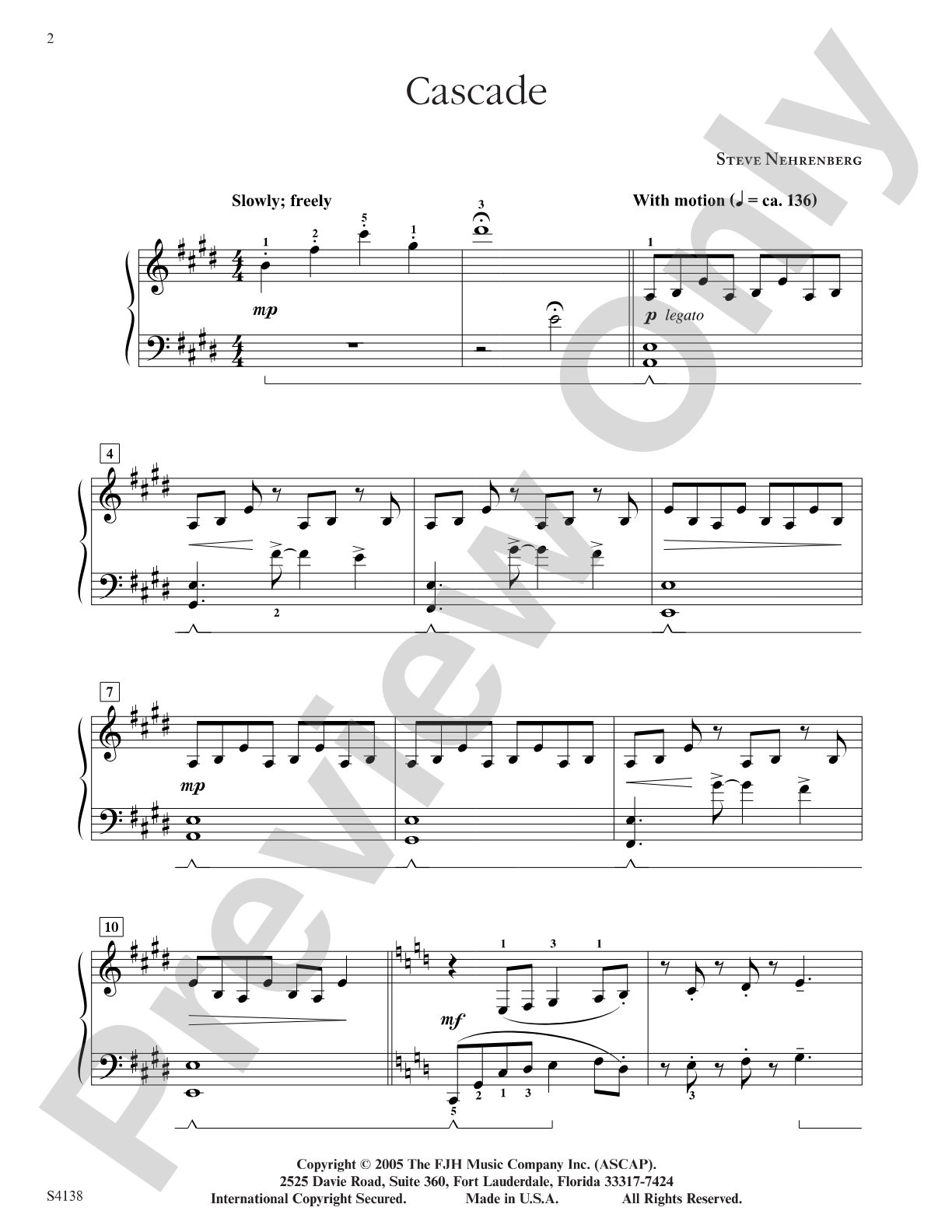
Open chords and running eighths characterize this New Age sounding piece, written in E major. Easy syncopations appear evenly among the chords and give Cascade a flowing motion. The melodic alteration between voices in the bridge is cleverly written. Great appeal, especially for teens and adults.
Discover MakeMusic Cloud: thousands of interactive titles your students can play along with today.
Nehrenberg captures that contemporary, atmospheric quality without resorting to heavy pedal work or complex harmonic language. The syncopations feel organic rather than imposed, and the bridge's voice leading gives students a genuine compositional lesson wrapped inside an accessible piece. This works beautifully for pianists who gravitate toward modern sounds but need something uncomplicated enough to learn quickly.
What to expect
Cascade evokes a sense of constant, gentle motion—like water flowing smoothly over stones. The open harmonic language and sustained sonorities create an unhurried, meditative atmosphere, while the flowing eighths and light syncopations prevent it from ever feeling static or overly precious. There's a quiet contemporary sophistication here.
Who it's for
This solo works especially well for teenagers and adult pianists who connect with contemporary sounds and want to expand beyond classical repertoire. It sits at an accessible technical level while offering genuine compositional interest, making it ideal for recitals, student showcases, or practice pieces that build confidence in modern music.
How to get the most out of it
Shape the running eighths as waves rather than as metronomic patterns. The flowing quality comes from subtle rubato and dynamic shaping through each figure.
Balance the open chord voicings so the melody registers clearly without the harmonies disappearing into the texture. Experiment with partial pedal to sustain resonance without muddying the running eighths.
Listen carefully during the bridge where the melodic material shifts between voices. Bring out whichever line carries the primary melodic thread, then shift that emphasis smoothly as the voices trade.
The syncopations should feel natural and conversational. Avoid over-articulating the off-beat accents; let them emerge through touch and phrasing rather than force.
How to use it
Pair this with other pieces that explore modern compositional approaches, or use it as a bridge between traditional classical repertoire and jazz or popular arrangements. It works particularly well in programs aimed at teen and adult audiences who appreciate accessible yet sophisticated contemporary music.
Skills your students will build
Balancing melody against open harmonic voicings
Playing syncopated rhythms with natural phrasing rather than mechanical precision
Voicing awareness and tracking melodic lines across multiple registers
Pedal control in contemporary music contexts
Interpreting New Age and contemporary classical idioms
You May Also Like
Scan to Complete Your Purchase
Use your phone's camera to scan the code below
You'll log in on your phone and the order will be added to your account