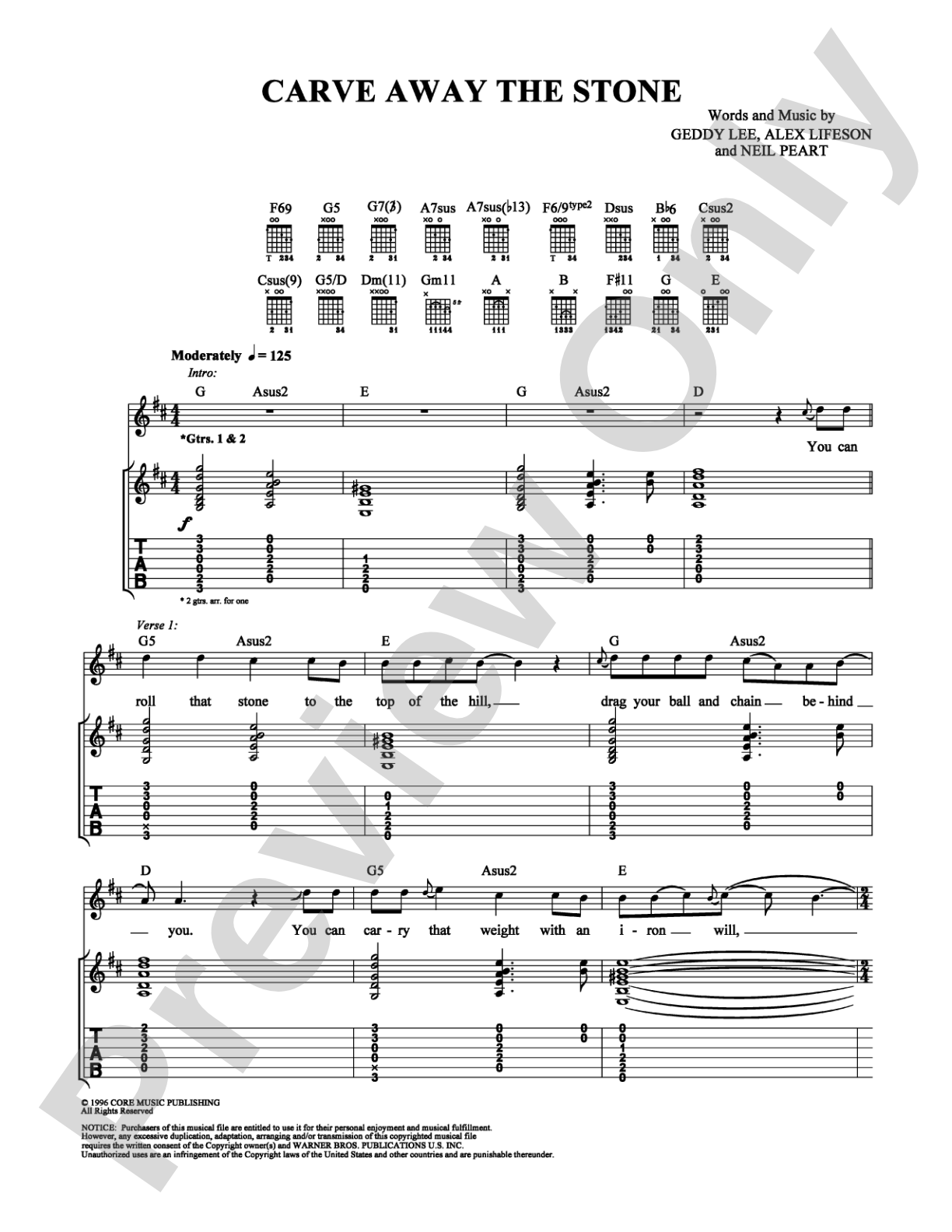
Carve Away The Stone: Guitar TAB Digital Sheet Music

Carve Away The Stone: Guitar TAB Digital Sheet Music

Rush, Geddy Lee, Neil Peart, Alex Lifeson

Item: 00-PS-0001231

Digital Download
$2.99
Description

Carve Away The Stone: Guitar TAB Digital Sheet Music isn't in MakeMusic Cloud just yet...but it could be. Let us know you'd like to see it, and you'll help shape what comes next. In the meantime, start a free trial and dive into thousands of interactive titles your students can play along with today.

Sample Audio
No sample audio found.
Sample Video
Additional Details
SKU: 00-PS-0001231

More about this title

About the Artist: Rush

Rush redefined what rock musicianship could be. Over four decades, the Canadian trio, Geddy Lee, Alex Lifeson, and Neil Peart, built a legacy on technical precision, complex arrangements, and uncompromising artistic vision. Their influence on guitar education is substantial; generations of players have learned to think differently about timing, harmony, and what's possible within the rock idiom.

Why we love this

Rush's catalog rewards the kind of focused, deliberate practice that serious guitarists need. This TAB transcription gives players direct access to the fingerboard logic behind one of their compositions, making the technical work transparent and achievable rather than mysterious. Having quality transcriptions of Rush material in your studio library means your intermediate to advanced students have authentic examples of how to construct compelling, complex guitar lines that still serve the song.

What to expect

Precise and architecturally intricate, this piece demands focus and rewards attention to detail. The music feels deliberate and constructed; every note serves a purpose within a larger harmonic and rhythmic framework rather than existing as ornamentation. Playing through it brings a sense of accomplishment tied directly to technical mastery and disciplined practice.

Who it's for

Intermediate and advanced guitarists who are ready to tackle technically demanding rock material and want direct access to how Rush constructs their arrangements. Students pursuing progressive rock styles or working toward a deeper understanding of complex rhythmic and harmonic concepts will find this transcription invaluable. Players interested in studying guitar as a compositional voice rather than purely a rhythm or lead instrument should make Rush a priority.

How to get the most out of it

  • Map out the tuning and any dropped or alternate tunings before you begin; Rush often uses non-standard tunings that significantly change hand position and fingering patterns.
  • Work through the rhythmic notation separately from the pitch information; Rush's meter changes and syncopation demand that you internalize the timing before focusing on left-hand placement.
  • Use a metronome at a reduced tempo to lock in precision on any fast passages or intricate picking patterns; accuracy matters more than speed in establishing the foundation.
  • Record yourself playing sections back to back to develop stamina and consistency, especially if the piece spans extended passages without a clear resting point.

How to use it

Feature this in a recital or studio showcase where you want to highlight a student's technical growth and ability to handle sophisticated rhythmic and harmonic material. It works particularly well in a progressive rock or metal-focused concert context where it can sit alongside similar advanced material. Consider assigning it as a long-term solo project for a student who has demonstrated readiness for real-world transcription and needs a motivating, guitar-centric goal.

Skills your students will build

  • Reading and executing complex guitar TAB notation across non-standard tunings
  • Navigating time signature changes and syncopated rhythmic patterns characteristic of progressive rock
  • Developing left-hand efficiency and accuracy across fast, intricate passages
  • Understanding guitar arrangement and voice leading in the context of a working composition
  • Building finger strength and endurance through sustained technical passages

You May Also Like