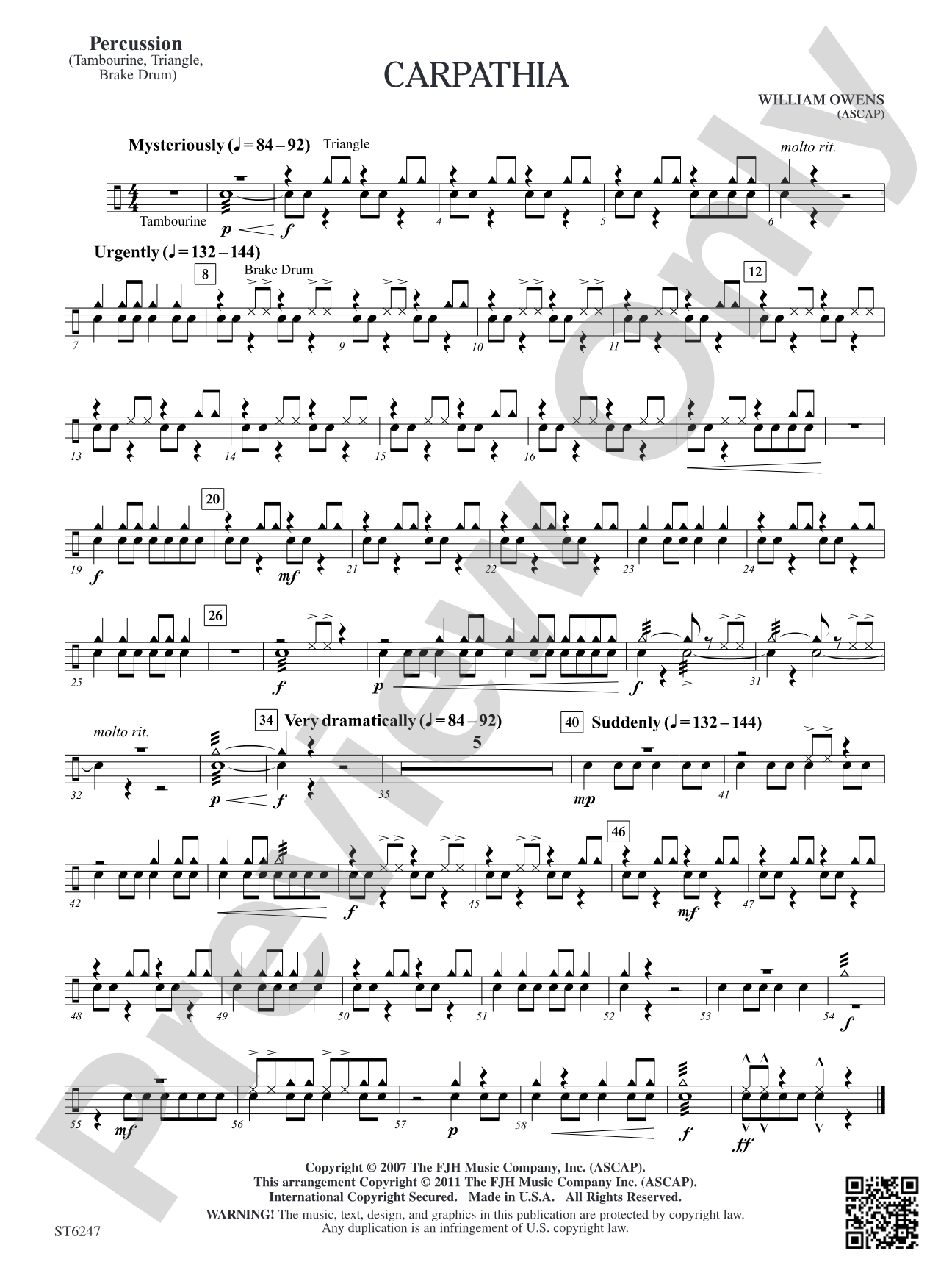
Carpathia: Percussion Sheet Music Preview

Carpathia: Percussion

By William Owens

Grade: 2.5

Item: 98-PC-DST6247_BDTDCYM

Digital Download
$7.00
Description
This powerful work depicts the frantic voyage of the RMS Carpathia, the first ship to arrive on the scene after receiving a distress call from the Titanic. The use of stomping and hissing helps depict the vibrations of the ship's hull along with the hissing of the boiler. The music becomes slow and mournful as the ship arrives on the terrible scene before embarking on her triumphant yet tragic return voyage to safety. Optional percussion adds to the dramatic effect. Stunning!

Don't just read it, hear it, play along with it, and watch your students grow with it. In MakeMusic Cloud, Carpathia: Percussion comes alive with professional accompaniment, adjustable tempo, and built-in practice tools that turn solo practice into real progress.

Sample Audio
0:00
0:00
Sample Video
Additional Details
Series: FJH Developing Strings
Publisher: The FJH Music Company, Inc.
SKU: 98-PC-DST6247_BDTDCYM

More about this title

About the Composer: William Owens

William Owens

William Owens has spent three decades shaping young musicians across North America as a composer, clinician, and conductor. A 1985 graduate of VanderCook College of Music, he brings a composer's ear grounded in classroom reality; his catalog of over 300 works for concert band, string orchestra, and small ensemble reflects both artistic ambition and deep understanding of what young players can achieve.

Owens has earned recognition from the American Society of Composers, Authors, and Publishers (ASCAP), the Texas Bandmasters Association, and his alma mater as a Distinguished Alumnus. After 30 years directing bands in Texas schools, he now writes full-time from Fort Worth, where his work continues to appear on festival lists and in educational curricula across the country.

Why we love this

Owens captures a gripping historical narrative through pure orchestral storytelling, using unconventional techniques like stomping and hissing to ground abstract sound in visceral reality. At Grade 2.5, the piece delivers dramatic arc without sacrificing playability, giving young string players a chance to inhabit a powerful moment in history rather than simply execute notes.

What to expect

The music pulses with urgent momentum as the Carpathia races through dark waters, then stills into profound sadness as the tragedy becomes real. The final return voyage carries both triumph and shadow, leaving listeners with the weight of what was lost alongside what was saved.

Who it's for

Intermediate string orchestras seeking a programmatic work with historical weight and emotional range. This piece engages young players in storytelling on a grand scale while respecting their developing technical abilities.

How to get the most out of it

  • Experiment with the intensity and timbral quality of the stomping and hissing passages before rehearsal; these effects require clarity of intention and group commitment to create the illusion of the ship's machinery.
  • Shape the mournful central section with long-phrase thinking, resisting the urge to rush during the shift from frenetic opening to solemn middle; let the emotional weight settle.
  • Balance optional percussion thoughtfully; these instruments should enhance dramatic effect without overwhelming the string writing that carries the narrative.
  • Mark the contrasting tempos clearly in your score and use deliberate transitions to signal the shift from rescue mission to tragic return voyage.

How to use it

Position this as a centerpiece for a concert exploring historical themes or human resilience. It pairs well with lighter works and shorter pieces, as its dramatic arc demands full attention and provides a natural climax to a program.

Skills your students will build

  • Performing extended techniques (stomping, hissing) with rhythmic precision and group coordination
  • Shaping extended phrases across contrasting tempos and dynamics
  • Connecting programmatic narrative to musical interpretation
  • Balancing independent string parts while maintaining textural cohesion
  • Managing optional percussion parts within the ensemble texture

You May Also Like