
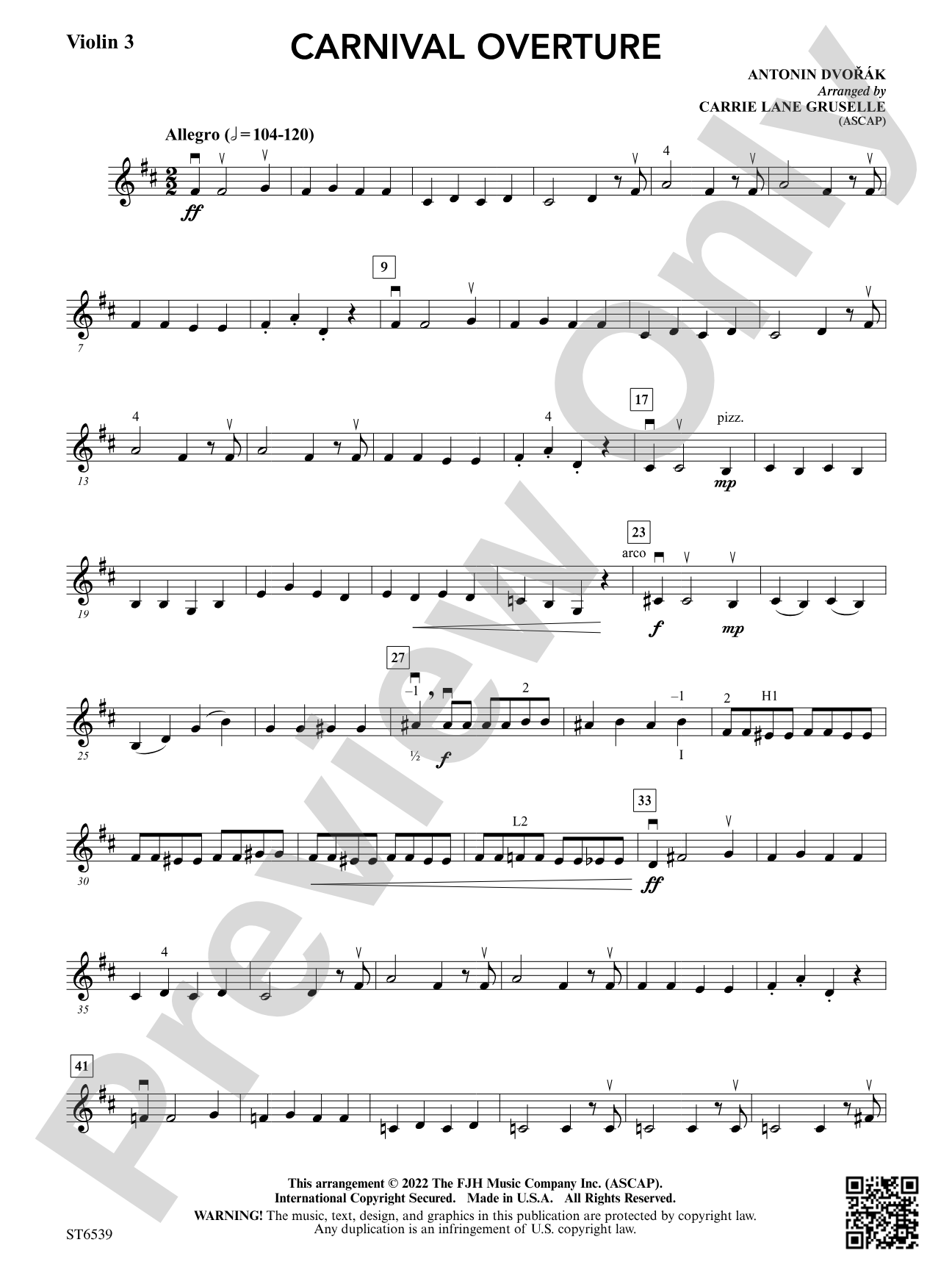

Carnival Overture: Violin 3 (Viola T.C.)
By Antonín Dvorák / arr. Carrie Lane Gruselle
Grade: 3.5
Item: 98-PC-DST6539_VN3
$7.00
Pickup currently not available
Description
The energy and excitement of this thrilling overture is exquisitely captured in this approachable setting for intermediate orchestras! Equally suited as an opener or closer (and everything in between!), your students will shine without being pushed too much technically. An incredible balance between the grandeur of the original and the pedagogical needs of students.


Don't just read it, hear it, play along with it, and watch your students grow with it. In MakeMusic Cloud, Carnival Overture: Violin 3 (Viola T.C.) comes alive with professional accompaniment, adjustable tempo, and built-in practice tools that turn solo practice into real progress.
Open in the Player
Jump straight in and assign it today.
Start Your Free Trial
Open this title and explore the full library in minutes.
Sample Audio
1
Audio File
--:--
0:00
0:00
Sample Video
Additional Details
Series:
FJH String Orchestra
Publisher:
The FJH Music Company, Inc.
SKU:
98-PC-DST6539_VN3
More about this title
About the Composer: Antonín Dvorák
Antonín Dvořák (1841-1904) was a Czech composer whose works bridged Romantic nationalism and the classical traditions of his predecessors. He spent ten years in the United States (1892-1902), including time as director of the National Conservatory in New York, where his symphonies and chamber works earned him international prominence. His Carnival Overture stands among his most performed concert works, showcasing his gift for memorable melody and orchestral color.
For music educators, Dvořák represents both accessibility and substance. His orchestrations sing naturally across instruments, his harmonic language is direct and engaging, and his structural clarity makes his music ideal for developing musicians learning to shape longer forms and understand how themes build a complete musical narrative.
Why we love this
This arrangement captures the exuberance and forward momentum of Dvořák's original without sacrificing the work's essential character or requiring virtuosity from your players. String orchestras at this level rarely get repertoire that sounds this substantial while remaining genuinely playable; the orchestration feels complete and idiomatic without excessive technical demands on individual sections.
What to expect
Festive, propulsive, and genuinely joyful. The piece captures carnival energy through lilting themes, bright harmonic motion, and orchestration that feels spacious and alive. Listeners hear a work of consequence, not a student arrangement; the musical integrity remains intact throughout.
Who it's for
String orchestras at the intermediate level (grades 3-4) seeking a concert opener or closer with real substance. Your students need solid intonation and rhythmic confidence, but not advanced technical skills; this arrangement rewards musicality and ensemble cohesion rather than individual virtuosity.
How to get the most out of it
- Shape the main theme with a singing quality; Dvořák's melodies thrive on lyrical phrasing rather than mechanical precision. Let the natural contour of the line guide your tempo variations.
- Balance the first violins carefully against the inner voices, especially where the arrangement distributes countermelody through the violas and cellos. These supporting lines deserve audibility to maintain harmonic and textural richness.
- Attend to the rhythmic energy in the accompaniment figures. Crisp articulation in the lower strings and violas propels the overture forward and creates the propulsive excitement the piece demands.
- Use the ritardandos and tempo variations as structural signposts rather than indulgences. They should clarify phrase endings and highlight key harmonic moments without losing the overall sense of momentum.
How to use it
Program this as a season opener to set an energetic, confident tone early in your concert. Its celebratory character and moderate duration also make it an excellent closer that leaves audiences with a sense of accomplishment and forward momentum. It works equally well as a centerpiece in a concert built around Romantic orchestral music or as a contrast to heavier contemporary works.
Skills your students will build
- Shaping long melodic lines across phrase boundaries
- Balancing melody and accompaniment across the string section
- Reading and executing rhythmic figures with precision and character
- Sustaining intonation across tempo and dynamic changes
- Understanding sonata form and thematic development in a masterwork context