
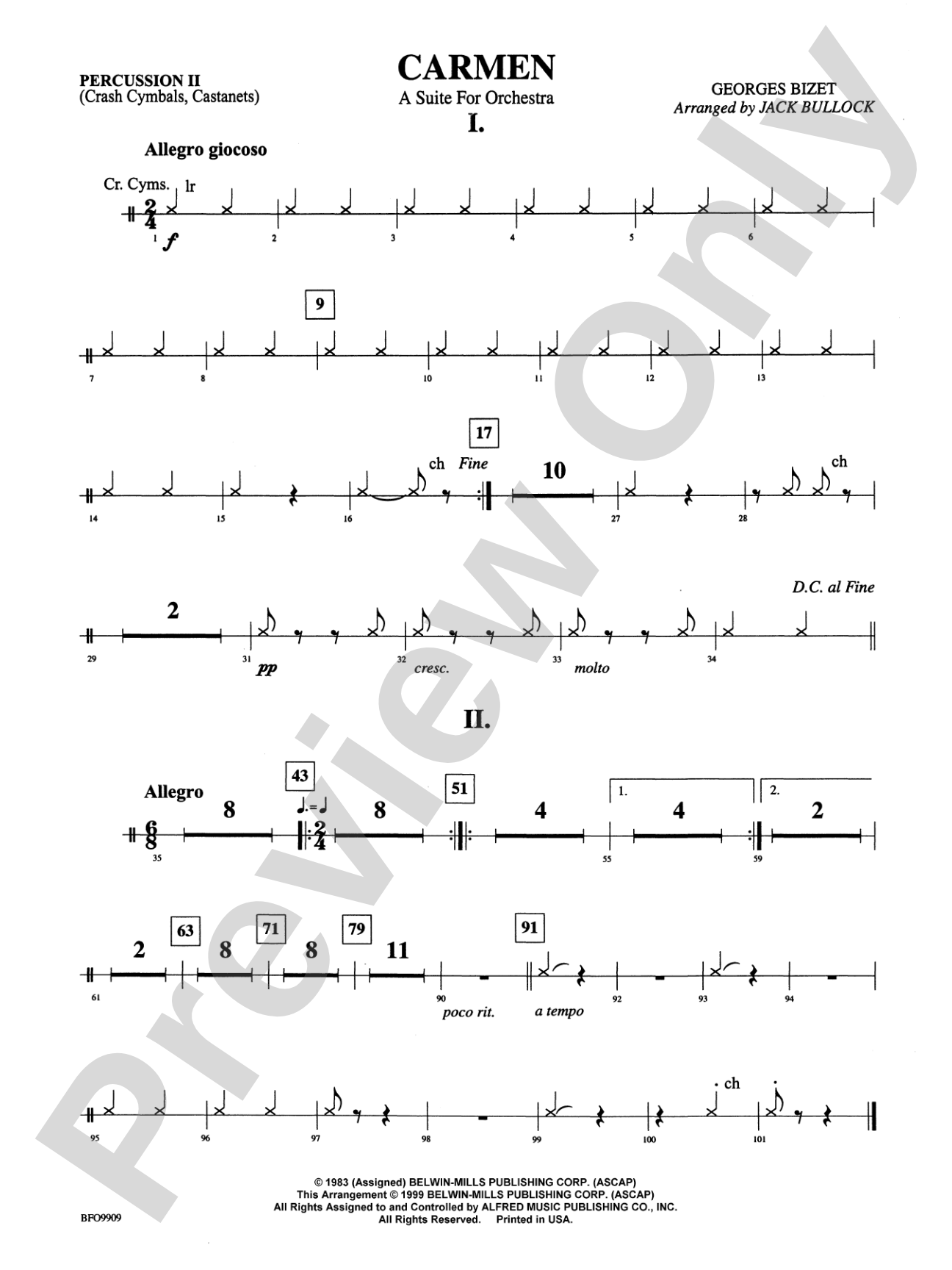

Carmen Suite: 2nd Percussion
By Georges Bizet / arr. Jack Bullock
Grade: 3.5
Item: 00-PC-0015205_PC2
$3.00
Pickup currently not available
Description
Georges Bizet is probably best known today for his opera Carmen. At its premiere, critics (and the audience) found the work unsatisfactory in both content and approach. However, the opera soon became a triumphant success and has since been staged regularly in opera houses throughout the world. This adaptation of the musical score for orchestra, a suite in four movements, retains the spirit of the original production. This is definitely an important new contribution to the repertoire for orchestra. * Movement 1 (1:09) * Movement 2 (1:39) * Movement 3 (1:35) * Movement 4 (2:29).


Carmen Suite: 2nd Percussion isn't in MakeMusic Cloud just yet...but it could be. Let us know you'd like to see it, and you'll help shape what comes next. In the meantime, start a free trial and dive into thousands of interactive titles your students can play along with today.
Request This Title
Tell us you want it.
Start Your Free Trial
Explore everything that's ready to play right now.
Sample Audio
No sample audio found.
Sample Video
No sample videos found.
Additional Details
Series:
Belwin Concert Full Orchestra
Publisher:
Alfred Music
Page Count:
360
SKU:
00-PC-0015205_PC2
More about this title
About the Arranger: Jack Bullock

Jack Bullock brings deep practical experience across performance, composition, and education to his arranging work. A trumpet player who performed with the Miami Philharmonic Orchestra and Miami Opera Company, he studied under renowned pedagogues Harry Glantz, James Ode, and Craig McHenry. His credentials include undergraduate, graduate, and doctoral degrees in Music Education, and he taught instrumental music in K-12 classrooms for two decades before joining the faculty at Ithaca College's School of Music, where he served as assistant band director and chaired the Music Education Department.
With over 600 published works for concert band, orchestra, jazz ensemble, and marching band, Bullock has shaped music curriculum at the national level. He co-authored the Belwin 21st Century Band Method and contributed arrangements to Music Expressions, Alfred Music's comprehensive school music program. His work has earned recognition in Who's Who in Entertainment and he has held ASCAP membership since 1980, conducting clinics and workshops across North America and internationally.
Why we love this
Bullock's arrangement captures the theatrical brilliance of Carmen while respecting the orchestral textures and dramatic arcs that made Bizet's original unforgettable. At Grade 3.5, the four-movement suite balances accessibility with musical substance, offering orchestras a substantial concert work that feels substantial without overwhelming younger or less experienced ensembles. The suite structure gives you natural programming flexibility while maintaining the opera's signature energy and character.
What to expect
Carmen Suite radiates dramatic flair and visceral energy. Bullock's orchestration preserves the opera's Spanish-inflected themes, driving rhythms, and moments of genuine passion, creating a concert experience that captures the work's theatrical vitality without requiring a stage or singers.
Who it's for
This arrangement is ideal for developing orchestras, youth orchestras, and high school orchestras seeking a major work with genuine musical authority. Conductors will appreciate the Grade 3.5 level, which challenges students with orchestral textures and musical sophistication while remaining technically within reach for mixed-ability ensembles.
How to get the most out of it
- Balance the lyrical passages in Movement 2 by supporting the principal melodic voice while keeping accompaniment figures transparent; Bizet's gift for memorable melody deserves clear projection throughout the ensemble.
- Maintain rhythmic precision in the faster sections, particularly Movement 4, where the propulsive energy depends on clean articulation and tight ensemble alignment in the lower voices and percussion.
- Shape the dramatic arcs within each movement by varying dynamic and tempo interpretations across rehearsals; small flexibility in phrasing will reveal the operatic storytelling embedded in each section.
- Work the brass and woodwind solos carefully in sectionals, as they carry thematic material that non-principals need to recognize and support when doubling or accompanying.
How to use it
Program this as a cornerstone work for a spring or fall concert, pairing it with smaller masterwork arrangements or contemporary pieces to create a balanced concert arc. The four-movement structure works equally well as a standalone feature or as part of a thematic program exploring operatic music in the orchestra.
Skills your students will build
- Reading compound and syncopated rhythmic figures across multiple instrumental lines
- Balancing lyrical and energetic passages within a single work
- Responding to operatic phrasing and dramatic intent in orchestral arrangements
- Coordinating between principal voices and supporting harmonic textures
- Understanding how theatrical source material translates to concert orchestral writing