
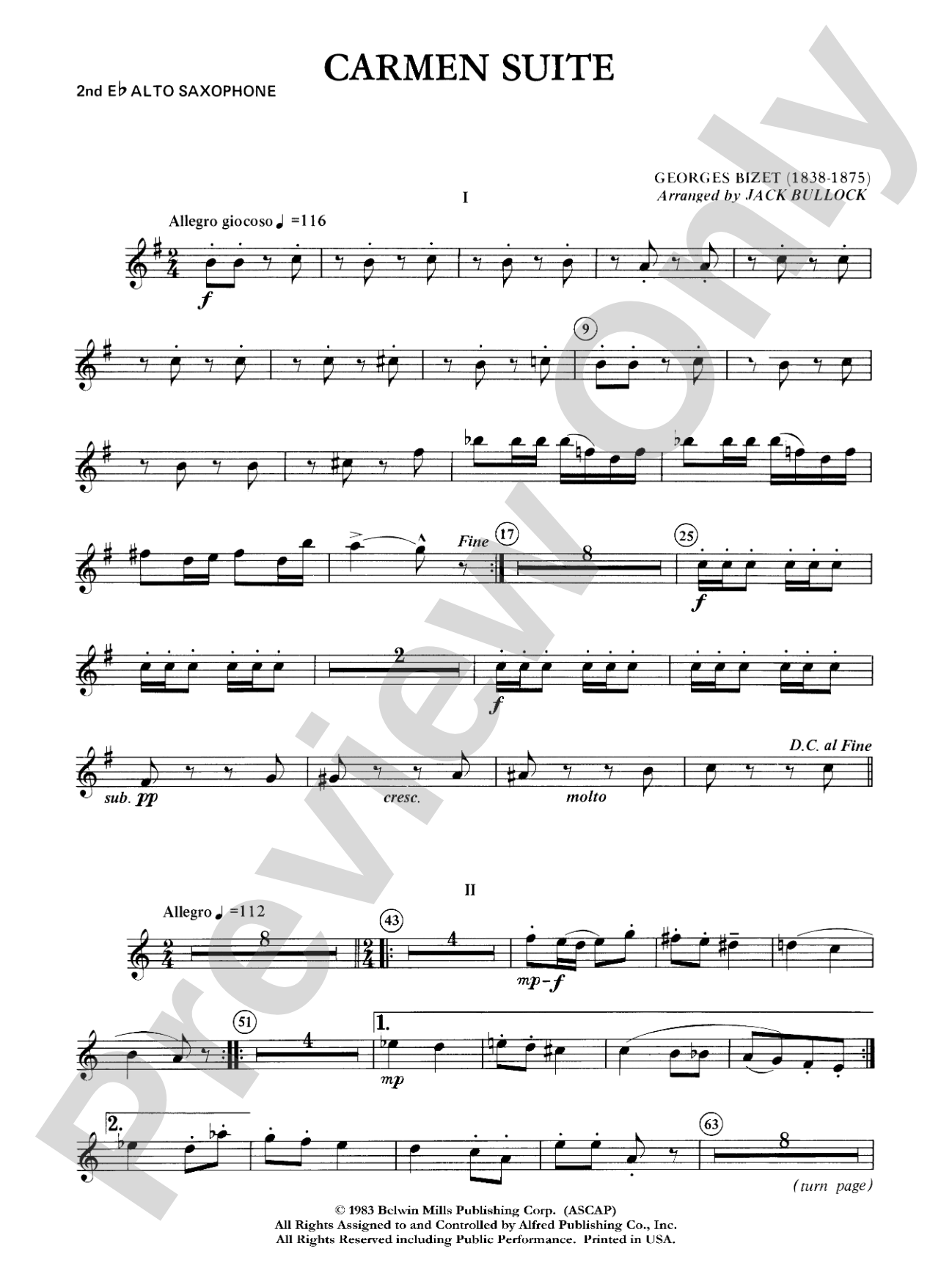

Carmen Suite: 2nd E-flat Alto Saxophone
By Georges Bizet / arr. Jack Bullock
Grade: 4 (Medium)
Item: 00-PC-0000004_AX2
$3.00
Pickup currently not available
Description
The story of Carmen is set in Seville, Spain, in 1820. It is story of a passionate, fickle, gypsy girl, Carmen, who is one of six major roles in the opera. The story, in four acts, is action-packed, animated, flowing, and never uninteresting. Bizet was well acquainted with Spanish folklore and folk music through his many visits to Spain. For Carmen, he composed a score that is rhythmical, tuneful, and characteristic of the gypsy lifestyle. The adaptation for concert band is a suite in four movements that retains the spirit of the original production.


Carmen Suite: 2nd E-flat Alto Saxophone isn't in MakeMusic Cloud just yet...but it could be. Let us know you'd like to see it, and you'll help shape what comes next. In the meantime, start a free trial and dive into thousands of interactive titles your students can play along with today.
Request This Title
Tell us you want it.
Start Your Free Trial
Explore everything that's ready to play right now.
Sample Audio
No sample audio found.
Sample Video
No sample videos found.
Additional Details
Series:
Symphonic Band
Publisher:
Alfred Music
Page Count:
314
SKU:
00-PC-0000004_AX2
More about this title
About the Arranger: Jack Bullock

Jack Bullock brings decades of practical experience across performance, composition, and education to his arranging work. A trumpet performer who played with the Miami Philharmonic Orchestra and Miami Opera Company, he studied with prominent teachers including Harry Glantz and Craig McHenry, and performed regionally and nationally with dance bands and show orchestras. His formal training in music education (undergraduate through doctorate) grounded him in both the theoretical and pedagogical sides of the craft.
As a prolific arranger, Bullock has created over 600 publications for concert band, orchestra, jazz ensemble, and marching band. He co-authored the Belwin 21st Century Band Method and contributed arrangements to Music Expressions, Alfred Music's comprehensive school curriculum. His twenty years teaching instrumental music in the classroom, including seven years as assistant band director at Ithaca College's School of Music, inform his ability to write idiomatically for student musicians. He has conducted clinics across the United States, Canada, and England, and is an ASCAP member since 1980.
Why we love this
Bullock's arrangement captures the opera's narrative sweep without losing the tunefulness that makes Carmen so immediately engaging for audiences. The four-movement suite structure lets your band tell the complete story while maintaining the characteristic Spanish rhythms and melodic generosity of Bizet's original, and Grade 4 scoring ensures your ensemble can handle the dramatic shifts without drowning in technical complexity.
What to expect
Spanish sunlight, passion, and intrigue unfold across four distinct scenes. The writing crackles with the rhythmic energy of gypsy life and swells with operatic melody; moments of tenderness sit alongside explosive dramatic peaks, keeping the audience invested in the unfolding story.
Who it's for
Band directors seeking a concert piece that combines narrative interest with solid Grade 4 accessibility, and ensembles ready to tackle a masterwork arrangement that demands musicality without excessive technical difficulty. This suite works for programs that want their band to engage with operatic material on concert band terms.
How to get the most out of it
- Honor the Spanish rhythmic character by shaping the percussion parts with clarity and drive; the guitar and castanets figures should sit comfortably in front of the ensemble, never buried.
- Balance the interplay between woodwind and brass melodies carefully through each movement; Carmen's themes pass between sections, and clarity here preserves the dramatic arc.
- Watch the transitions between movements for clean cutoffs and breathing room; they're architectural moments that deserve attention.
- Let the romantic passages breathe without losing momentum; Bizet's gift for long-lined melody works only if players shape phrases with real intention.
How to use it
Program this as the centerpiece of a concert exploring romantic masterworks, or pair it with other Spanish-inflected repertoire to build a cultural theme. Its narrative clarity and four-movement architecture make it ideal for a concert's second half, where it can command full attention without the weight of an extended symphonic work.
Skills your students will build
- Balancing lyrical melody across changing instrumental colors
- Executing Spanish rhythmic figures with precision and style
- Navigating sectional transitions and large formal structures
- Sustaining musicality through contrasting tempos and textures
- Responding to dramatic content through dynamic and tonal shaping