
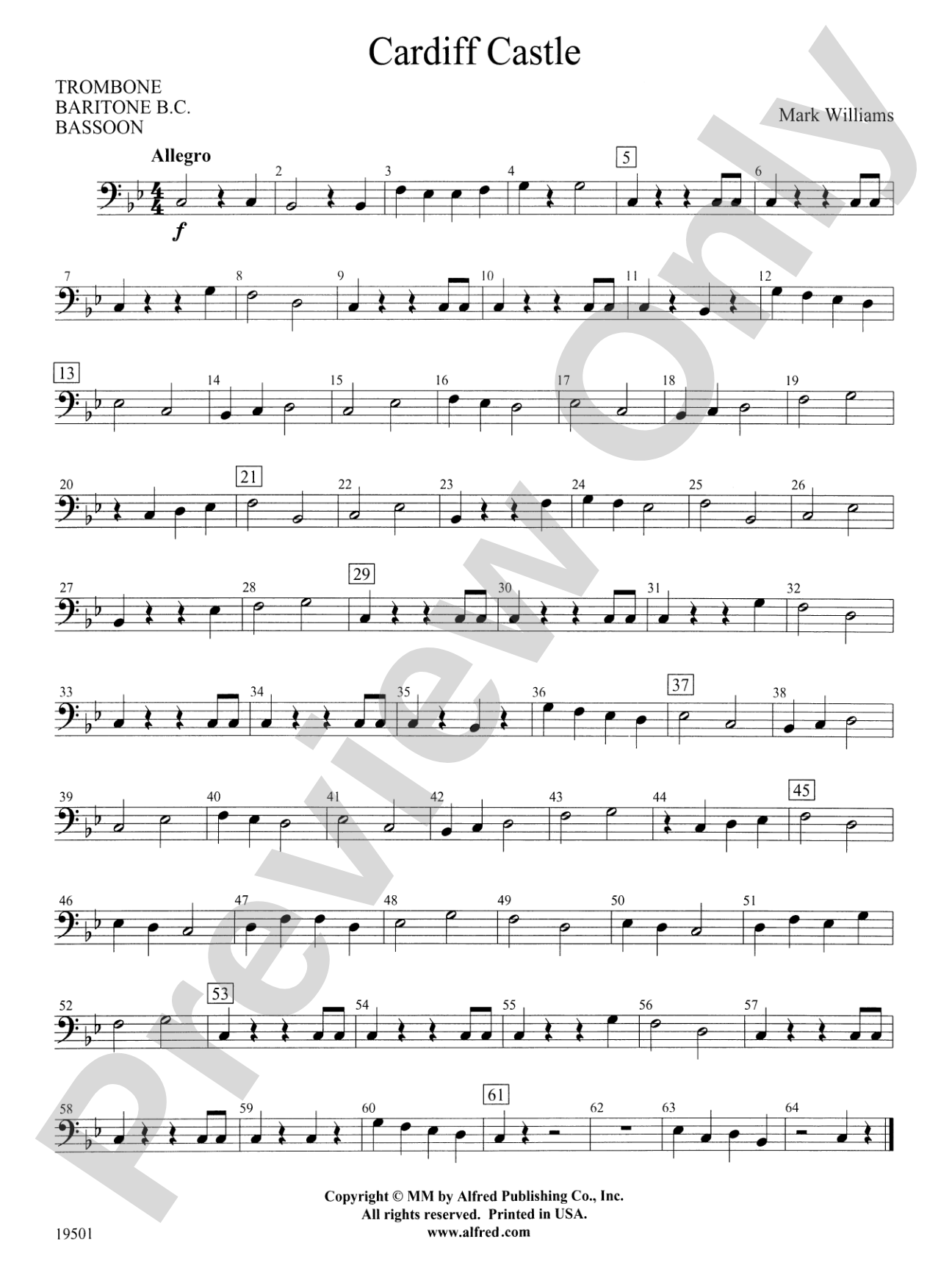

Cardiff Castle: 1st Trombone
By Mark Williams
Grade: 1 (Very Easy)
Item: 00-PC-0000319_TN1
$3.00
Pickup currently not available
Description
The sounds of a valiant knight going into battle are heard in this powerful original by Mark Williams. Correlated with Accent on Achievement, Book 1, page 13, this work uses only seven notes yet sounds surprisingly sophisticated. Named after the famous castle in Cardiff, Wales, this selection will make your first-year band sound great. An excellent introduction to the modal sounds of Medieval and Celtic music.


Don't just read it, hear it, play along with it, and watch your students grow with it. In MakeMusic Cloud, Cardiff Castle: 1st Trombone comes alive with professional accompaniment, adjustable tempo, and built-in practice tools that turn solo practice into real progress.
Open in the Player
Jump straight in and assign it today.
Start Your Free Trial
Open this title and explore the full library in minutes.
Sample Audio
1
Audio File
--:--
0:00
0:00
Sample Video
Additional Details
Series:
Accent on Achievement
Publisher:
Alfred Music
Page Count:
116
SKU:
00-PC-0000319_TN1
More about this title
About the Composer: Mark Williams

Mark Williams built his reputation as one of the most prolific and accessible composers for school ensembles, with over 200 published works spanning band, orchestra, and choral settings. A native of Chicago who spent his formative years in Spokane, Washington, he devoted his career to elementary band instruction while maintaining an active schedule as a clinician and guest conductor across the United States, Canada, and Australia. His work as co-author of the Accent on Achievement Band Method shaped how countless young musicians learned to read and play.
Williams earned his degrees from Eastern Washington University and brought both compositional skill and practical classroom experience to every piece he wrote. Beyond his writing, he was an accomplished bassoon performer and served as conductor and artistic director for the Spokane British Brass Band. His contributions earned recognition through the Western International Band Clinic's Gralia Competition and multiple ASCAP Special Awards, cementing his legacy as a composer who understood exactly what beginning and developing bands needed to grow musically.
Why we love this
Mark Williams knew how to write for first-year bands without talking down to them. This piece proves that using only seven notes doesn't mean sacrificing musicality or sophistication. The modal language and Medieval/Celtic flavor give your ensemble something genuinely interesting to play and hear, which keeps young musicians engaged and eager to perform.
What to expect
Medieval pageantry meets Celtic mystery. The opening conjures the sound of a valiant knight preparing for battle, with fanfare-like figures that feel both ancient and strangely modern through the modal harmony. The piece has weight and purpose despite its brevity and limited note set, creating a genuine sense of drama and adventure that will resonate with young players and audiences alike.
Who it's for
First-year concert bands and elementary band students ready to tackle their first repertoire beyond method book exercises. Teachers using Accent on Achievement, Book 1 will find this a natural and perfectly calibrated extension of the method's curriculum. This works equally well for festival and contest contexts where Grade 1 pieces are required.
How to get the most out of it
- Shape the opening fanfare with clear articulation to establish the knightly character. Young players will respond well to a literal description of what they're playing—the call to battle, not just a collection of notes.
- Let the modal color breathe. Resist rushing; the magic of this piece comes from the sustained and deliberate quality of the harmony, which will sound more sophisticated if you give it space.
- Balance the melody across your section. With limited note material, uneven playing becomes immediately obvious, so encourage careful listening and adjustment among the players carrying the main line.
- Use this as an opportunity to discuss the relationship between simplicity and impact. Young musicians often equate difficulty with musicality; this piece beautifully demonstrates that isn't true.
How to use it
Pair this with other Grade 1 selections to create a thematic concert around world music, history, or fantasy. Its accessible difficulty makes it ideal for early-season performances while your ensemble is still building technical facility. The Medieval/Celtic flavor also works beautifully as a natural bridge into more complex modal repertoire later in the year.
Skills your students will build
- Reading and performing with consistent articulation across the full band
- Understanding modal tonality and how it differs from major/minor scales
- Balancing melody and harmony when working with limited pitch material
- Sustaining longer phrases and resisting the urge to rush through simpler music
- Responding to expressive conducting and understanding character-driven performance