Caravan: Lead Sheet Digital Sheet Music

Caravan: Lead Sheet Digital Sheet Music

Duke Ellington, Juan Tizol

Item: 00-PS-0009068

Digital Download
$1.99
Description

Caravan: Lead Sheet Digital Sheet Music isn't in MakeMusic Cloud just yet...but it could be. Let us know you'd like to see it, and you'll help shape what comes next. In the meantime, start a free trial and dive into thousands of interactive titles your students can play along with today.

Sample Audio
No sample audio found.
Sample Video
Additional Details
SKU: 00-PS-0009068

More about this title

About the Artist: Duke Ellington

Duke Ellington (1899-1974) stands as one of the most consequential composers in American music history. His career spanned five decades, during which he wrote over a thousand compositions that pushed jazz beyond improvisation into sophisticated orchestral art. Ellington's harmonic innovations, orchestration techniques, and prolific output fundamentally shaped how jazz could be composed, arranged, and performed at the highest levels.

As a bandleader, pianist, and composer, Ellington created a body of work that bridges jazz, popular song, and concert music. His pieces remain central to jazz education because they demonstrate how melody, harmony, and structure can serve both improvisation and composition. Many of his standards have become essential learning repertoire for musicians across all skill levels.

Why we love this

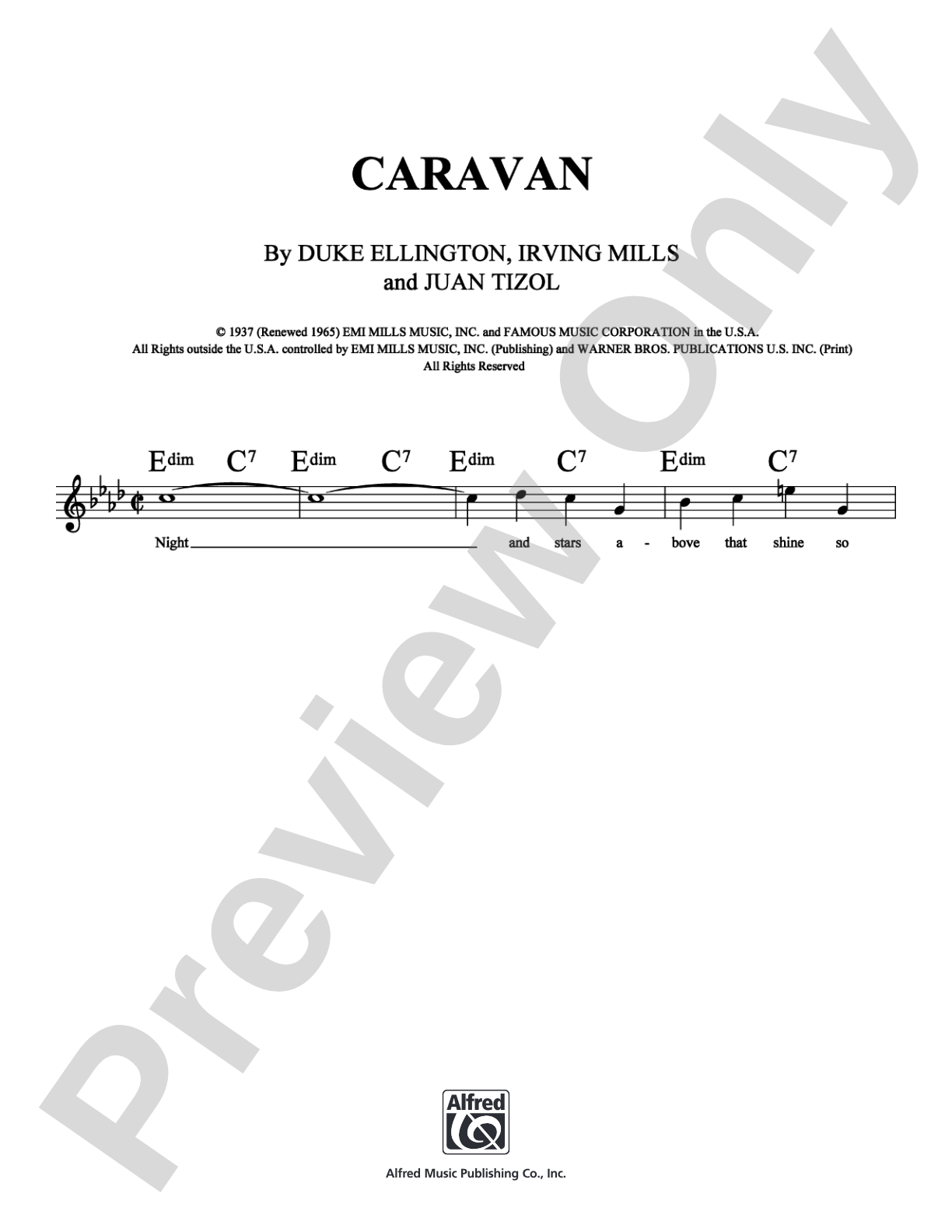
Caravan is instantly recognizable and endlessly rewarding to work with in any jazz ensemble setting. The lead sheet format preserves Ellington's harmonic sophistication while leaving room for genuine musical invention, making it equally valuable for student combos exploring chord changes and professional ensembles developing interpretive depth. Musicians at every level connect with this piece because its exotic character and strong melodic hook invite both careful listening and creative risk-taking.

What to expect

Caravan conjures images of exotic travel and mystery from its opening notes, combining a steady, propulsive groove with lush harmonic color. The melody has an almost hypnotic quality, built from repetition and subtle variation, while the chord changes suggest movement through unexpected harmonic territories. It feels both grounded in jazz tradition and distinctly individual, capable of sounding contemplative or energetic depending on how an ensemble approaches it.

Who it's for

Jazz ensemble directors, combo leaders, and serious jazz students learning to read lead sheets and navigate jazz standards with harmonic depth. Pianists and guitarists developing their comping skills will find Caravan's chord progression both challenging and musically rewarding. Improvisers at intermediate level and beyond benefit from this piece's rich harmonic movement and clear structural divisions.

How to get the most out of it

  • Study the original recording and at least one other well-known interpretation before settling on your own approach; Caravan rewards musicians who understand its recorded tradition while developing personal voice.
  • Pay particular attention to the bridge section and how the harmony shifts; these changes define the piece's architecture and give improvisers clear landmarks for their solos.
  • Lock the tempo early and maintain it with confidence; the piece's rhythmic drive depends on steady time, especially when soloists begin layering complexity on top of the groove.
  • Balance precision on the written melody with space for rubato and swing feel once the solos begin; Ellington's notation is a starting point, not a boundary.

How to use it

Feature this as a centerpiece for a jazz combo performance, where its harmonic sophistication allows multiple soloists meaningful room to develop ideas. Pair it with other Ellington standards or mid-century jazz repertoire to build a cohesive set that traces the evolution of jazz composition. Use it in workshop settings to teach lead sheet reading, chord symbol interpretation, and how to build arrangements from a single melodic line.

Skills your students will build

  • Reading jazz lead sheet notation and chord symbols
  • Navigating and comping over a 32-bar form with sophisticated harmonic movement
  • Understanding song structure (AABA or similar) and using it as a framework for improvisation
  • Developing swing feel and rhythmic precision while leaving space for interpretation
  • Listening to and learning from recorded jazz tradition

You May Also Like