
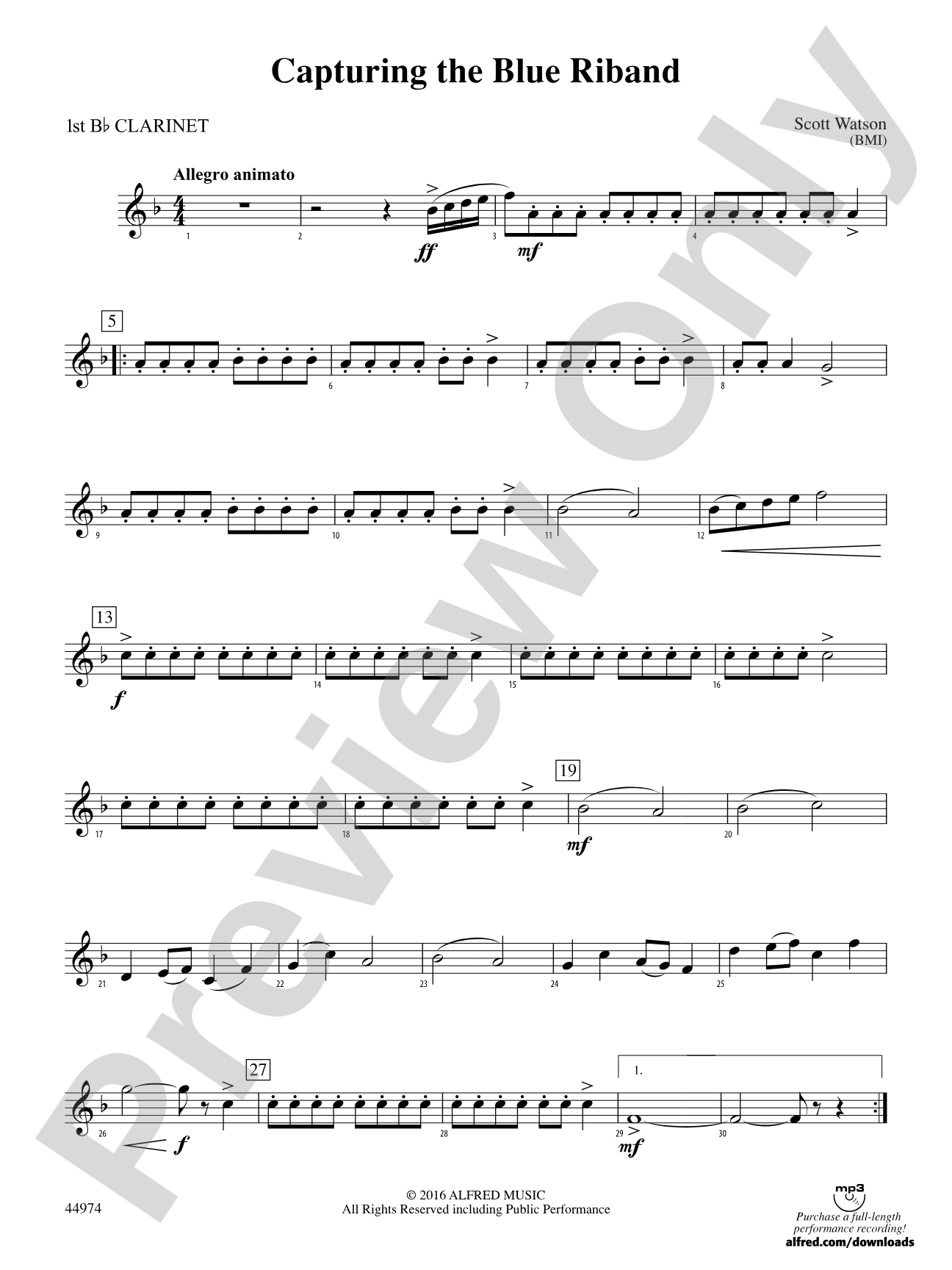

Capturing the Blue Riband: 1st B-flat Clarinet
By Scott Watson
Grade: 1.5 (Easy)
Item: 00-PC-0017439_C1
$3.00
Pickup currently not available
Description
"Capturing the Blue Riband" musically celebrates the excitement and sense of occasion experienced when traveling aboard the grand, early 20th century transatlantic liners, such as the Queen Mary and Lusitania. The Blue Riband was the coveted trophy bestowed on the vessel that clocked the fastest transatlantic time. The energetic opening and closing sections of this piece evoke the exhilaration of taking to the sea in this historic race of prestige, while a contrasting section conveys the sense of grandeur and honor central to the era and the award. (3:05)


Don't just read it, hear it, play along with it, and watch your students grow with it. In MakeMusic Cloud, Capturing the Blue Riband: 1st B-flat Clarinet comes alive with professional accompaniment, adjustable tempo, and built-in practice tools that turn solo practice into real progress.
Open in the Player
Jump straight in and assign it today.
Start Your Free Trial
Open this title and explore the full library in minutes.
Sample Audio
1
Audio File
--:--
0:00
0:00
Sample Video
Additional Details
Series:
Challenger Band Series
Publisher:
Alfred Music
Page Count:
168
SKU:
00-PC-0017439_C1
More about this title
About the Composer: Scott Watson

Scott Watson brings three decades of classroom experience to his work as a composer and educator. After spending 35 years teaching instrumental music in the Parkland School District (Allentown, PA), where he directed the high school band program and later coordinated elementary band and strings across the district, he transitioned to higher education as Associate Professor of Music at Cairn University in Langhorne, PA. His compositions reflect this dual foundation: they emerge from deep familiarity with what student musicians can achieve, shaped also by serious study of contemporary concert music.
Watson has composed more than 120 works for concert band, string orchestra, and chamber ensembles spanning all grade levels. His music appears regularly on festival and contest programs nationwide and has been performed at prestigious venues including the Academy of Music in Philadelphia, the Midwest Clinic in Chicago, and the White House. He serves as exclusive composer and clinician for Alfred Publications, contributes to their Sound Innovations series, and authored the music education text Using Technology to Unlock Musical Creativity (Oxford University Press, 2011). More information is available at www.scottwatsonmusic.com.
Why we love this
Watson nails the balance between narrative clarity and genuine musical substance. The piece unfolds with unmistakable character: you hear the ocean, the pride, the speed of competition, and the elegance of the era, yet every section serves the band's musical development. At Grade 1.5, it's approachable for younger or less experienced groups without ever feeling simplistic, making it ideal for building confidence while maintaining engagement.
What to expect
You're standing on the deck as the ship cuts through the Atlantic in full competitive glory. The opening brims with forward momentum and optimism, the middle settles into refined elegance and pageantry, and the closing reclaims that exhilaration with confidence. The piece conjures the romance of ocean travel in the early 20th century without nostalgia: it's vivid, immediate, and thrilling.
Who it's for
Directors working with Grade 1.5 concert bands who want narrative substance alongside technical accessibility. The piece suits festival and contest settings, and it engages bands that benefit from music connected to real-world history and visual imagery.
How to get the most out of it
- Establish the tempo clearly in the energetic opening and closing sections. The driving rhythm is what sells the excitement of the transatlantic race, so conduct with precision and energy to lock the ensemble's pulse.
- Shape the contrasting middle section with legit phrasing and dynamic control. This passage showcases the grandeur of the era, so encourage players to listen for longer melodic lines and support the harmonic movement with sustained tone quality.
- Balance the accompanying figures against the principal melodies throughout. Concert band textures can easily blur at this level, so highlight who carries the tune and what's there for support during sectional rehearsals.
- Use the full three-minute arc to build drama. The piece asks for restraint in the middle and then recovery of momentum toward the finale, so rehearse the shape as a single journey rather than isolated sections.
How to use it
Open a concert or festival set with this piece to establish energy and narrative interest. Its 3:05 length pairs well with longer works, and the historical subject makes a natural program note that connects audiences to the music. It also works as a confident choice for early-season festivals when your band is still solidifying fundamentals.
Skills your students will build
- Sustaining steady tempo and articulation in rhythmically active passages
- Listening for and balancing melody against accompaniment figures
- Shaping longer musical lines with dynamic control and phrasing
- Responding to tempo and character changes across contrasting sections
- Building ensemble tone quality at sustained dynamic levels