Captain O'Kane's Lament: 1st Violin Sheet Music Preview

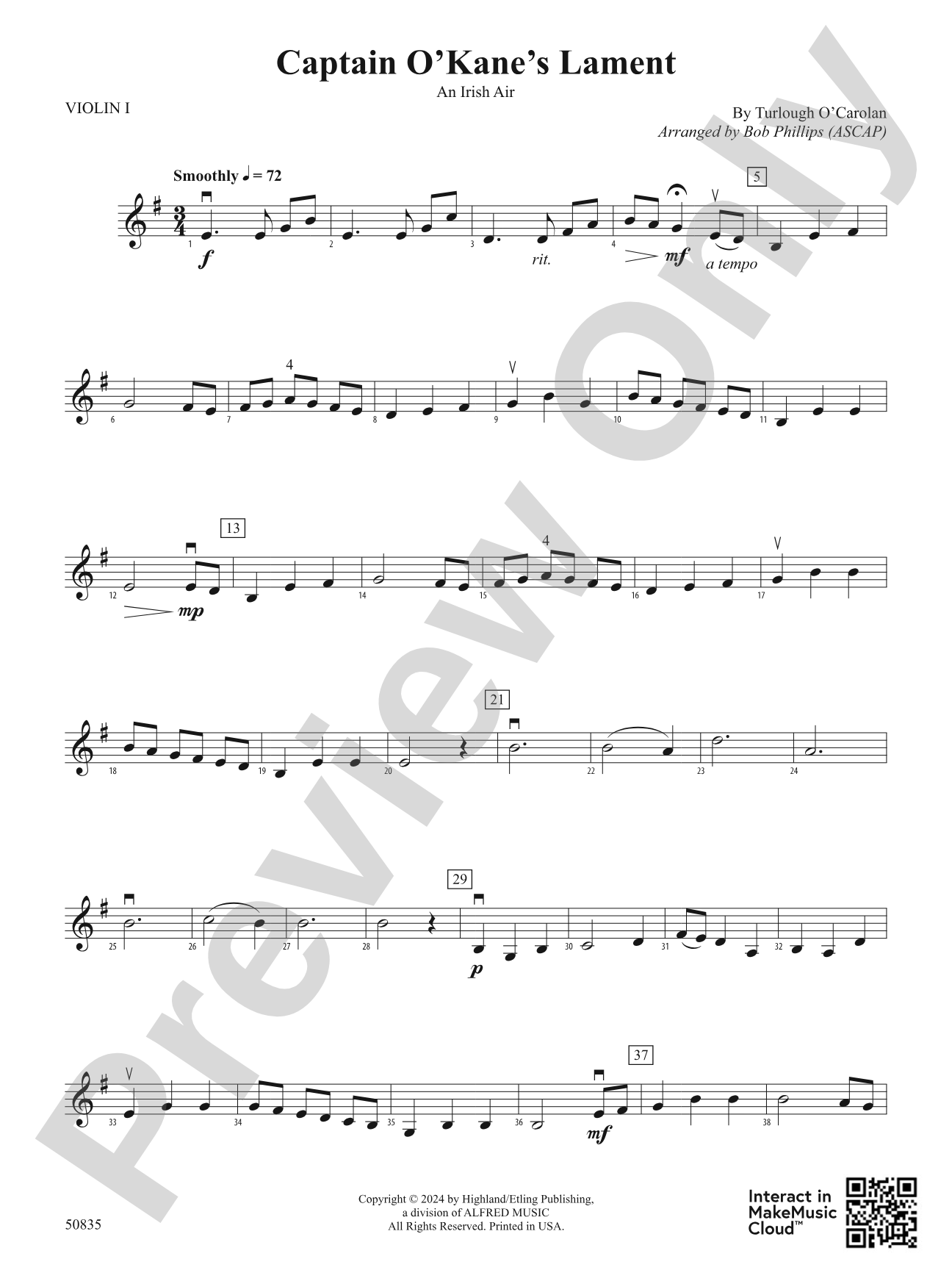
Captain O'Kane's Lament: 1st Violin

An Irish Air

By Turlough O'Carolan / arr. Bob Phillips

Grade: 2.5

Item: 00-PC-0019282_VN1

Digital Download
$3.00
Description
A beautiful melody in a stunning setting with flowing counterpoint that provides opportunities for every section to play both the tune and the harmony! This is a perfect festival piece for both middle and high school, even though it is all in first position, except for the basses, who shift to 3rd position. This setting of Captain O'Kane's Lament (An Irish Air), by Bob Phillips, is highly playable and will become a favorite. (3:10)

Don't just read it, hear it, play along with it, and watch your students grow with it. In MakeMusic Cloud, Captain O'Kane's Lament: 1st Violin comes alive with professional accompaniment, adjustable tempo, and built-in practice tools that turn solo practice into real progress.

Sample Audio
0:00
0:00
Sample Video
Additional Details
Series: Highland/Etling String Orchestra
Publisher: Alfred Music
SKU: 00-PC-0019282_VN1

More about this title

About the Composer: Turlough O'Carolan

Turlough O'Carolan (1670-1738) was an Irish harper and composer whose work bridges the Baroque era and Irish folk tradition. Blind from childhood, he became one of Ireland's most celebrated musicians, traveling throughout the country and composing both instrumental pieces and songs that reflected the landscapes and patrons he encountered. His melodies remain central to Irish musical identity and continue to inspire arrangements across centuries.

For music educators, O'Carolan's legacy matters because his compositions are deeply singable and inherently expressive, making them ideal vehicles for teaching musicality at all levels. His melodies reward careful phrasing and sensitivity to shape, qualities that serve young players well whether they're encountering Irish traditional music for the first time or deepening their understanding of how folk melody functions as a foundation for harmony.

Why we love this

Bob Phillips's arrangement distributes both melody and counterpoint across the entire ensemble, ensuring every player has something substantive to do rather than padding out a texture. The all-first-position writing for violins and violas (with only 3rd position for basses) removes technical barriers and lets the group focus on ensemble blend and singing tone from the opening notes.

What to expect

A contemplative melody that unfolds with Irish warmth and restraint, supported by gentle harmonic movement that creates depth without complexity. The interweaving of melody and counterpoint gives the piece a sense of conversation between the voices, as though the tune is being passed through a gathering of musicians, each adding their own voice to the story.

Who it's for

Middle and high school string orchestras of intermediate ability looking for festival and contest repertoire that doesn't sacrifice musical substance for accessibility. Directors seeking a piece where every student plays a genuine part of the musical conversation, not just rhythmic filler.

How to get the most out of it

  • Shape the melody with a consistent vibrato regardless of which section carries it; the tune should feel like a single voice moving through the orchestra rather than shifting focus each time it passes to new players.
  • Balance the counterpoint by having inner voices listen for the harmonic motion underneath the melody line; this prevents accompaniment figures from overwhelming the main tune.
  • Use the 3:10 duration as a guide to tempo; resist the urge to drag, which can make the flowing lines feel static.
  • Emphasize the lyrical quality of the Irish air by allowing slight rubato in phrase endings, giving the melody room to breathe without losing rhythmic cohesion in the supporting parts.

How to use it

Program this alongside other folk-inspired or arranged repertoire to create a thematic concert half exploring how traditional melodies translate across time and cultural contexts. Its modest length and moderate demands make it an excellent opener that settles an audience while establishing a refined, artistic tone for the concert.

Skills your students will build

  • Playing sustained harmonic lines that support a mobile melody
  • Blending tone across sections while maintaining clear individual voice independence
  • Identifying and bringing out countermelodies in scored arrangements
  • Managing position shifts (basses) in service of intonation and phrasing
  • Shaping a phrase that passes between instrumental families

You May Also Like