
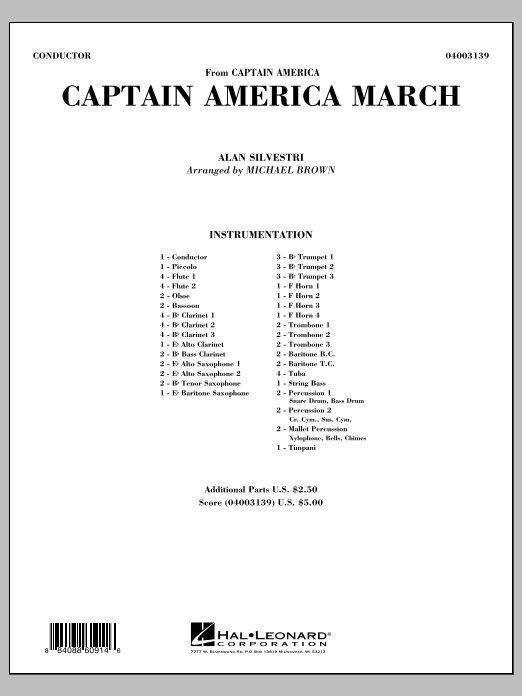

Captain America March: Concert Band Conductor Score & Parts
By Alan Silvestri / Arranged by Michael Brown
Grade: 4
Item: 35-PK00200393
$75.00
Pickup currently not available
Buy Extra Parts (Digital PDF Download)
Parts Added to Cart!
Description
From the summer blockbuster film "Captain America: The First Avenger", composer Alan Silvestri has created a powerful and memorable march based on the main theme. Skillfully adapted for the concert stage by Michael Brown, here is an exciting and uplifting march for mature groups. Dur: 2:40


Captain America March: Concert Band Conductor Score & Parts isn't in MakeMusic Cloud just yet...but it could be. Let us know you'd like to see it, and you'll help shape what comes next. In the meantime, start a free trial and dive into thousands of interactive titles your students can play along with today.
Request This Title
Tell us you want it.
Start Your Free Trial
Explore everything that's ready to play right now.
Sample Audio
No sample audio found.
Sample Video
No sample videos found.
Additional Details
Publisher:
Hal Leonard
SKU:
35-PK00200393
More about this title
About the Composer: Alan Silvestri
Alan Silvestri has scored some of Hollywood's biggest action and adventure films, bringing orchestral sophistication to blockbuster cinema. His gift for memorable melodic material combined with dynamic orchestration makes his film themes natural fits for concert band adaptation, where his harmonic language and structural clarity shine through effectively.
Why we love this
This march captures genuine heroic energy without relying on bombast alone. Michael Brown's adaptation respects Silvestri's original intent while understanding what makes a march work for concert band, so you get a piece that energizes audiences and players equally. It's substantial enough for mature groups yet accessible enough to execute with precision.
What to expect
Stirring and forward-moving, with a melody that lodges itself in memory. The march unfolds with cinematic scope, building momentum through skillful orchestration that reminds you why this theme resonated in the theater.
Who it's for
Mature concert bands at the Grade 4 level who want crowd-pleasing repertoire with genuine musical substance. This works especially well for groups with secure fundamentals and enough players to balance the full concert band voicing.
How to get the most out of it
- Establish the march tempo confidently in rehearsals before drilling individual sections; the rhythmic precision of the ensemble depends on a rock-solid pulse from downbeat one.
- Balance the melodic line across your first section so it projects clearly over the harmonic foundation, particularly in passages where the theme passes between upper and lower voices.
- Shape the dynamic arch across the full two minutes and forty seconds to sustain interest. Avoid playing at a constant forte throughout; let the score breathe with its natural contours.
- Pay attention to articulation consistency in rhythmic figures that appear across multiple sections. Aligned tonguing and staccato technique unify the march character.
How to use it
Program this as a first-half closer or opener for pops concerts, or position it as a strong contrast within a concert mixing classical and contemporary works. The film connection makes it particularly effective for family-friendly concerts or school events where audiences recognize the source material.
Skills your students will build
- Maintaining steady march rhythm across sectional transitions
- Executing balanced voicing when the melody distributes across multiple instruments
- Sustaining dynamic control through a moderate-length single-movement form
- Responding to conductor direction within a cinematic, non-traditional harmonic framework