
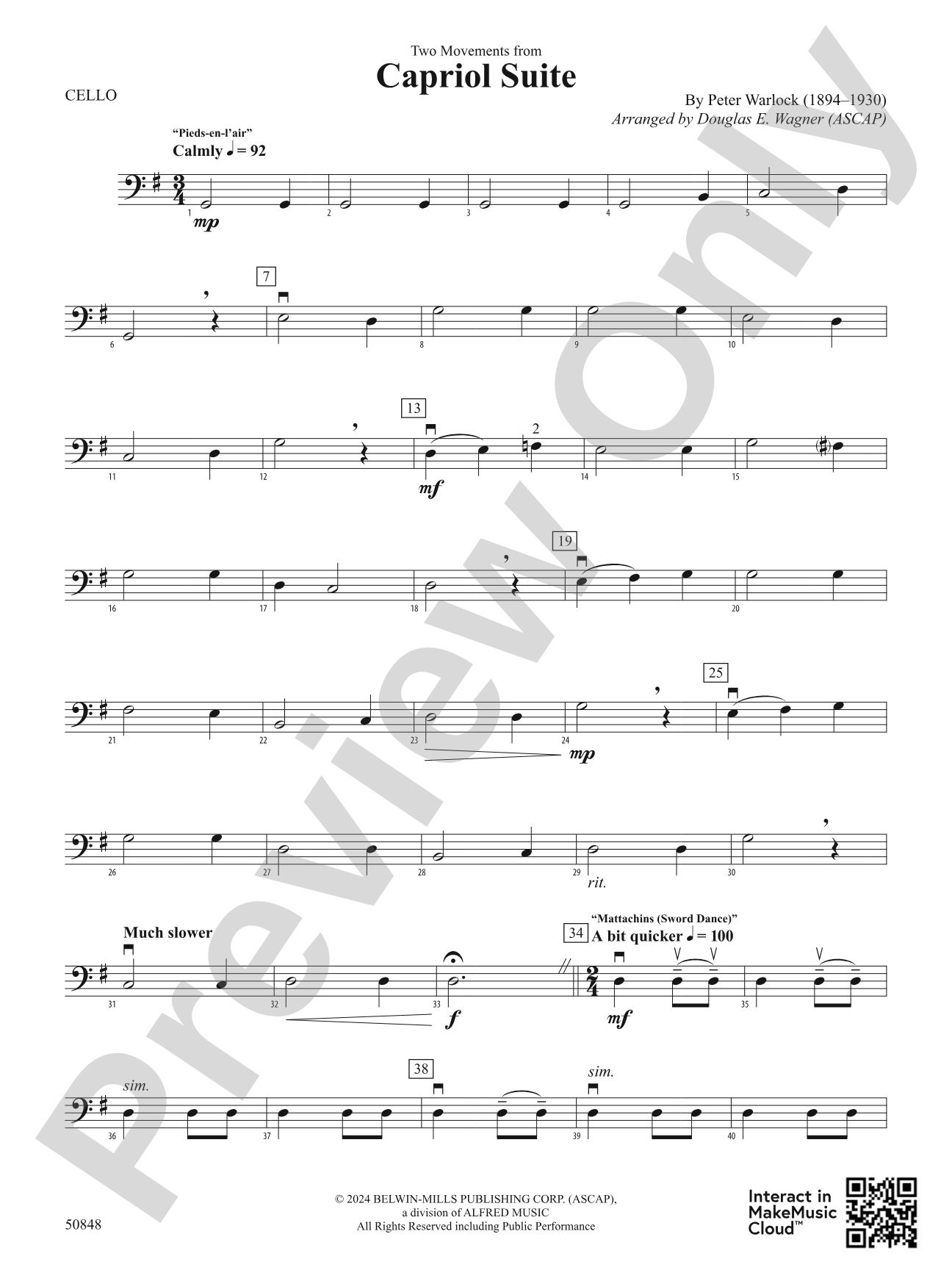

Capriol Suite: Cello
By Peter Warlock / arr. Douglas E. Wagner
Grade: 2
Item: 00-PC-0019328_VC1
$3.00
Pickup currently not available
Description
Capriol Suite, by British composer Philip Arnold Heseltine (who wrote under the nom de plume Peter Warlock), is a set of six stylized Renaissance dances drawn from Thoinot Arbeau's comprehensive late-sixteenth-century vade mecum on the subject, "Orchésographie." The last two contrasting movements of the suite, "Pieds-en-l'air" (literally "feet in the air") and "Mattachins (Sword Dance)," were arranged with care for young string players. This would make an outstanding addition to a concert program anytime during the year, with music that is a delight for audiences to listen to and contains many opportunities for teachable moments. (2:25)
The PerformancePlus+ series is an innovative addition to the ever-expanding MakeMusic Cloud interactive library. These engaging selections are presented with educational resources designed to enrich the rehearsal process and create outstanding performances. Including:


The PerformancePlus+ series is an innovative addition to the ever-expanding MakeMusic Cloud interactive library. These engaging selections are presented with educational resources designed to enrich the rehearsal process and create outstanding performances. Including:
- Assignment, recording, and assessment tools within MakeMusic Cloud
- Piece-specific exercises focused on skills and techniques
- Educational tips and suggestions to support learning
Available in print and digital formats.
Don't just read it, hear it, play along with it, and watch your students grow with it. In MakeMusic Cloud, Capriol Suite: Cello comes alive with professional accompaniment, adjustable tempo, and built-in practice tools that turn solo practice into real progress.
Open in the Player
Jump straight in and assign it today.
Start Your Free Trial
Open this title and explore the full library in minutes.
Sample Audio
1
Audio File
--:--
0:00
0:00
Sample Video
Additional Details
Series:
Belwin String Orchestra - PerformancePlus+
Publisher:
Alfred Music
SKU:
00-PC-0019328_VC1
More about this title
About the Composer: Peter Warlock
Peter Warlock (1894-1930) was the pen name of Philip Heseltine, a British composer whose brief but prolific career left an indelible mark on 20th-century music. Trained in classical composition yet drawn to English folk traditions and Renaissance music, Warlock created works that bridged historical styles with modern sensibility. His fascination with early music led him to study primary sources directly, informing arrangements like the Capriol Suite that treat historical material with scholarly care and artistic imagination.
Warlock's legacy in music education rests partly on pieces that make earlier musical idioms accessible to young players without sacrificing authenticity or charm. His arrangements demonstrate that studying history need not mean performing dusty recreations; instead, they show how skilled composers can honor a tradition while making it speak to contemporary musicians. Though he died at 36, his influence on both composition and the arrangement of historical music for teaching purposes continues.
Why we love this
Douglas Wagner's arrangement captures the character and pedagogical value of Warlock's Renaissance dances while crafting something genuinely playable for Grade 2 ensembles. The suite works as both concert programming and a gateway into early music for young string players, offering repertoire that audiences recognize as "real" music rather than student material. At just over two minutes, it fits naturally into festival seasons, pops concerts, or thematic programs exploring historical styles without demanding extensive rehearsal time.
What to expect
The suite captures the courtly elegance of Renaissance dances translated into the bright, clean sound of strings. Each movement dances forward with its own personality, from graceful steps to the playful energy of sword dances, creating a program piece that feels both refined and spirited.
Who it's for
String orchestra directors teaching Grade 2 ensembles who want accessible concert repertoire with real musical substance. Young string players benefit from performing Renaissance-inspired dances that connect them to historical music through immediate, engaging melodies rather than abstract studies.
How to get the most out of it
- Shape each dance with its own rhythmic character; the contrasting movements require distinct articulations and bow speeds rather than uniform approaches across the suite.
- Pay close attention to the arranging details that support young players. Wagner's voicings should guide your seating and section balancing decisions to ensure clarity in the string parts.
- Build the two featured movements (Pieds-en-l'air and Mattachins) with particular care since the description notes they were specially arranged for young players; these deserve extra rehearsal focus.
- Use the MakeMusic Cloud resources to isolate technical passages and reinforce the skills embedded in each dance before running the piece end-to-end.
How to use it
Program this as part of a concert celebrating compositional heritage or historical music traditions. Its modest performance time makes it ideal for festival performances, young artist concerts, or as a program opener that establishes an accessible, cultured tone before moving into larger works.
Skills your students will build
- Reading and interpreting period-style articulations and bowings
- Playing with differentiated character across related movements
- Ensemble balance and section listening in arrangement for Grade 2 strings
- Understanding stylistic sources and historical context through performance