
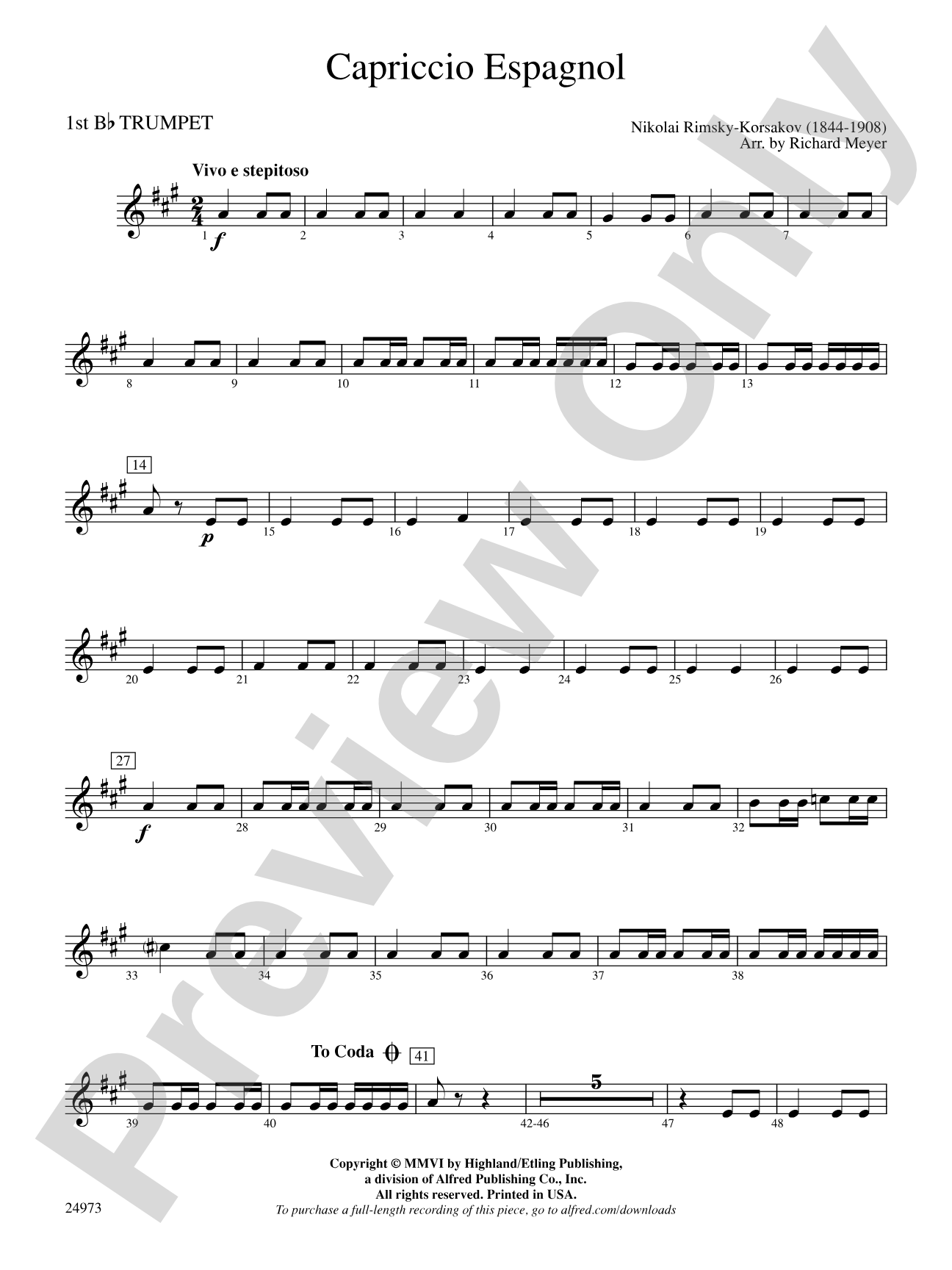

Capriccio Espagnol: 1st B-flat Trumpet
By Nicolai Rimsky-Korsakov / arr. Richard Meyer
Grade: 2.5
Item: 00-PC-0000960_T1
$3.00
Pickup currently not available
Description
Hailed by Tchaikovsky as "a colossal masterpiece of instrumentation", Rimsky-Korsakov's Capriccio Espagnol has delighted audiences since its premiere in 1887. The melodies used in the piece go back to themes sketched by the composer for a virtuoso work for solo violin and orchestra. After changing his mind, Rimsky decided to make the work a display piece for the entire orchestra. This arrangement features two sections of the original capriccio: the "Alborada" (morning serenade) in 2/4 and the "Fandango of the Asturias" (a dance traditionally played with guitar and castanet accompaniment) in 3/4. Tastefully arranged by Richard Meyer, Rimsky's flashy showpiece is now playable by the less-experienced orchestra.


Don't just read it, hear it, play along with it, and watch your students grow with it. In MakeMusic Cloud, Capriccio Espagnol: 1st B-flat Trumpet comes alive with professional accompaniment, adjustable tempo, and built-in practice tools that turn solo practice into real progress.
Open in the Player
Jump straight in and assign it today.
Start Your Free Trial
Open this title and explore the full library in minutes.
Sample Audio
1
Audio File
--:--
0:00
0:00
Sample Video
Additional Details
Series:
Highland/Etling First Philharmonic
Publisher:
Alfred Music
Page Count:
192
SKU:
00-PC-0000960_T1
More about this title
About the Composer: Nicolai Rimsky-Korsakov
Nicolai Rimsky-Korsakov (1844-1908) was a Russian composer whose contributions to orchestration fundamentally shaped how composers think about instrumental color. He served as director of the Imperial Chapel and later as a professor of composition, mentoring a generation of Russian composers while maintaining an active compositional career that spanned opera, ballet, symphonic works, and vocal music. His treatise on orchestration remains essential reading for any musician interested in how individual instruments combine to create sophisticated, luminous sound.
Rimsky-Korsakov's genius lay in his ability to coax extraordinary effects from the orchestra without demanding virtuosity beyond reach. He understood that orchestral writing need not be sparse to be transparent, nor simple to be ineffective. His legacy endures in concert halls worldwide, where audiences continue to experience the vitality and imagination that defined his work.
Why we love this
Richard Meyer's arrangement strips away nothing essential from Rimsky's orchestral ambition while making it accessible to groups still building their technical foundation. Your players get to experience a genuinely sophisticated orchestration in action, not a simplified knockoff, which means they're learning from the real thing even as the demands remain reasonable. This is the kind of piece that reminds young musicians why they wanted to play orchestra in the first place.
What to expect
Sunlit, spirited, and full of swagger. The Alborada evokes a Spanish morning alive with possibility, while the Fandango crackles with energy and traditional dance character. Rimsky's orchestration ensures that even at this accessible level, every moment feels vivid and alive.
Who it's for
Orchestras at the Grade 2.5 level that want to program something with genuine musical substance and orchestral color without overextending their players' range or endurance. Concert and festival settings benefit equally from the piece's immediate audience appeal and educational value.
How to get the most out of it
- Balance the melodic lines across sections rather than featuring one at a time. The Spanish themes pass between woodwinds, strings, and brass; make sure each color registers clearly without drowning adjacent parts.
- Treat rhythmic precision in the 2/4 and 3/4 sections as foundational. The switching between meters won't feel disorienting if your ensemble locks the beat from the first rehearsal.
- Encourage the brass to play with warmth and projection in the Fandango section. Spanish character doesn't come from aggressive tone; it comes from rhythmic confidence and a relaxed, singing approach.
- Mark the tempo relationships between sections clearly in parts so players can anticipate transitions. Confidence here elevates the entire performance.
How to use it
Open a concert with this piece to establish immediate energy and color, or use it as a centerpiece that shows off your orchestra's range without stealing focus from adjacent repertoire of different character. Its Spanish flavor makes it a natural pairing with Latin American works or other Romantic-era orchestral showpieces.
Skills your students will build
- Meter transitions (switching between 2/4 and 3/4 sections)
- Orchestral balance (tracking independent melodic lines across instrument families)
- Phrasing across phrase lengths that shift with thematic content
- Stylistic interpretation of Spanish folk character within a concert setting
- Reading parts that feature extended rhythmic figures and syncopation