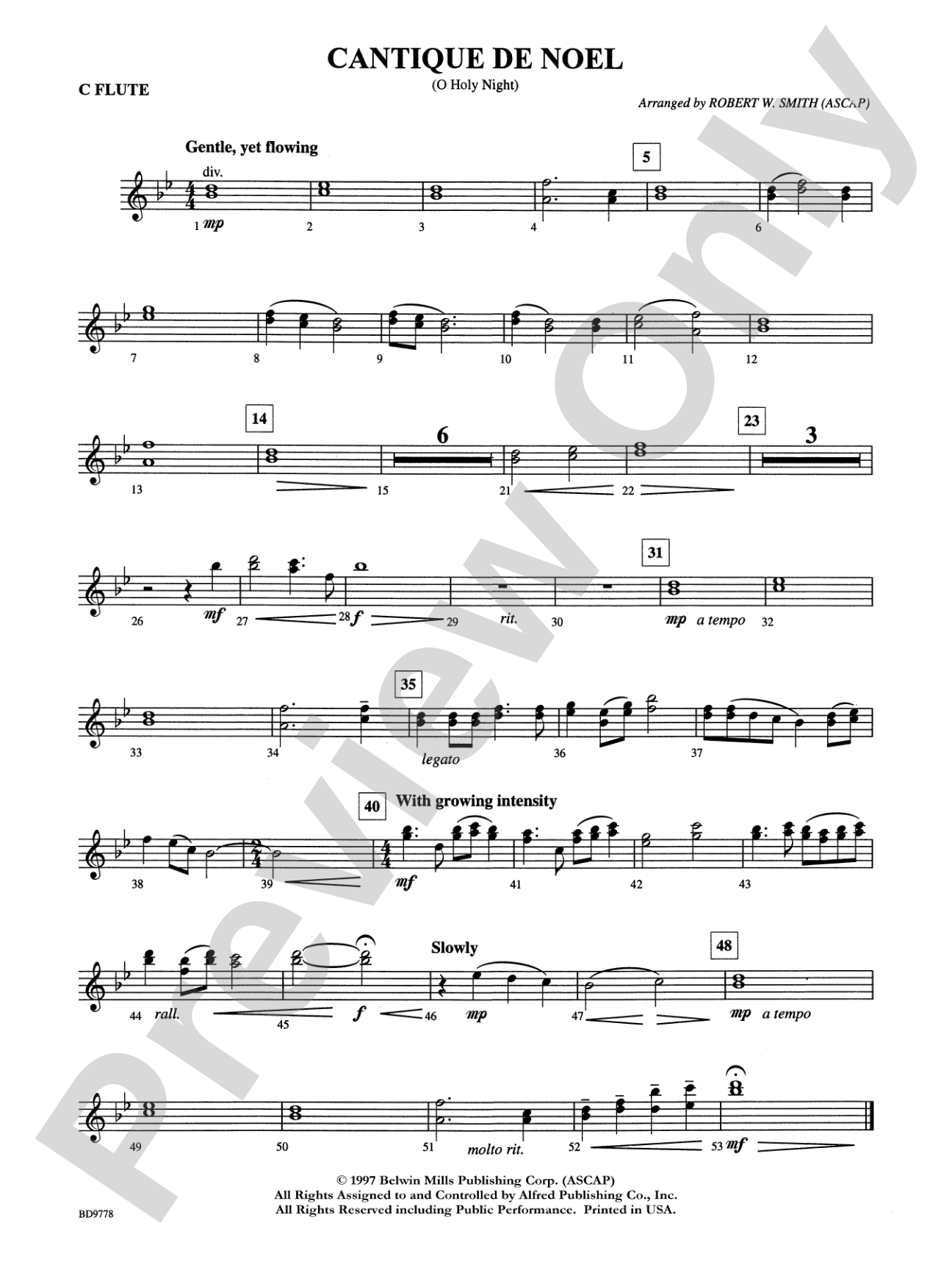
Cantique de Noel (O Holy Night): Flute Sheet Music Preview

Cantique de Noel (O Holy Night): Flute

Arr. Robert W. Smith

Grade: 2 (Easy)

Item: 00-PC-0002070_F1

Digital Download
$3.00
Description
With a very gentle opening, this sensitive scoring of the lovely melody receives very special treatment in the hands of Robert W. Smith. Liberal cross-cueing provides for selective tonal colors from solo/soli voices within your ensemble. Exquisite voice leading and accompanying lines provide for a very mature and fresh presentation for performing groups at any skill level. Give special attention to this work! (duration 3:16)

Don't just read it, hear it, play along with it, and watch your students grow with it. In MakeMusic Cloud, Cantique de Noel (O Holy Night): Flute comes alive with professional accompaniment, adjustable tempo, and built-in practice tools that turn solo practice into real progress.

Sample Audio
No sample audio found.
Sample Video
Additional Details
Series: Belwin Young Band
Publisher: Alfred Music
Page Count: 146
SKU: 00-PC-0002070_F1

More about this title

About the Arranger: Robert W. Smith

Robert W. Smith

Robert W. Smith is a prolific voice in American concert band and orchestral music, with more than 400 published works performed by ensembles worldwide. He holds a Bachelor's degree in Music Education from Troy State University and a Master's degree in Music from the University of Miami. His compositions and arrangements have appeared on major network broadcasts, from presidential ceremonies in Japan to the opening of the Macy's Thanksgiving Day Parade and the Olympic Games.

Smith's original works for concert band and orchestra have become foundational repertoire at all levels. His symphonies, The Divine Comedy and The Odyssey, and works like The Tempest have gained recognition across North America, Europe, Australia, and Asia. As a conductor and clinician, he continues to advocate for quality literature in music education through performances and collaborations in the United States, Canada, Japan, Australia, and Europe.

Why we love this

Smith's treatment of this beloved melody respects its gentle, lyrical character while using his gift for clever orchestration to keep performers engaged at Grade 2. The cross-cuing gives you real choices about instrumentation and color, which means your band sounds intentional and mature regardless of who shows up on rehearsal day.

What to expect

A reverent space opens quietly, inviting the familiar melody to emerge with intimacy rather than grandeur. The accompaniment unfolds with warmth and careful attention to voice leading, creating a mature soundscape that honors the original while feeling fresh and band-specific.

Who it's for

This arrangement belongs in the repertoire of developing concert bands and intermediate ensembles that need a winter piece with genuine musical substance. Whether your group is still building fundamental skills or approaching Grade 3 repertoire, this sensitive treatment of a holiday classic gives everyone something meaningful to play.

How to get the most out of it

  • Shape the opening with restraint. The gentle opening sets a devotional tone, so avoid pushing the dynamics too early; let the melody breathe naturally as it unfolds across your ensemble.
  • Balance the soloists and soli passages against the accompaniment lines. Smith's voice leading is deliberate, so make sure the inner parts don't overshadow the main melodic thread.
  • Use the cross-cuing strategically to match your available personnel. If certain sections are light, redistribute the principal line to stronger voices; if you have full instrumentation, layer the cues for richer sonority.
  • Keep the accompaniment figures delicate throughout. These supporting lines carry the harmonic sophistication, so clarity here elevates the entire arrangement.

How to use it

Program this as a centerpiece for a winter concert or holiday assembly where a single, fully realized piece carries more weight than a medley would. It also works well as a bridge between more upbeat seasonal fare and serious concert programming, offering audiences a moment of genuine musical expression.

Skills your students will build

  • Balancing solo/soli passages with accompaniment lines
  • Sustaining gentle, controlled dynamics throughout an extended melody
  • Reading and executing flexible instrumentation through cross-cuing
  • Responding to mature voice leading and inner-part independence
  • Maintaining clear articulation and phrasing in lower-grade arrangements

You May Also Like