
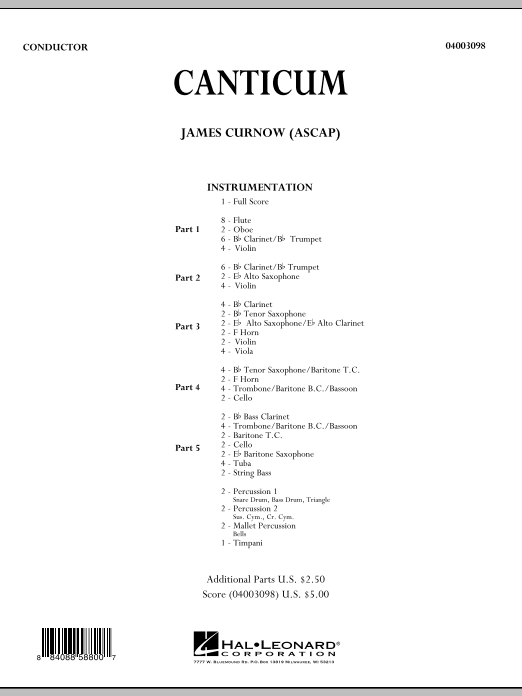

Canticum: Flex Ensemble Conductor Score & Parts
As performed by James Curnow
Grade: 2-3
Item: 35-PK00186909
$65.00
Pickup currently not available
Buy Extra Parts (Digital PDF Download)
Parts Added to Cart!
Description
One of the classics of young band literature, this composition by James Curnow is found on many state lists throughout the country. This adaptation is scored for flexible instrumentation and features all the power and excitement of the original work. Dur: 3:15


Canticum: Flex Ensemble Conductor Score & Parts isn't in MakeMusic Cloud just yet...but it could be. Let us know you'd like to see it, and you'll help shape what comes next. In the meantime, start a free trial and dive into thousands of interactive titles your students can play along with today.
Request This Title
Tell us you want it.
Start Your Free Trial
Explore everything that's ready to play right now.
Sample Audio
No sample audio found.
Sample Video
No sample videos found.
Additional Details
Publisher:
Hal Leonard
SKU:
35-PK00186909
More about this title
About the Artist: James Curnow
James Curnow stands among the most prolific and respected composers for young and intermediate ensembles. His deep understanding of pedagogical progression and instrumental capabilities informs every measure he writes, making his works accessible without sacrificing musical substance. Curnow's compositional output spans concert band, wind ensemble, and flexible instrumentation settings, and his pieces consistently appear on state contest lists and festival programs nationwide.
Why we love this
Canticum delivers genuine concert-hall impact at a grade level where students are still building fundamental skills. The flexible instrumentation means you can perform it regardless of who shows up on rehearsal day, and the writing remains musically coherent across different configurations. It earns its place on state lists because it engages players and audiences equally.
What to expect
Canticum unfolds with the grandeur of a full concert work despite its modest grade level. Energy and momentum carry throughout its three-minute arc, giving the ensemble a sense of accomplishment and the audience a satisfying musical statement. The writing feels confident and purposeful rather than didactic.
Who it's for
Young bands and flex ensembles in grades 2 and 3 who want to program meaningful repertoire without logistical headaches. Teachers managing uncertain instrumentation lineups will find this especially valuable since the flexible scoring adapts to what you have. Contest-bound programs benefit from a piece that satisfies festival judges while remaining achievable for developing players.
How to get the most out of it
- Balance the melodic lines across your available instrumentation. With flexible scoring, doubling and reinforcement shifts depending on who's in the room; assign parts thoughtfully so the primary voice cuts through without overpowering.
- Shape the phrasing in longer passages by considering the architecture of each section. Avoid treating all forte sections identically; let dynamic growth emerge organically from the harmonic progression.
- Lock the tempo internally before layering in the recorded accompaniment. Students benefit from feeling secure in their own rhythm section first.
- Assign the most secure music readers to solos and exposed lines within the ensemble parts, which often double or counter the primary melodic material.
How to use it
Open a concert with Canticum to establish energy and engagement from the opening moments. Pair it with contrasting smaller ensemble works or lighter selections to create varied programming within a single set. It also serves as an ideal warm-up piece before moving to more demanding repertoire in later concert slots.
Skills your students will build
- Balancing melody and accompaniment across multiple instrument families
- Sustaining focus and ensemble cohesion in sectional arrangements
- Responding to dynamic change and phrasing in concert literature
- Executing syncopated rhythmic figures within a steady metric framework
- Reading and adapting to flexible instrumentation scores