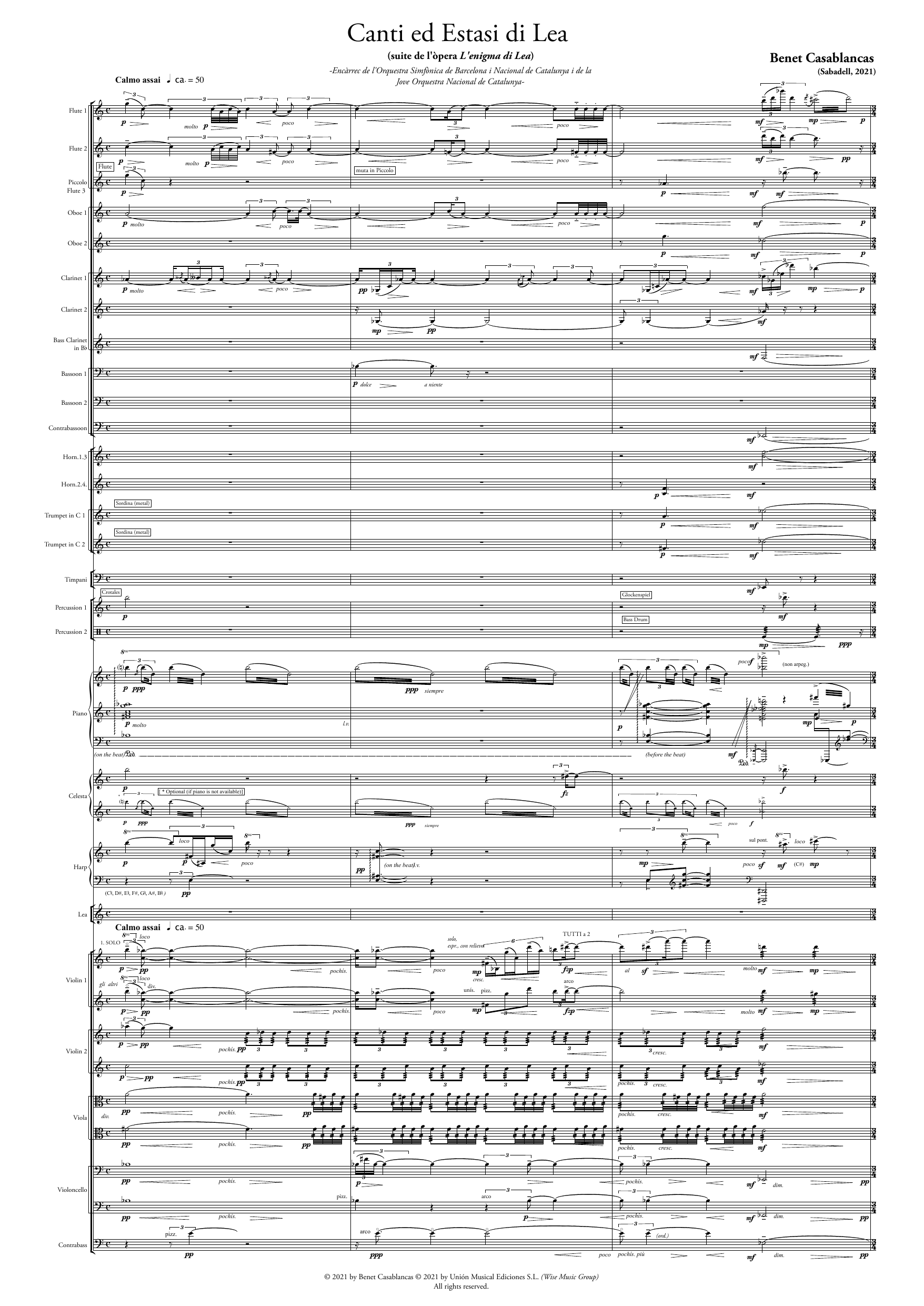
Canti ed estasi di Lea (Suite de l'òpera L'enigma di Lea) Sheet Music Preview

Canti ed estasi di Lea (Suite de l'òpera L'enigma di Lea): Full Orchestra Conductor Score & Parts

By Benet Casablancas

Item: 35-PK01740618

Digital Download
$40.00

Buy Extra Parts (Digital PDF Download)

Parts Added to Cart!

Description
Full Score only

Canti ed estasi di Lea (Suite de l'òpera L'enigma di Lea): Full Orchestra Conductor Score & Parts isn't in MakeMusic Cloud just yet...but it could be. Let us know you'd like to see it, and you'll help shape what comes next. In the meantime, start a free trial and dive into thousands of interactive titles your students can play along with today.

Sample Audio
No sample audio found.
Sample Video
Additional Details
Publisher: Hal Leonard
SKU: 35-PK01740618

More about this title

About the Composer: Benet Casablancas

Benet Casablancas is a Catalan composer whose work spans opera, orchestral music, and chamber works. His compositional voice draws on both modernist techniques and lyrical sensibility, with particular attention to vocal writing and dramatic narrative. L'enigma di Lea stands as a significant operatic work in his catalog, demonstrating his ability to craft compelling theatrical music with orchestral sophistication.

Why we love this

This suite extracted from a full opera gives orchestras access to substantial, dramatically coherent material without requiring singers or staging. The orchestration itself carries the narrative weight, making it ideal for concert programming when you need repertoire that sounds ambitious and complete rather than fragmentary.

What to expect

Richly orchestrated and dramatically invested, with the expressive weight of opera translated into pure instrumental sound. The music alternates between introspective, lyrical moments and surging orchestral climaxes, creating a journey that feels both intimate and grand.

Who it's for

Orchestras seeking full-length concert works with operatic scope and strong melodic content. This score works well for conductors who want to program something beyond the standard symphonic repertoire while maintaining accessibility for players at intermediate to advanced levels.

How to get the most out of it

  • Balance the dialogue between lyrical passages and dramatic moments by using section dynamics strategically; the orchestra must support emotional arcs rather than simply accompany.
  • Study the original opera context when possible to understand thematic relationships across movements; this deepens musicians' interpretive choices even in purely instrumental passages.
  • Shape phrase endings with care, particularly in sustained melodic sections, to avoid the flatness that can occur when orchestral textures become thick.

How to use it

Feature this as the centerpiece of a concert exploring contemporary operatic writing, or pair it with other dramatic orchestral suites to showcase how modern composers approach large ensemble writing. Its scale and emotional content make it suitable as a season closer or special feature concert.

Skills your students will build

  • Balancing multiple melodic lines in dense orchestrations
  • Sustaining dramatic pacing across extended movements
  • Expressive intonation in exposed string passages
  • Sectional coordination in rapid textural changes
  • Interpreting operatic content in purely instrumental context

You May Also Like