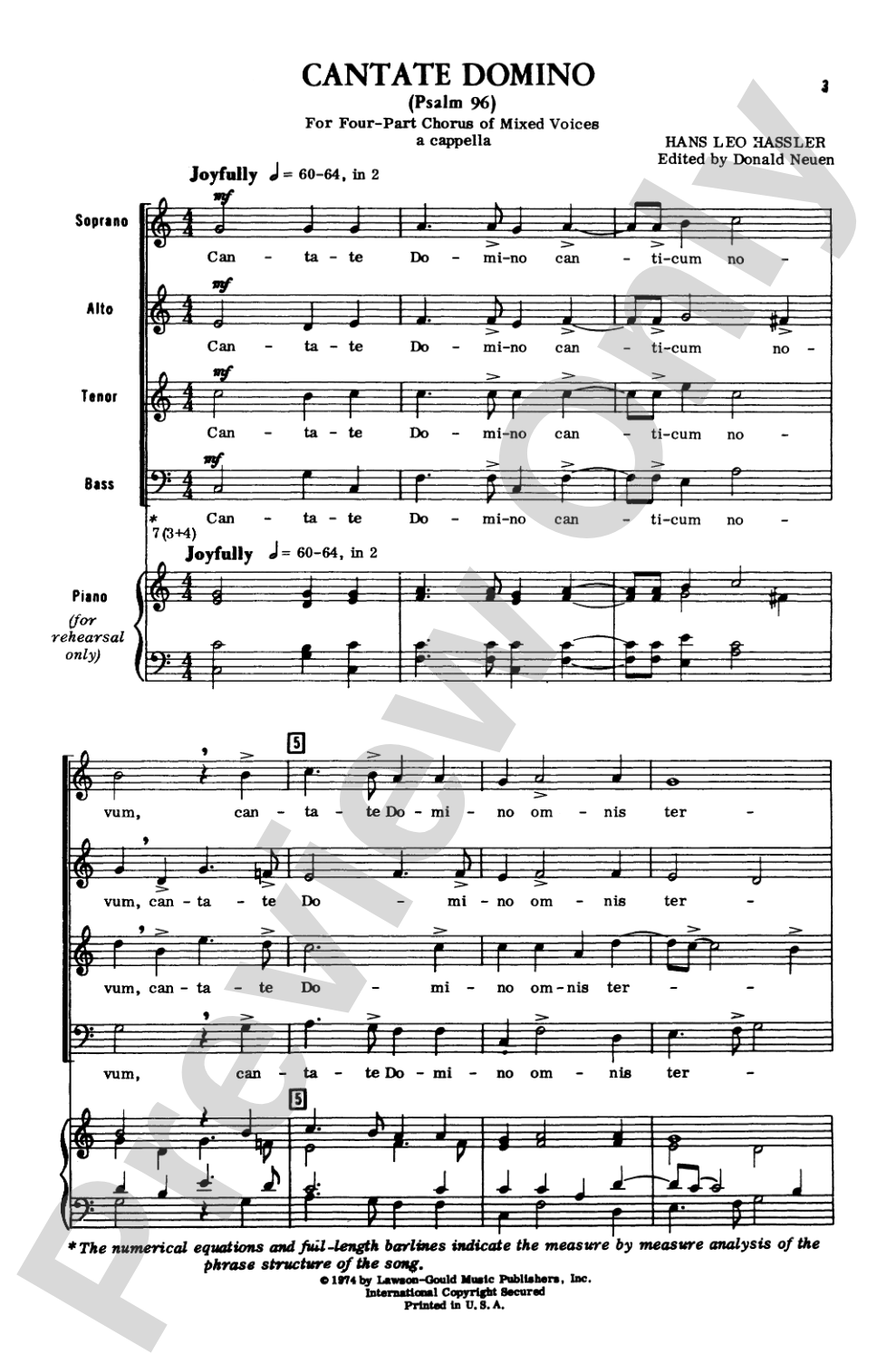
Cantate Domino (Psalm 96) Sheet Music Preview

Cantate Domino (Psalm 96): SATB Choral Octavo

By Hans Leo Hassler / ed. Donald Neuen

Item: 00-PO-0002670

Digital Download
$2.25

Minimum order quantity: 20 copies

Description

Cantate Domino (Psalm 96): SATB Choral Octavo isn't in MakeMusic Cloud just yet...but it could be. Let us know you'd like to see it, and you'll help shape what comes next. In the meantime, start a free trial and dive into thousands of interactive titles your students can play along with today.

Sample Audio
No sample audio found.
Sample Video
Additional Details
Series: Alfred Archive Edition: Lawson-Gould Music Publishers
Publisher: Alfred Music
Page Count: 8
SKU: 00-PO-0002670

More about this title

About the Composer: Hans Leo Hassler

Hans Leo Hassler (1564-1612) was among the most accomplished composers of the late Renaissance, equally skilled in sacred and secular music. Born in Nuremberg, he trained in Italy under the influence of the Venetian school before returning to German-speaking lands, where he served as organist and court musician in Augsburg, Nuremberg, and Dresden. His sacred works, including motets and psalm settings, combine the clarity and harmonic innovation of the Renaissance with an emerging Baroque sensibility.

Why we love this

Cantate Domino sits at a sweet spot where Renaissance technique meets emotional warmth. The piece offers your singers genuine musical substance without requiring specialized vocal training or extreme ranges, making it accessible for high school and community choirs while sounding elegant enough for concert or liturgical contexts.

What to expect

The piece radiates quiet confidence and spiritual depth. Flowing lines and carefully placed harmonic arrivals create a sense of processional dignity, while the text setting allows moments of contemplative stillness alongside passages of gentle forward momentum.

Who it's for

This work suits intermediate to advanced SATB choirs with a season focused on sacred repertoire or Renaissance survey programming. It works well for choirs preparing concert or worship services and offers singers genuine Renaissance masterwork exposure without excessive technical demand.

How to get the most out of it

  • Shape the text through phrasing rather than dramatic dynamic shifts; Renaissance word-painting is subtle and depends on harmonic color and the natural rise and fall of the vocal line.
  • Tune the third and sixth scale degrees carefully in major harmonies, as Renaissance intonation practices differ slightly from modern equal temperament and will open up the sound.
  • Bring out inner voices as they enter with text or thematic material; Hassler's writing rewards clarity of all four parts, not just soprano melody.

How to use it

Pair this with other Renaissance motets or psalm settings to build a liturgical concert segment, or use it as an anchor for a program exploring sacred music across centuries. Its moderate length and reverent character make it ideal for church services or formal concert contexts.

Skills your students will build

  • Reading Renaissance notation conventions and harmonic language
  • Sustaining long vocal lines with proper breath management
  • Balancing four independent melodic lines without losing harmonic cohesion
  • Performing text-sensitive phrasing in Latin

You May Also Like