
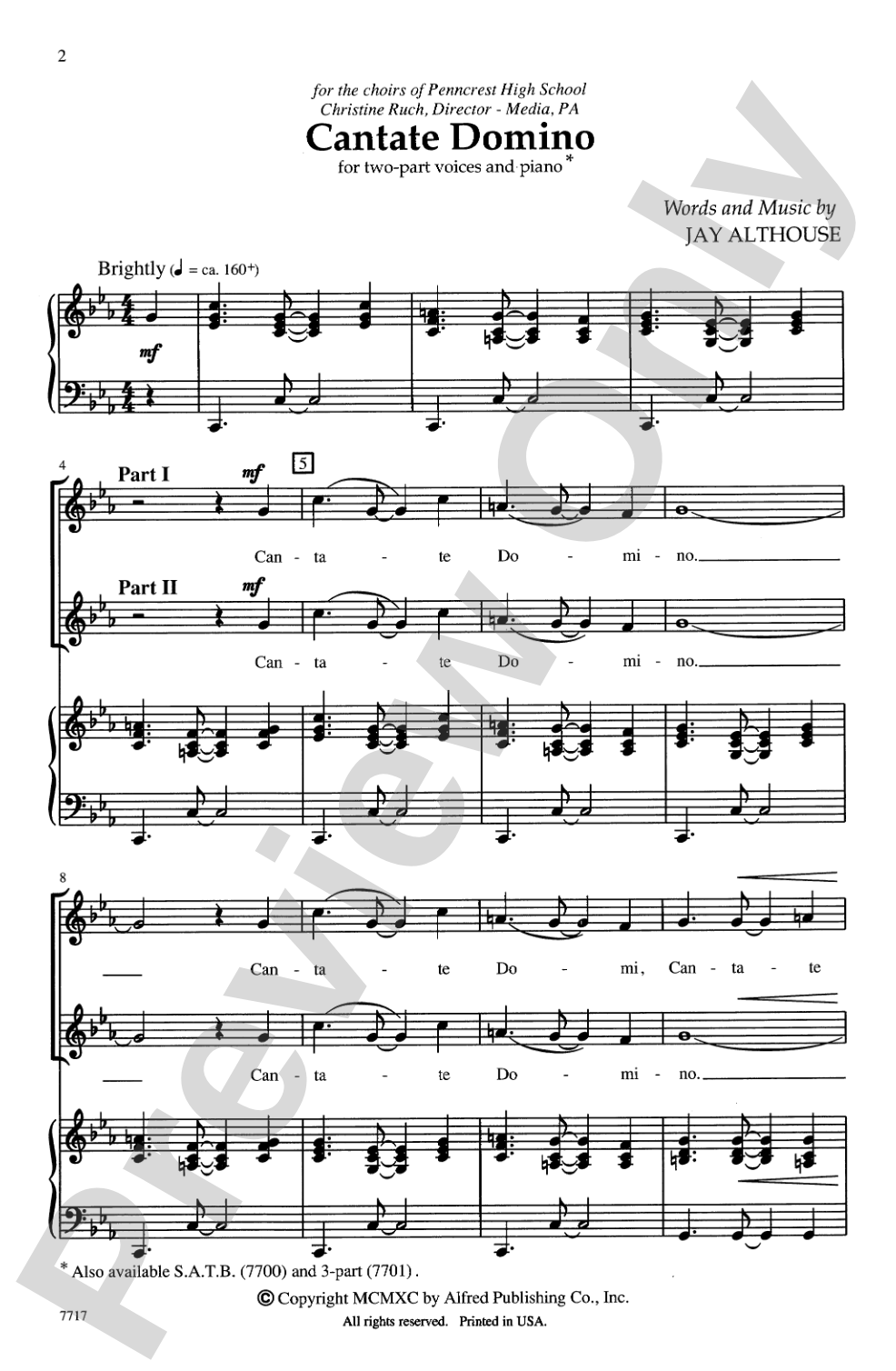
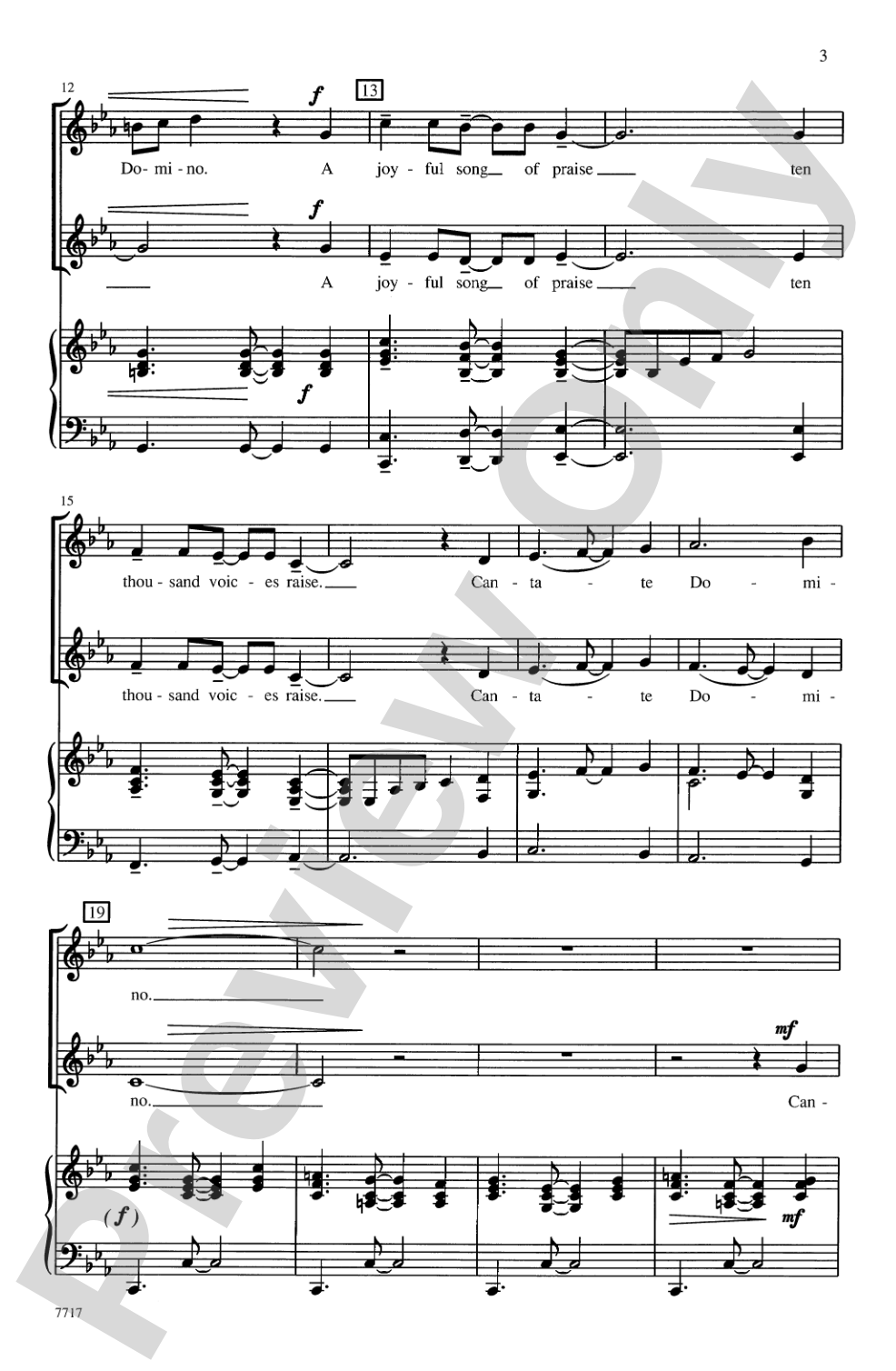

Cantate Domino: 2-Part Choral Octavo
Music by Jay Althouse
Item: 00-PO-0002484
$2.25
Minimum order quantity: 20 copies
Pickup currently not available
Description
An exciting choral work mixing traditional Latin with a fresh, new English text. The strong rhythmic pulse of the opening and closing melody contrasts with a chant-like middle section. For choirs of all ages at any time of the year. Powerful!


Cantate Domino: 2-Part Choral Octavo isn't in MakeMusic Cloud just yet...but it could be. Let us know you'd like to see it, and you'll help shape what comes next. In the meantime, start a free trial and dive into thousands of interactive titles your students can play along with today.
Request This Title
Tell us you want it.
Start Your Free Trial
Explore everything that's ready to play right now.
Sample Audio
1
Audio File
--:--
0:00
0:00
Sample Video
No sample videos found.
Additional Details
Series:
Alfred Archive Edition: Alfred Choral Designs
Publisher:
Alfred Music
Page Count:
12
SKU:
00-PO-0002484
More about this title
About the Composer: Jay Althouse

Jay Althouse holds degrees in Music Education and Music from Indiana University of Pennsylvania, where he was recognized with the Distinguished Alumni award. His career spans both the publishing and composing worlds; he spent eight years as a rights and licenses administrator for a major educational music publisher and served on the Executive Board of the Music Publishers Association of America. As a composer, he has over 800 choral works in print performed regularly across the English-speaking world.
Althouse is a writer member of ASCAP and a consistent recipient of the ASCAP Special Award for his compositions. Beyond choral writing, he has co-created children's musicals with his wife Sally K. Albrecht, compiled vocal solo collections including Folk Songs for Solo Singers, and co-authored widely used resources like The Complete Choral Warm-up Book and Accent on Composers. His educational materials for the classroom include Ready to Read Music, Sixty Music Quizzes, and One-Page Composer Bios. He served on the board of the North Carolina Master Chorale and currently sits on the National Advisory Board of the Folk Art Society of America.
Why we love this
Althouse strikes a rare balance here between accessibility and musical substance. The rhythmic vitality of the outer sections gives choirs something energizing to sink their teeth into, while the chant-like middle provides a moment of contrasting reflection that feels earned rather than predictable. The bilingual text adds textural richness without creating unnecessary difficulty for singers at any developmental level.
What to expect
The opening pulses with confidence and forward energy, drawing the listener immediately into the music's gravitational center. That momentum yields to a meditative, almost processional quality in the middle, creating genuine contrast that makes the return to rhythmic drive feel like a satisfying resolution. The fusion of Latin tradition with fresh English text gives the whole work a sense of timelessness meeting immediacy.
Who it's for
This piece works for treble choirs, mixed choirs reduced to 2 parts, or any developing ensemble that benefits from rhythmic clarity and singable ranges. The accessible voicing and flexible performance requirements make it ideal for middle school through adult choirs seeking sacred literature that feels contemporary without compromising musical substance.
How to get the most out of it
- Maintain the rhythmic integrity of the opening and closing sections; this piece thrives on forward momentum and clear articulation of the pulse.
- Shape the chant-like middle section with sustained vocal line and careful attention to breath placement rather than rushing through the text.
- Use the movement and staging elements intentionally; they should enhance the textural shift between sections rather than distract from the music itself.
- Balance the Latin and English text so both feel equally grounded; ensure singers understand the meaning of both languages to inform phrasing.
How to use it
Consider pairing this with other sacred works that emphasize text and rhythm rather than harmonic complexity; its moderate length makes it valuable for concert programs where you want variety without demanding excessive rehearsal time. The movement and staging options make it particularly effective as a concert centerpiece or closing number, where it can command the audience's full attention without requiring elaborate production.
Skills your students will build
- Rhythmic precision in mixed-meter contexts
- Sustained vocal production in chant-like textures
- Clear articulation and text projection in Latin and English
- Awareness of how musical contrast (rhythm versus repose) shapes form and meaning