
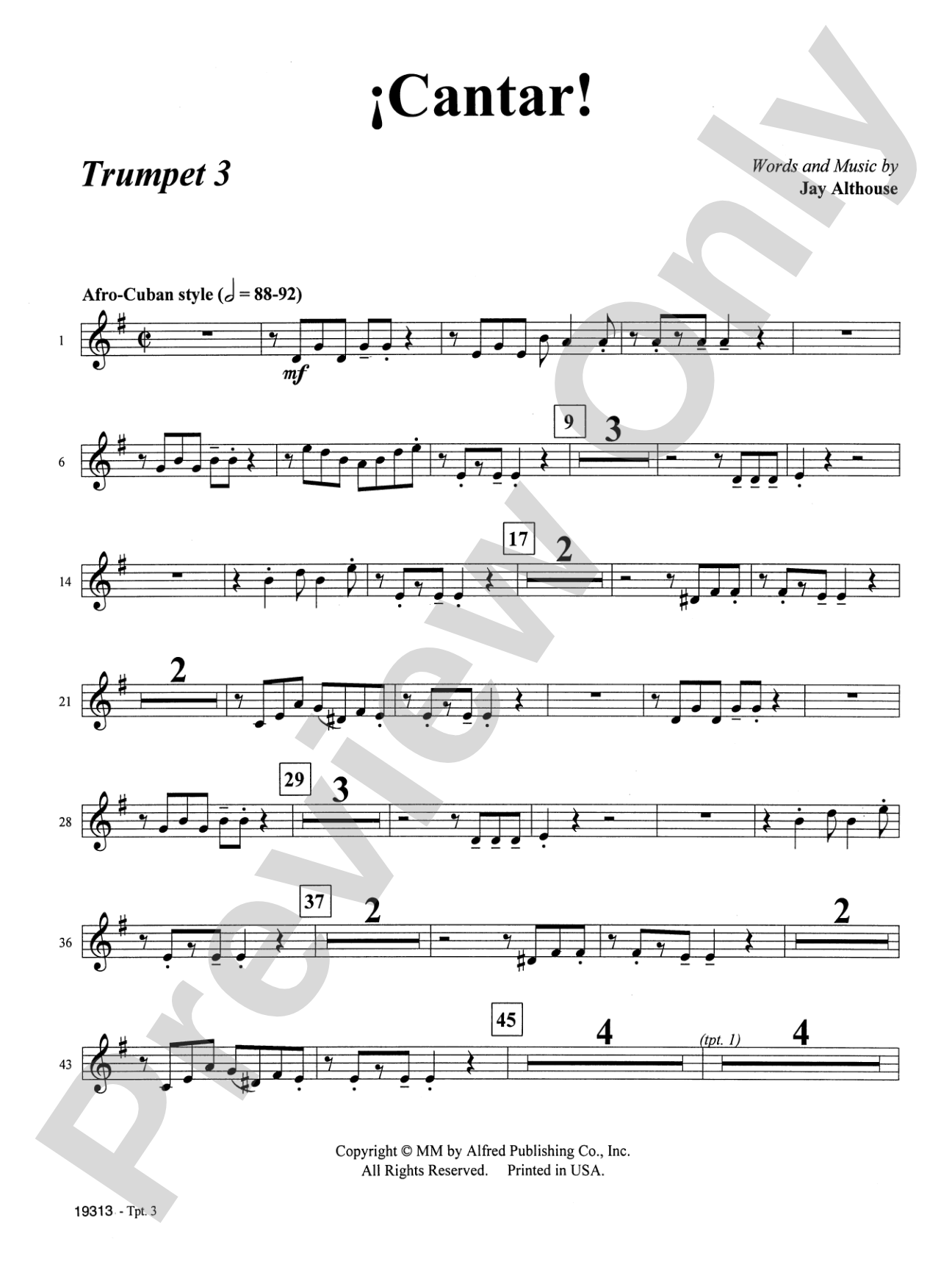

Cantar! (Sing!): 3rd B-flat Trumpet: Choral SoundPax
Words and music by Jay Althouse
Item: 00-PC-0000317_T3
$3.00
Pickup currently not available
Description
"¡Cantar!" is a stylistically authentic salsa work for choir. The text is a combination of English and simple, repetitive Spanish phrases set to a rhythmically infectious melody. Enjoy this new SSA voicing of Jay's #1 seller! Sizzling! SoundPax includes t. sax., b. sax., 3 tpt., 2 tbn.


Don't just read it, hear it, play along with it, and watch your students grow with it. In MakeMusic Cloud, Cantar! (Sing!): 3rd B-flat Trumpet: Choral SoundPax comes alive with professional accompaniment, adjustable tempo, and built-in practice tools that turn solo practice into real progress.
Open in the Player
Jump straight in and assign it today.
Start Your Free Trial
Open this title and explore the full library in minutes.
Sample Audio
1
Audio File
--:--
0:00
0:00
Sample Video
No sample videos found.
Additional Details
Series:
Alfred Choral Designs
Publisher:
Alfred Music
Page Count:
28
SKU:
00-PC-0000317_T3
Instrumentation:
SoundPax
More about this title
About the Composer: Jay Althouse

Jay Althouse holds degrees in Music Education and Music from Indiana University of Pennsylvania, where he was honored as a Distinguished Alumnus. His career spans composition, publishing administration, and music education advocacy. He served eight years managing rights and licenses for a major educational publisher and held a position on the Executive Board of the Music Publishers Association of America.
With over 800 choral works in print, Althouse has built a catalog performed widely across English-speaking regions. His contributions extend beyond composition into vocal pedagogy and classroom resources; he has co-authored The Complete Choral Warm-up Book and Accent on Composers, compiled vocal solo collections including Folk Songs for Solo Singers, and created reproducible educational materials for music teachers. He is a writer member of ASCAP and a regular recipient of the ASCAP Special Award. His collaborative work with his wife, Sally K. Albrecht, includes children's musicals and I Hear America Singing, performed by the San Francisco Girls and Boys Choirs at President Obama's 2009 Inauguration.
Why we love this
This SSA voicing gives choirs of all sizes access to one of Althouse's signature successes without needing a full SATB arrangement. The salsa idiom arrives fully realized through the SoundPax instrumentation, so even choirs without a rhythm section can deliver the sizzling energy the piece demands. English and Spanish lyrics blend naturally, making cultural inclusion feel organic rather than obligatory.
What to expect
Infectious, celebratory, and grounded in the driving pulse of salsa. The melody sits naturally in the voice while the rhythm section propels the music forward with unmistakable groove and confidence.
Who it's for
SSA choirs at all experience levels who want to expand beyond traditional repertoire and engage students with authentic Latin music. This works equally well for school choirs seeking cultural programming and adult ensembles hungry for modern, energetic material.
How to get the most out of it
- Lock the rhythm section to the recorded accompaniment during early rehearsals so singers can hear where the groove sits and how the syncopation lands against the band parts.
- Emphasize the repetition in the Spanish text as a strength, not a limitation; it gives singers space to nail the rhythmic precision that makes salsa feel alive.
- Balance the choir's harmonic texture against the bright brass and saxophones by keeping your blend warm and cohesive rather than pushing for volume.
- Mark the clave rhythm subtly in conducting so the ensemble stays anchored to the Latin feel rather than drifting into straight rhythm.
How to use it
Program this as an energetic concert opener or closer to set a joyful tone and showcase your choir's range beyond classical or art song repertoire. It pairs well with other multicultural works and gives audiences a taste of contemporary choral writing that reflects modern musical life.
Skills your students will build
- Reading and performing syncopated rhythms in a Latin context
- Singing in Spanish with authentic pronunciation and phrasing
- Maintaining rhythmic independence from the band accompaniment
- Blending three-part harmony while staying rhythmically precise
- Understanding the clave concept and its role in salsa music structure