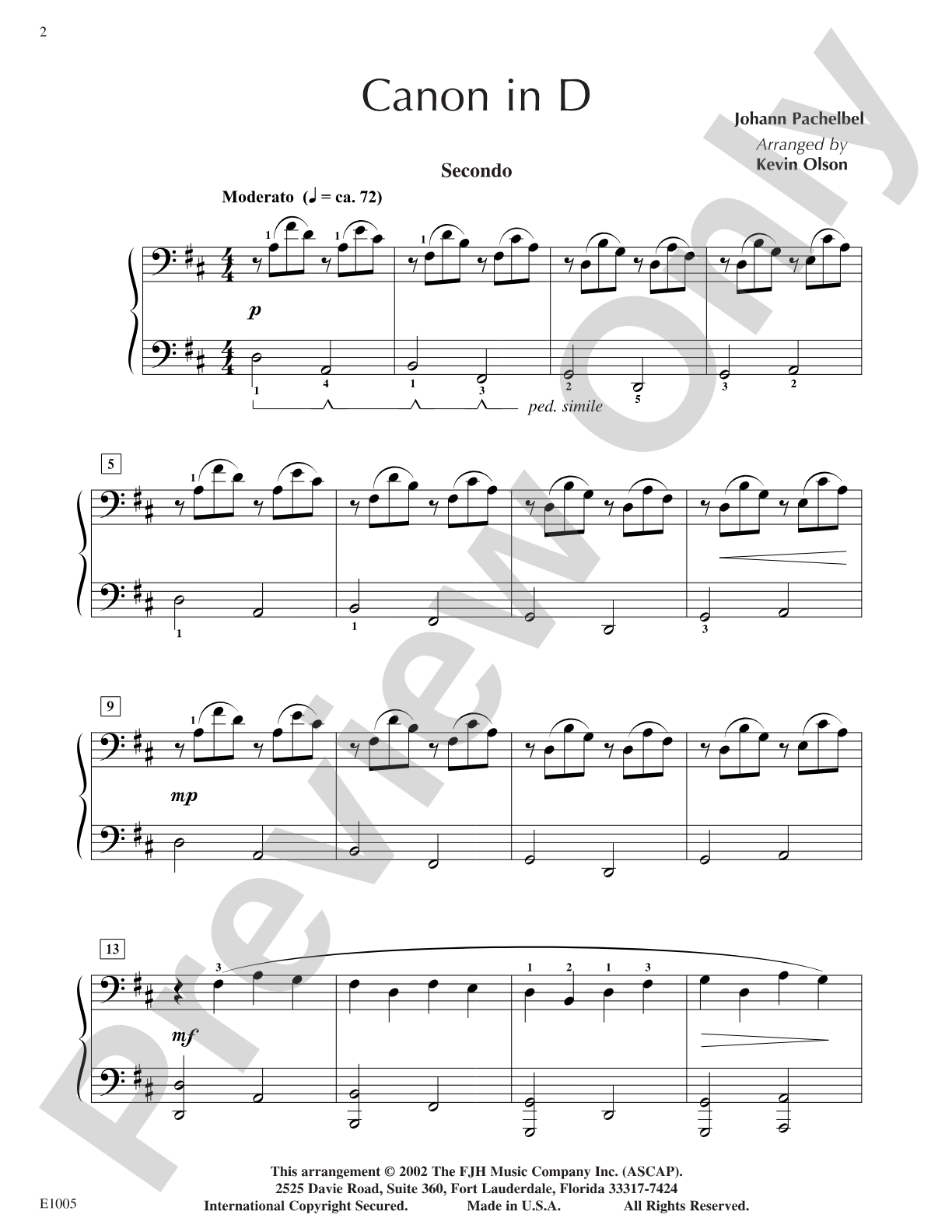
Canon in D Sheet Music Preview

Canon in D: Piano

By Johann Pachelbel / arr. Kevin Olson

Item: 98-DE1005

Digital Download
$7.95
Description
Charming duet is arranged equally for four hands. Both players will enjoy this piece as they share its wonderful melody and harmony. Challenge your students to listen carefully for the balance and dynamic changes.

Canon in D: Piano isn't in MakeMusic Cloud just yet...but it could be. Let us know you'd like to see it, and you'll help shape what comes next. In the meantime, start a free trial and dive into thousands of interactive titles your students can play along with today.

Sample Audio
No sample audio found.
Sample Video
Additional Details
Series: The FJH Piano Ensemble Series
Publisher: The FJH Music Company, Inc.
SKU: 98-DE1005

More about this title

About the Composer: Johann Pachelbel

Johann Pachelbel (1653-1706) was a German Baroque composer whose harmonic inventiveness and gift for melody secured his influence across three centuries of music. Known for mastering both sacred and secular forms, Pachelbel composed over 600 works including cantatas, fugues, and chamber music that shaped the compositional language of his era. His music emphasizes clarity, balance, and the elegant marriage of contrapuntal technique with melodic appeal—qualities that make his work enduringly valuable in music education.

Today Pachelbel is celebrated primarily for Canon in D, which demonstrates his instinct for writing music that feels both sophisticated and immediately accessible. The piece's repeating bass line and luminous harmonic progression have inspired countless arrangements and adaptations, proving that great music speaks across skill levels and instrumental combinations.

Why we love this

Kevin Olson's arrangement distributes both the famous canon melody and its supporting voices so evenly that neither player feels relegated to accompaniment. Students who might otherwise hear only the top line suddenly discover the architecture underneath, and the shared ownership of this beloved piece makes rehearsals genuinely collaborative rather than hierarchical.

What to expect

Canon in D blooms with warmth and gentle grandeur. The repeating bass progression creates an almost hypnotic foundation while the melody floats above with understated elegance, producing a sound that feels both intimate and majestic. There's no struggle or drama here—only the satisfaction of two voices weaving in and out of each other's light.

Who it's for

This duet suits intermediate pianists who have developed comfortable reading skills and basic pedaling technique, including students working toward early-to-mid level repertoire. It works equally well for student duet partners of similar ability or for a teacher-student pairing where the teacher can play either part.

How to get the most out of it

  • Shape each phrase musically rather than mechanically; the canon's repeating structure can tempt players into autopilot, so emphasize deliberate phrasing choices that breathe with the melodic line.
  • Balance the two parts so that the listener hears complementary voices rather than a soloist with backup. This requires both players to listen actively and adjust dynamics moment by moment.
  • Establish a clear pulse together before playing; the canonical nature of the piece means rhythmic precision and unified tempo create the magic, not rushing or pulling.

How to use it

Program this as an intermission piece during a student recital or chamber concert, where its immediate appeal welcomes listeners without demanding intense focus. It also serves as an excellent reward piece for duet partners who have completed a method book or course, offering them a chance to perform something genuinely moving without overextending technically.

Skills your students will build

  • Listening for balance and blend between two independent parts
  • Coordinate rhythms and phrasing with another pianist
  • Reading multiple voices and textures simultaneously
  • Managing dynamic nuance and voicing within a four-hand texture
  • Sustaining musical line across repeated harmonic progressions

You May Also Like